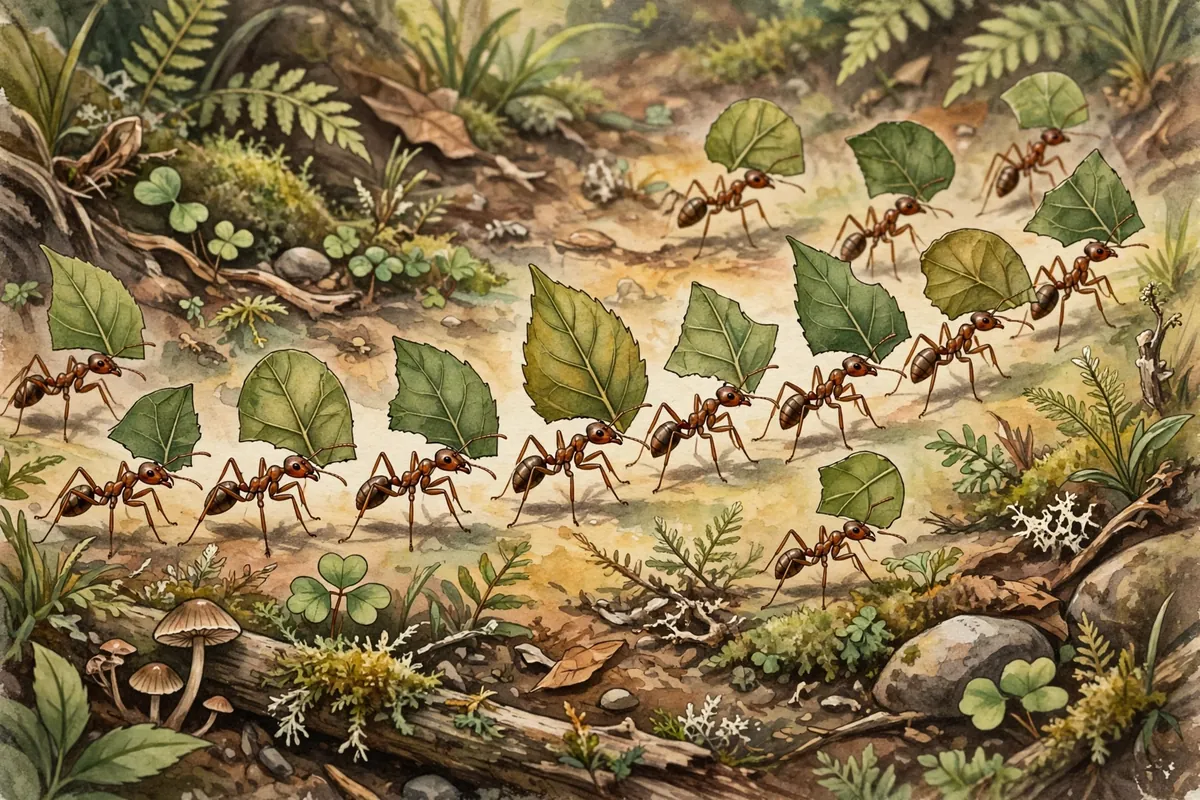
In the forests of Central and South America, you can sometimes spot what looks like a moving green river. Look closer and it's thousands of ants, each one holding a freshly cut piece of leaf over its head. The line can stretch a long way, all heading back to the nest.
Here's the twist: the ants don't eat those leaves. Leafcutter ants are farmers. They carry the leaves underground to feed a fungus garden, and the fungus is what feeds their young. The adult ants drink leaf sap, and the larvae live on the fungus the colony grows.
A Partnership Neither Side Can Quit
The ants and their fungus depend on each other completely. The ants actively tend their crop, feeding it freshly cut plant material and keeping it free of pests and molds. In return, the fungus grows special swollen tips that seem to exist for one purpose only, which is to feed the ants.
This farming partnership is ancient. Scientists say these ants fully domesticated their fungus about 15 million years ago, a process that took around 30 million years to complete. The fungi grown by the most advanced farming ants no longer even produce spores. They've become a crop that can't survive without its farmers.
Only two other groups of insects are known to farm fungus: ambrosia beetles and termites. Among ants, leafcutters are the famous ones.
Picky About What Goes in the Garden
Leafcutter ants seem to listen to their crop. If a certain type of leaf turns out to be toxic to the fungus, the colony stops collecting it. Scientists think the ants pick up chemical signals from the fungus that tell them something is wrong.
They also carry their own medicine. A type of bacteria grows on the ants' bodies and releases chemicals that help protect the garden. In effect, the ants walk around with portable antimicrobials. When part of the garden gets infected, workers remove it and throw it away, a habit researchers describe as weeding.
Every Ant Has a Job
A big colony runs like a city with a strict job chart. Workers come in different sizes, and size often decides the job. The tiniest workers, called minims, have heads less than a millimeter wide and tend the fungus and the young. Slightly larger minors patrol the foraging lines and attack threats.
Mediae are the leaf cutters and haulers. The largest workers, the majors, are also known as soldiers. Some ants even work as garbage crews, carrying used plant material and old fungus to a waste heap, where other workers keep shuffling the pile to help it break down.
Small Ants, Huge Numbers
Leafcutter ants can carry up to 50 times their own body weight. Next to humans, they form some of the largest and most complex animal societies on Earth. In just a few years, the main mound of a nest can grow more than 98 feet across, home to millions of ants.
Every one of those colonies starts with a single risky trip. A young queen packs a little bit of fungus from her home garden into a pocket inside her mouth, then sets off to start a new nest. Only about 2.5 percent of these young queens go on to found a long-lived colony.
Farmers aren't always welcome neighbors, of course. In some places, leafcutters are serious crop pests, and some species can strip an entire citrus tree in less than a day. Still, it's hard not to admire an insect that figured out farming millions of years before we did.