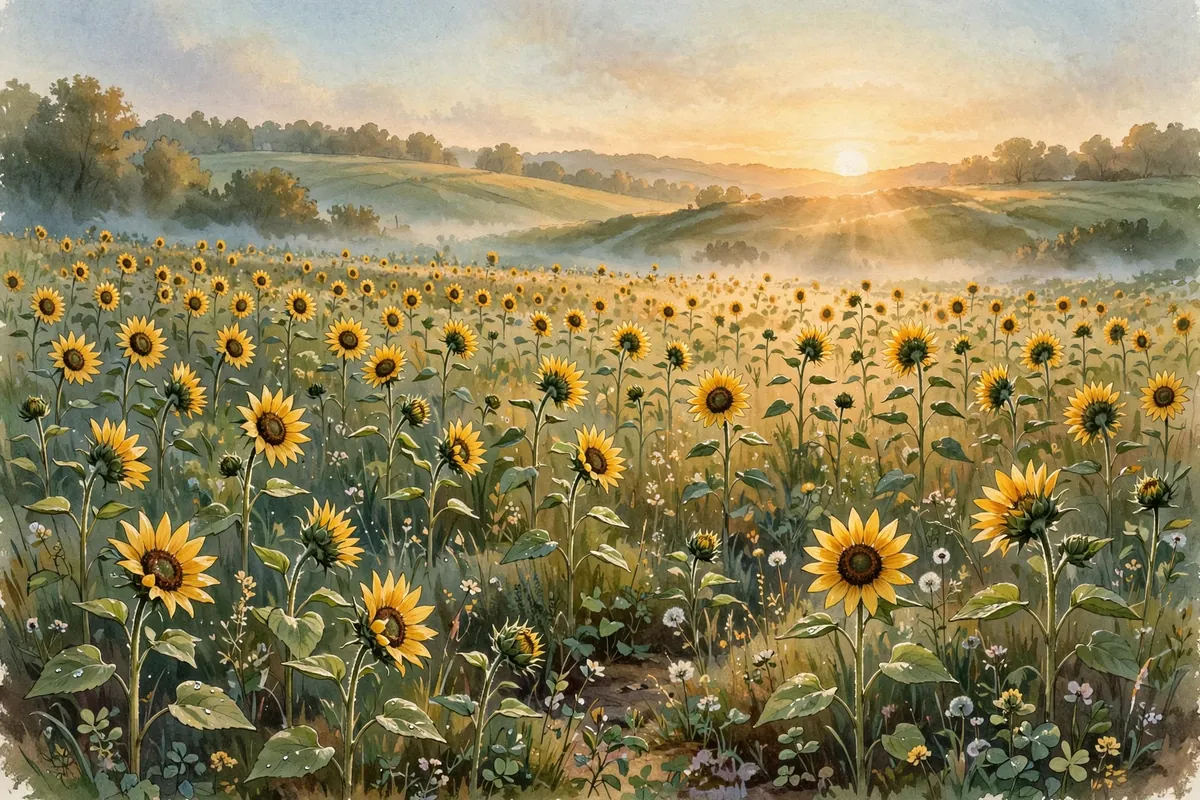
There's something cheerful about a field of sunflowers, all turned the same way like a crowd watching a parade. Many of us grew up hearing that sunflowers follow the Sun across the sky all day long. It's a lovely picture, but is it true?
It's only half right. Young sunflowers do track the Sun, turning from east to west during the day and swinging back to face east overnight. But once the plant matures and the flower opens, the movement stops. Mature sunflowers simply face east from then on. The idea that they track the Sun their whole lives is a common misconception.
A Daily Dance in the Bud Stage
This Sun-following behavior is called heliotropism. In sunflowers, it happens during the bud stage, before the flower head fully opens. At dawn, the young plant's top faces east. As the day goes on, it slowly turns west, following the Sun across the sky.
Then, during the night, it swings back to face east again, ready for sunrise. It's as if the plant is getting into position before the show starts.
A Built-In Clock
The surprising part is that sunflowers aren't just reacting to light. Their movement follows a circadian rhythm, an internal daily clock that is kept in sync by the Sun. The motion even continues on cloudy days, or when plants are moved into constant light.
Scientists have tested this. If a sunflower in the bud stage is turned around 180 degrees, it will spend a few days turning the wrong way, away from the Sun, because its clock needs time to reset. Sunflowers adjust that clock using blue light.
Unlike some plants, sunflowers don't have a flexible "joint" under the flower that bends back and forth. Instead, the stem bends by growing unevenly, with some parts stretching more than others. A growth hormone called gibberellin plays a role. One dwarf variety that lacks it doesn't track the Sun at all.
Why Grown-Ups Face East
When the flower stalk stops growing and the bloom matures, the tracking stops too. The flower keeps the last direction it had as a bud, which is east. That's why a mature field of sunflowers tends to face the same way.
Facing east isn't random. It lets the flower warm up quickly in the morning sun, and warmer flowers get more visits from pollinators like bees. For a plant that needs help making seeds, that's a pretty smart strategy.
More Than One Flower
Here's another surprise. What we call a sunflower is actually a flower head made of many tiny flowers, called florets. The outer "petals" are separate ray flowers, and the spiral pattern in the center is made of disk flowers that eventually become sunflower seeds.
Those spirals follow a mathematical pattern linked to the golden ratio, which packs the florets together very efficiently. People have noticed plants turning toward the Sun since ancient Greek times. One Greek tale tells of the nymph Clytie, spurned by the sun god Helios, who was turned into a flower that faces the Sun. That plant was probably a heliotrope or a marigold, though, not a sunflower.
So if you plant sunflowers in your garden, watch them closely while they're young. You'll see a slow daily dance as they follow the light. And once they bloom, you'll know exactly which way they'll be looking: toward the sunrise.