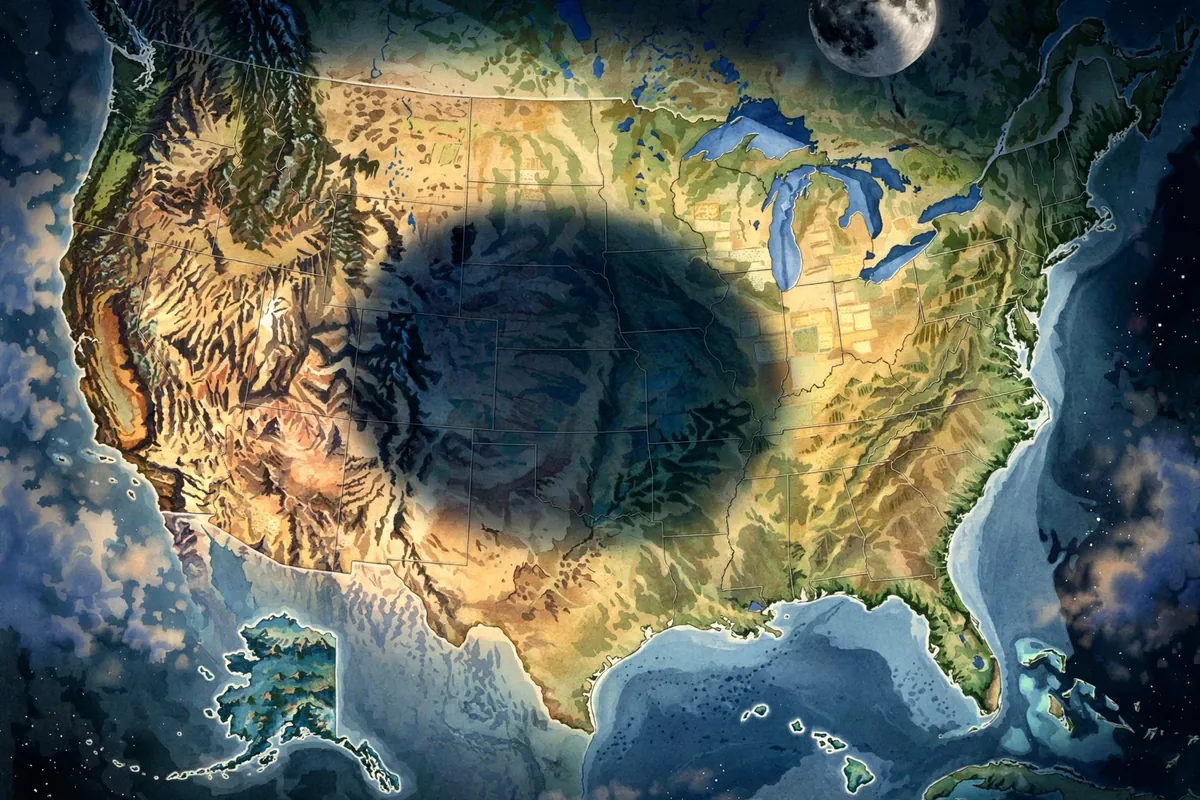
On April 8, 2024, millions of people across North America stepped outside, put on special glasses, and watched the Moon swallow the Sun. For a few minutes, day turned into dusk, the temperature dipped, and the sky went eerie. If you saw it, you probably still talk about it. If you missed it, you're probably wondering when you'll get another chance.
Here's the answer. The next total solar eclipse in the United States will be on March 30, 2033, but only in Alaska. For the contiguous 48 states, the next one comes on August 22, 2044, crossing parts of Montana, North Dakota, and a sliver of South Dakota. A much bigger coast-to-coast show follows almost exactly a year later, on August 12, 2045.
2033: Alaska Gets the View
The 2033 eclipse will darken parts of the Russian Far East and Alaska in the mid-morning hours. Its path of totality includes the Alaska towns of Nome and Utqiaġvik. The rest of North America, including Hawaii, will see only a partial eclipse, with the Moon taking just a bite out of the Sun.
2044: A Short Visit to the Northern Plains
The August 2044 eclipse is often listed as August 23, but in the U.S. and Canada nearly the whole path actually sees it in the evening of August 22. It begins in northwestern Greenland, sweeps across much of western Canada, including Edmonton and Calgary, and then dips into the United States.
In the U.S., totality will cover the northeastern half of Montana, with Glacier National Park and Great Falls just inside the path. It will also cross western North Dakota, including Williston, Minot, and Dickinson, and the extreme northwest corner of South Dakota.
2045: The Big One
If you can wait a little longer, August 12, 2045, looks spectacular. The path of totality will run from northern California through Nevada, Utah, Colorado, Kansas, Oklahoma, Texas, Arkansas, northeastern Louisiana, Mississippi, Alabama, Georgia, and Florida.
Cities in the path include Reno, Salt Lake City, Colorado Springs, Oklahoma City, Tulsa, Jackson, Montgomery, Tallahassee, Tampa, Orlando, Fort Lauderdale, and Miami. It will be the fourth-longest total eclipse of the 21st century. Starting around Camden, Alabama, and across Florida, totality will last at least six minutes, with the longest stretch, just over six minutes, near the Bahamas.
Why Total Eclipses Are So Rare in One Place
A solar eclipse happens when the Moon passes between Earth and the Sun. For a total eclipse, the Moon has to look slightly bigger in the sky than the Sun, blocking all of its direct light. That perfect shadow falls on only a narrow path across Earth's surface, while a much wider area sees a partial eclipse.
That's why any one spot can wait a very long time between total eclipses. Between 1900 and 2100, the United States will see 182 solar eclipses of all kinds, but only 26 of them total. Alaska alone gets eight total eclipses over those same two centuries.
In the meantime, there are smaller treats. A partial eclipse will be visible from the U.S. on January 26, 2028. Just remember the golden rule: never look directly at the Sun without proper eclipse glasses, except during the brief moment of totality itself.
So pencil in a trip to Montana for 2044 or Florida for 2045. It's a long wait, but anyone who has stood in the Moon's shadow will tell you it's worth it. And it gives the grandkids something to look forward to sharing with you.