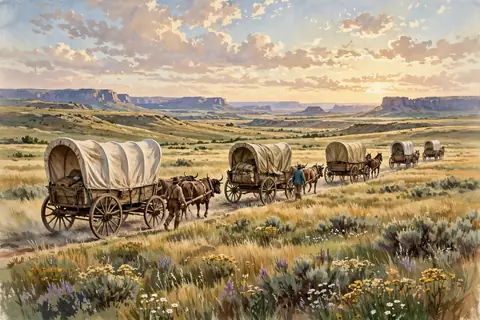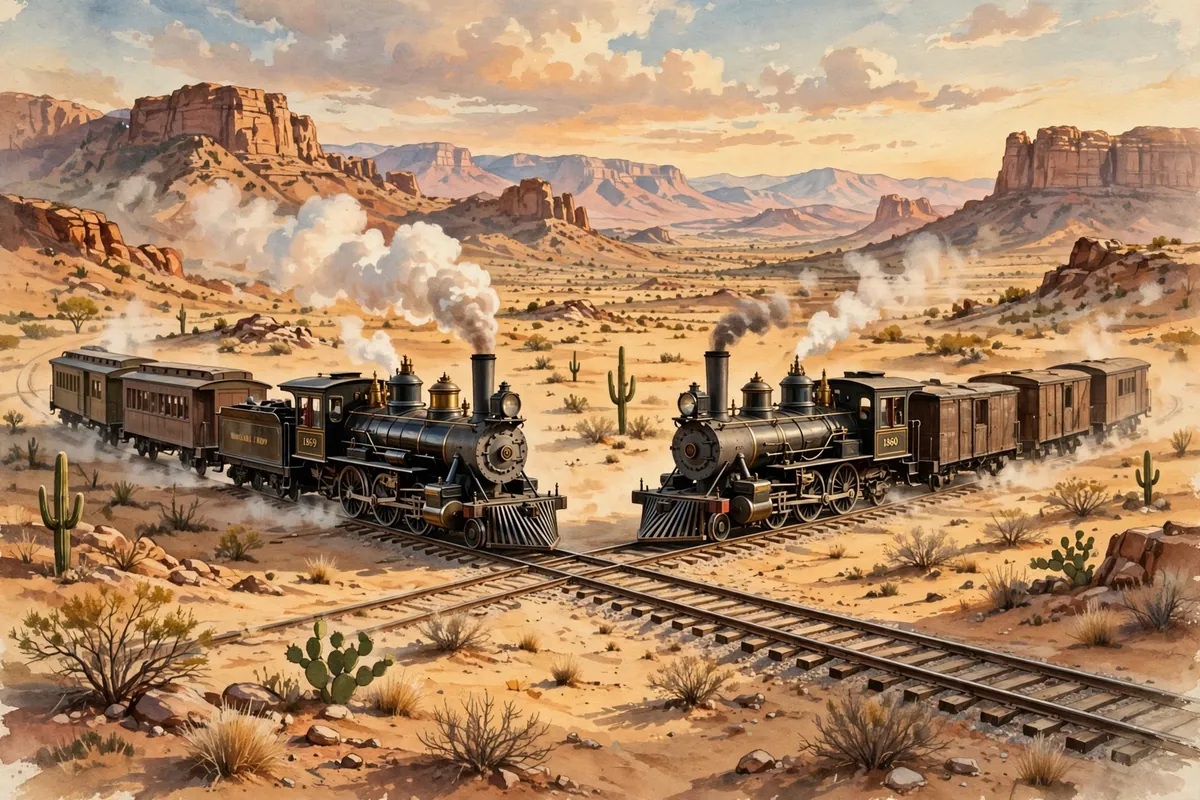
For years, two crews raced across America from opposite directions, laying track through mountains, deserts, and plains. One came east from California, the other west from the Missouri River. On a spring day in 1869, they finally met in the middle, and the whole country listened for the news.
That meeting point was Promontory Summit, in what was then Utah Territory. On May 10, 1869, a ceremonial gold spike marked the link between the Central Pacific and Union Pacific railroads, with Central Pacific president Leland Stanford doing the honors with a silver maul. The first transcontinental railroad across the United States was complete, and a single word, done, was sent by telegraph across the nation.
Two Railroads, One Line
The project was enormous. The whole route ran 1,911 miles, connecting the eastern rail network at Council Bluffs, Iowa, with San Francisco Bay. The Central Pacific built 690 miles east from Sacramento. The Union Pacific built 1,085 miles west from Council Bluffs and Omaha.
It was built by private companies on public land granted by the U.S. government, and paid for with a mix of government subsidy bonds and the companies' own bonds. A third company, the Western Pacific, built the final stretch between Sacramento and the Oakland area.
The Central Pacific had trouble finding workers, so it began hiring Chinese immigrants. Many had come from the Pearl River Delta in southern China, escaping poverty and war. When they proved themselves, the railroad came to prefer hiring Chinese workers and even recruited in China.
A Spike Made of Gold
The idea of a golden spike came from David Hewes, a San Francisco financier and contractor. The spike was made of 17.6-karat gold and weighed about 14 troy ounces. It was engraved on all four sides, including a message hoping God would continue the unity of the country as the railroad united the two great oceans.
The ceremony was supposed to happen on May 8, the date engraved on the spike. But bad weather and a labor dispute delayed the Union Pacific side, so it was pushed back two days. Other commemorative spikes were used that day too, including a silver one from Nevada and a blended iron, silver, and gold spike from Arizona Territory.
A Missed Swing
The big moment wasn't as smooth as it sounds. When Stanford and Hewes swung at the spike, they missed. The telegraph announced the news anyway, and the event became one of the first nationwide media events in American history.
Two locomotives, the Central Pacific's Jupiter and Union Pacific No. 119, were pulled forward until their front ends met, and photographs were taken. Nobody knows exactly how many people were there. Estimates range from about 500 to 3,000.
Then came a quick swap. The golden spike and its special tie of polished California laurel were removed right away, so they wouldn't be stolen. A regular iron spike and an ordinary tie took their place. At exactly 12:47 p.m., the last iron spike was driven, and the line was truly finished.
Where the Spike Is Now
Today the golden spike is displayed at the Cantor Arts Center at Stanford University. A duplicate spike, cast at the same time and engraved with the correct date of May 10, stayed with the Hewes family until 2005.
The railroad changed the country. Moving people and goods from coast to coast became much quicker, safer, and cheaper, and the American West was transformed. All of it was marked by a spike of gold that, fittingly enough, only had to stay in place long enough for a photo.