It sounds like a tall tale: one year, someone simply switched off Niagara Falls. Photos from 1969 show workers walking across bare rock where torrents of water normally pour over the edge. So did engineers really turn off one of the world's most famous waterfalls?
Partly. Niagara Falls is actually three waterfalls, and only one of them was shut off. In June 1969, the U.S. Army Corps of Engineers built a temporary rock and earth dam that completely diverted the river away from the American Falls for several months. Meanwhile, the much larger Horseshoe Falls kept flowing the whole time, absorbing the extra water.
Three Falls, Not One
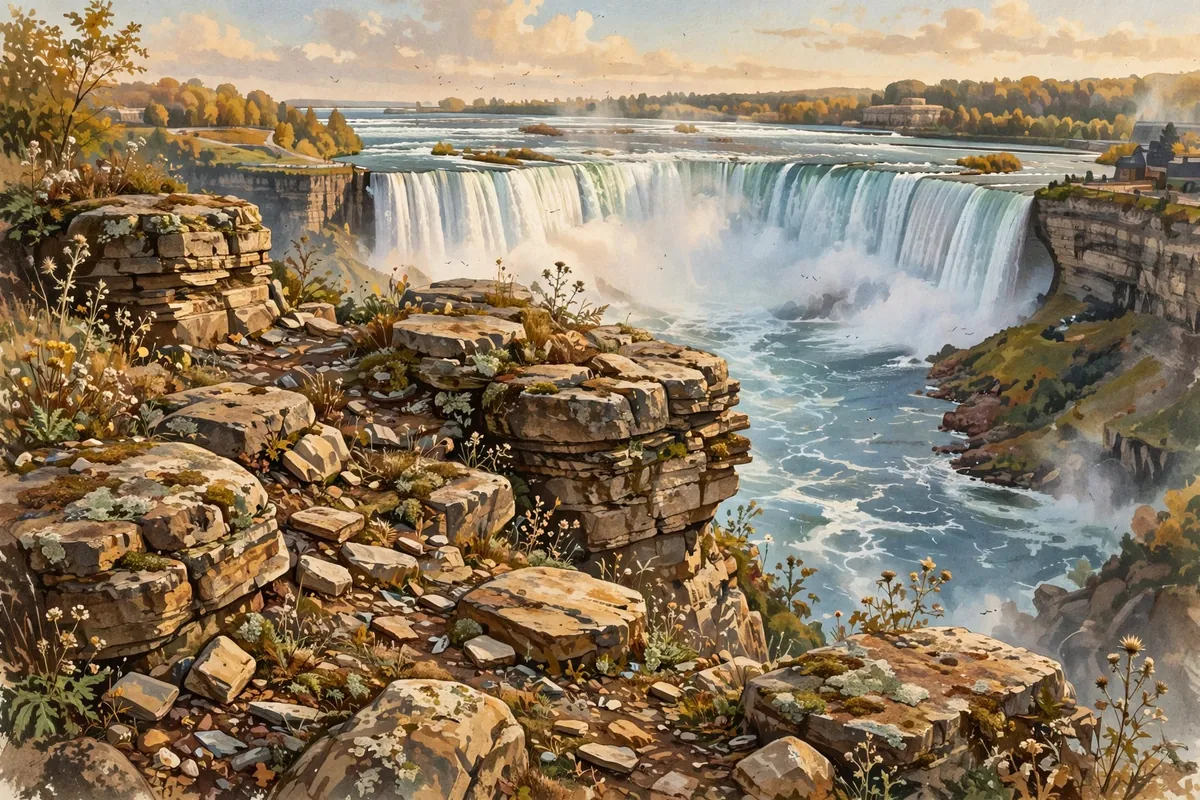
Niagara Falls sits on the border between Ontario and New York. The biggest of its three waterfalls is the Horseshoe Falls, also called the Canadian Falls, which straddles the international border. It's about 187 feet high and about 2,592 feet wide, and it's the most powerful waterfall in North America by flow rate.
The smaller American Falls and Bridal Veil Falls lie entirely in the United States. The American Falls drops somewhere between 69 and 98 feet, depending on where you measure, because of giant boulders piled at its base. In summer, about 90 percent of the water going over Niagara flows across the Horseshoe Falls. That's why it could easily take on the extra water when the American Falls was dammed.
Why Dry Up a Waterfall?
The reason was erosion. Over the past 150 years, rockfalls have piled a huge mound of rock at the base of the American Falls. The biggest recent one came in 1954, when Prospect Point collapsed. Engineers worried the falls might eventually turn into little more than a series of rapids.
With the water turned away, the Corps of Engineers studied the riverbed and bolted and strengthened weak spots that could have sped up the falls' retreat. They considered removing the giant pile of fallen rock but dropped the idea because of the cost. Workers also made a grim discovery: two bodies were found beneath the falls once the water was gone.
Turning It Back On
In November 1969, the temporary dam was blown up with dynamite, and water flowed over the American Falls once again. By December, the falls looked like their old selves. In the mid-1970s, officials decided not to alter the rock wall, choosing to let nature take its course.
Tourism that year is a bit of a mystery. Some reports say more people came to see the dry falls, while others say fewer came because they thought all of Niagara had been shut down.
The Day Niagara Really Stopped
There was a time when the whole thing nearly went silent, though nobody planned it. On March 29, 1848, an ice jam choked the river, and for as long as 40 hours little or no water went over the falls. Waterwheels stopped and mills shut down. It's the only recorded freeze-up of the river and falls.
Even today, the falls aren't running at full power around the clock. A 1950 treaty between the U.S. and Canada allows more water to be diverted for hydroelectric power at night and in winter, when fewer tourists are watching. So Niagara gets turned down a little every evening. It just never gets turned all the way off.