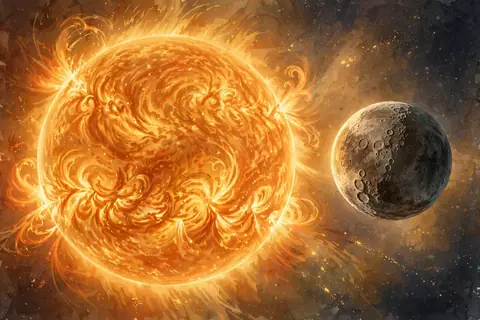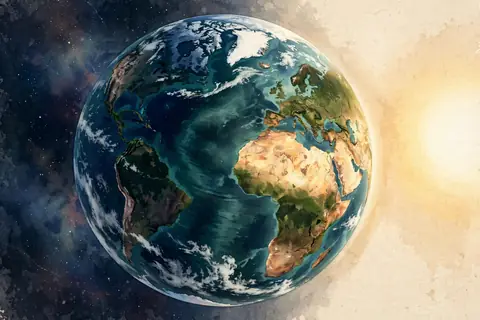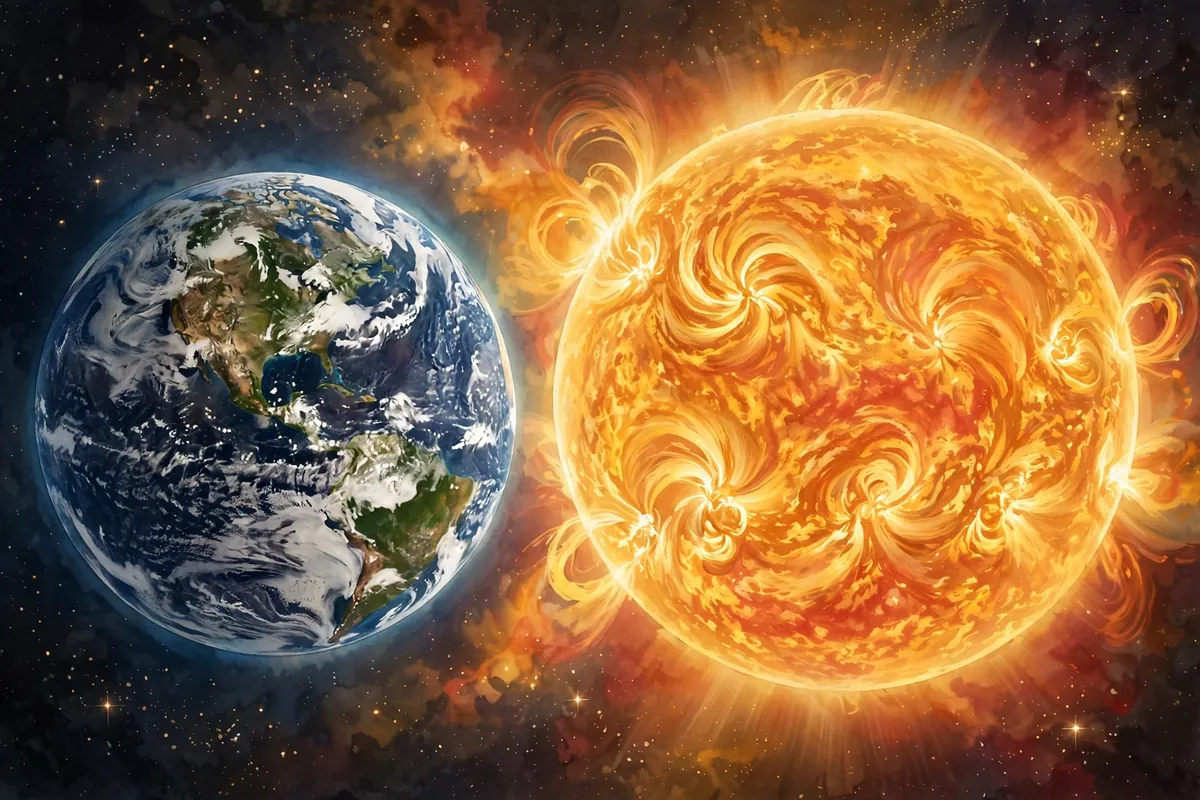
From here, the Sun and the full Moon look about the same size in the sky, which is why the Moon can cover the Sun during a total eclipse. That's a trick of distance, of course. So just how big is the star at the center of our solar system, compared with the planet we call home?
Big enough to hold about 1.3 million Earths. The Sun's diameter is about 864,600 miles, roughly 109 times that of Earth. Because volume grows with the cube of width, 109 times wider means about 1.3 million times the space inside. If you packed in solid, round Earths like marbles, the gaps between them would bring the count down to roughly 960,000.
The Math Behind the Million
Here's why the number climbs so fast. If you double the width of a ball, you don't just double the space inside. You multiply it by eight, because it grows in length, width, and height all at once.
The same goes for the Sun. Multiply 109 by itself three times and you get roughly 1.3 million. That's how many Earths it would take to match the Sun's volume, if you could melt them down and pour them in.
For comparison, Jupiter, the biggest planet, has a volume 1,321 times that of Earth. You could fit roughly a thousand Jupiters inside the Sun.
The Marble Problem
Real planets don't melt, though. If you tried to fill the Sun with solid, round Earths, there would be gaps between them, the way a jar full of marbles still has room for sand.
Mathematicians have worked out the densest way to stack equal-sized balls. Even the tightest arrangement, the familiar pyramid you see in a stack of oranges, fills only about 74 percent of the space. The idea is called the Kepler conjecture, after the 17th-century astronomer Johannes Kepler.
So with whole, solid Earths, about 74 percent of 1.3 million, or roughly 960,000, would fit. That's still close to a million planets.
Heavier Than Everything Else Combined
The Sun isn't just huge, it's heavy. Its mass is about 330,000 times that of Earth, and it makes up about 99.86 percent of all the mass in the solar system. Every planet, moon, asteroid, and comet put together is just a sliver of what's left.
It's a powerhouse, too. Every second, the Sun's core fuses about 600 billion kilograms of hydrogen into helium. The light it gives off takes about 8 minutes to reach us.
Not Even a Giant Among Stars
As enormous as it is, the Sun is a fairly ordinary star. It's brighter than about 85 percent of the stars in the Milky Way, most of which are small red dwarfs, but it looks tiny next to true giants.
Betelgeuse, the reddish star in the constellation Orion, has a radius between 640 and 764 times the Sun's. If it sat where the Sun is, its surface would reach beyond the asteroid belt, swallowing the orbits of Mercury, Venus, Earth, and Mars. It's expected to end its life as a supernova, most likely within the next 100,000 years.
So the next time you feel the Sun's warmth on your face, remember what's behind it: a sphere of hot plasma big enough to hold about a million Earths, and still just an average star in a very big galaxy.