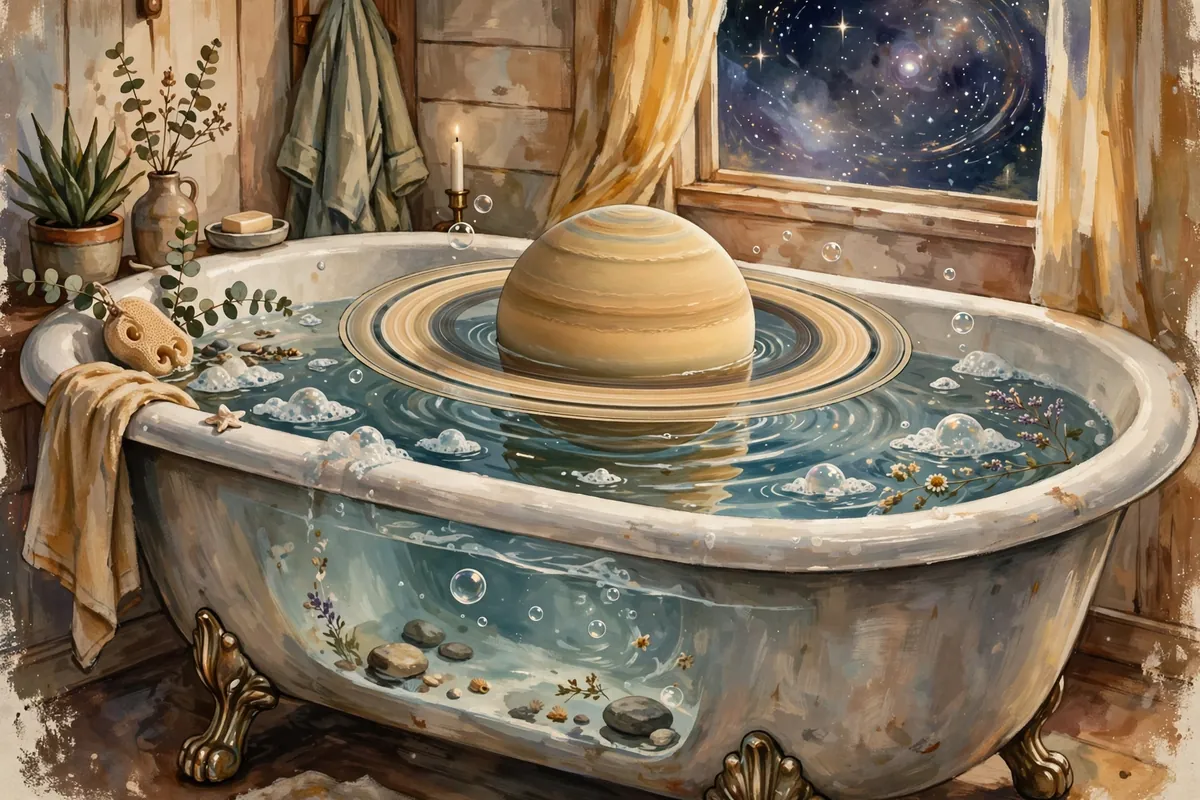
Saturn is a true giant. It's the second-largest planet in our solar system, about nine times as wide as Earth, with a mass more than 95 times greater. So it sounds like a joke when people say it could float in a bathtub. Yet astronomers repeat that line all the time.
Here's the truth behind it. Saturn is the only planet in our solar system that's less dense than water, about 30 percent less. In principle, anything less dense than water floats. So if you could somehow find a tub of water big enough, Saturn would be light enough for its size to float. It's a thought experiment, not something that could ever really happen.
Big Doesn't Mean Heavy for Its Size
The key word is density, which means how much stuff is packed into a given space. A bowling ball and a beach ball can be the same size, but one is far denser than the other. That's why one sinks and one floats.
Saturn's average density is about 0.69 grams per cubic centimeter. Water is 1 gram per cubic centimeter. Earth, a rocky planet, is about eight times denser than Saturn. So although Saturn is enormously heavy overall, all that mass is spread out over a gigantic volume.
What Saturn Is Made Of
Saturn is a gas giant, made mostly of hydrogen and helium, the two lightest elements. It doesn't have a solid surface you could stand on. Instead, its atmosphere gets thicker and hotter the deeper you go.
Deep inside, the pressure becomes so intense that hydrogen turns into a liquid, and deeper still into a metal. Scientists think the center holds a fuzzy, spread-out core of rock and ice, where temperatures may reach around 21,000 degrees Fahrenheit. Some researchers have even suggested it may rain diamonds deep inside.
Why the Bathtub Is Just for Fun
Of course, there's no bathtub in the universe large enough to hold a planet. And Saturn is a huge ball of gas and liquid with no solid outer shell, so it wouldn't sit neatly on the water like a rubber duck. The bathtub is simply a memorable way to picture how light Saturn is for its size.
Its low density shows up in its shape, too. Saturn spins quickly, and that rotation makes it bulge at the middle and flatten at the poles. Its width across the equator is more than 10 percent bigger than its height from pole to pole, making it the most squashed of the giant planets.
More Saturn Surprises
Saturn's famous rings stretch about 75,000 miles out from the planet, yet on average they're only about 66 feet thick. They're made mostly of water ice, in pieces ranging from specks of dust to chunks about 30 feet across.
Galileo saw something odd about Saturn in 1610 but mistook the rings for two moons on either side. The rings weren't recognized until Christiaan Huygens observed them in 1655. Saturn also has more moons than any other planet, including Titan, which is bigger than the planet Mercury.
It's also a long way from home. Saturn orbits about 9.6 times farther from the Sun than Earth does, so a single year there lasts about 29.5 Earth years.
So, no, you won't ever see Saturn bobbing in a tub. But the next time you spot it through a telescope, you'll know that the gorgeous ringed giant is surprisingly light on its feet.