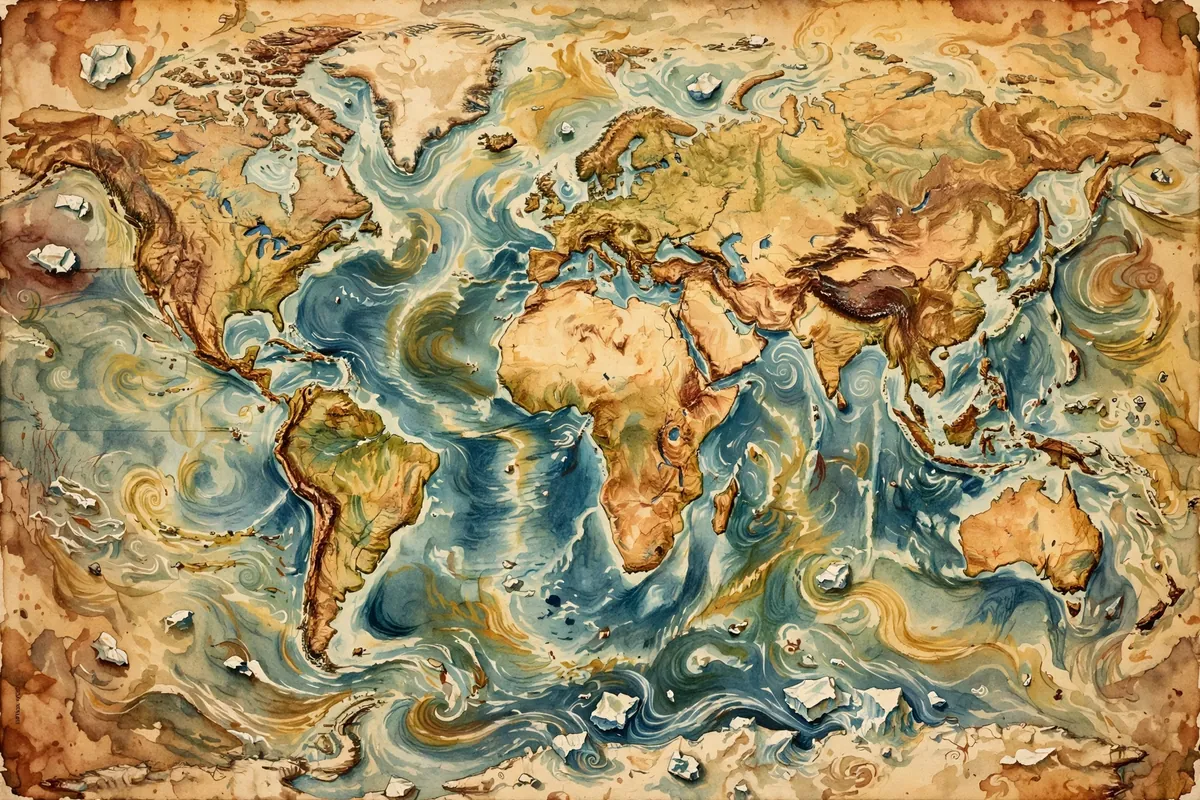
Look at a world map and you might notice something odd. The bulge of South America looks like it could tuck neatly into the curve of Africa, like two puzzle pieces. People noticed that centuries ago. It turns out the resemblance is no accident, and the continents are still on the move today.
Here's the short answer. Earth's outer shell is broken into huge tectonic plates that slowly slide around. Along the Mid-Atlantic Ridge, plates separate at about 10 to 40 millimeters a year, roughly 0.4 to 1.6 inches. That's about as fast as your fingernails grow. Some plates move faster, like the Nazca plate off South America, at about 6.3 inches a year, about the speed hair grows.
How Scientists Measure It
You can't feel the ground moving a couple of inches a year, but instruments can. Today, the motion of the plates is tracked with satellite data, checked against measurements from stations on the ground. At an inch a year, a plate would shift about seven feet over an 80-year lifetime. That's not enough to notice from your porch, but plenty for a satellite.
Earthquakes give clues, too. In the 20th century, better seismographs showed scientists that earthquakes cluster in particular zones, especially along deep ocean trenches and ridges. Those zones turned out to mark the edges of the plates.
The Idea Nobody Believed at First
The notion of drifting continents is surprisingly old. In 1596, mapmaker Abraham Ortelius suggested the Americas had been torn away from Europe and Africa, and said the matching coasts proved it.
The modern version came from German scientist Alfred Wegener, who presented his idea on January 6, 1912. He proposed that all the continents had once formed a single giant landmass, which he called Pangaea. Many scientists rejected it, largely because no one could explain what force could push entire continents around.
In 1931, English geologist Arthur Holmes suggested the answer: slow churning of hot rock deep inside the Earth. The theory finally won over geologists after evidence for seafloor spreading came in during the mid- to late 1960s.
Clues Hidden in Fossils
Some of the best evidence comes from fossils. Remains of Mesosaurus, a small freshwater reptile a bit like a crocodile, have been found in both Brazil and South Africa. It couldn't have swum across an ocean. The land reptile Lystrosaurus turns up in rocks of the same age in Africa, India, and even Antarctica.
Living creatures tell the story too. Some families of earthworms are found in both South America and Africa, separated today by thousands of miles of salt water.
Small Steps, Giant Changes
A couple of inches a year doesn't sound like much. But given enough time, it reshapes the planet. Pangaea came together around 335 million years ago and began breaking apart about 175 million years ago, at the start of the Jurassic period, the age of dinosaurs.
Moving continents also build mountains. As early as 1908, American geologist Frank Bursley Taylor linked the Himalayas to India crashing into Asia. And the drifting isn't finished. Scientists think a new supercontinent, nicknamed Pangaea Proxima, could form within the next 250 million years.
So next time you trim your nails, think about the ground beneath you. It's creeping along at about the same pace, patiently rearranging the world one fingernail's width at a time.