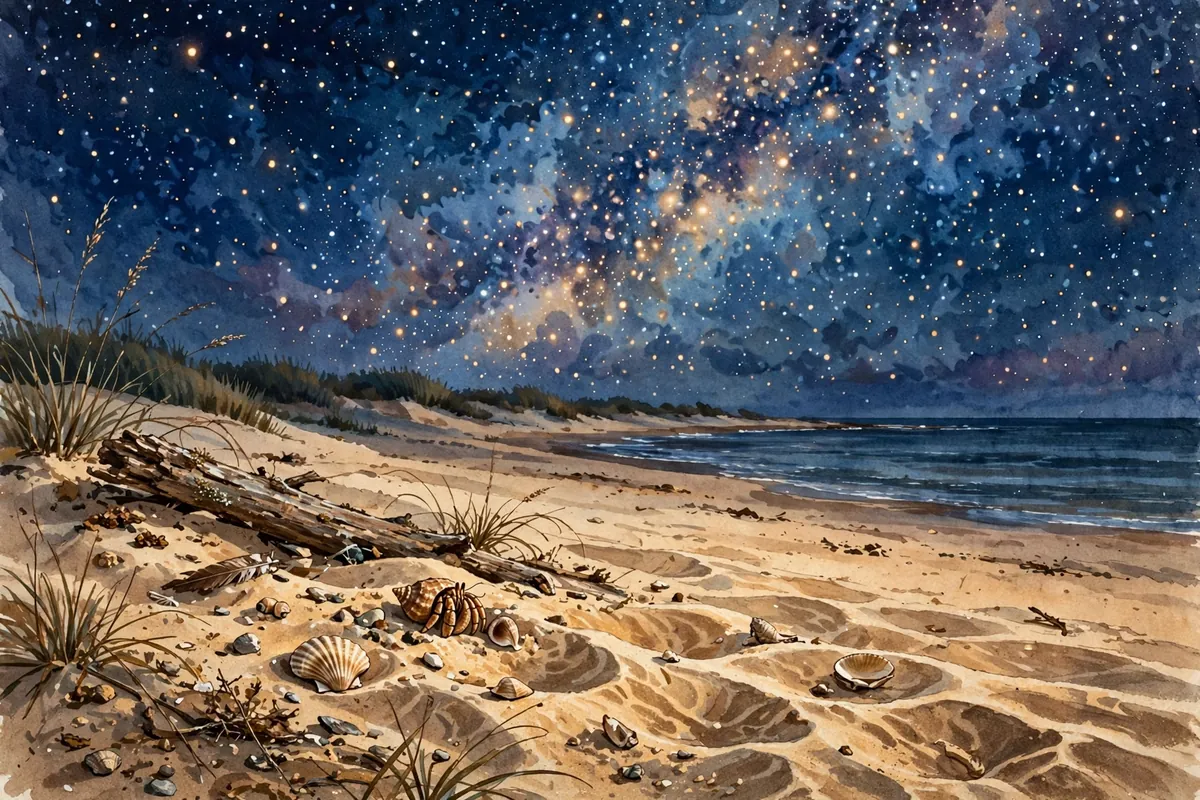
Scoop up a handful of sand at the beach and let it run through your fingers. There must be thousands of grains in that one handful. Now picture every beach and desert on Earth. It's hard to imagine anything outnumbering that. But look up on a clear night, and you're seeing a hint of something even bigger.
Astronomers estimate that the observable universe contains somewhere between 10 billion trillion and a trillion trillion stars. That's a 1 followed by 22 to 24 zeros. By those estimates, there are likely more stars than all the grains of sand on planet Earth. The numbers are rough, but the stars probably win.
Counting Stars by the Galaxy
Nobody counts stars one by one. Instead, astronomers estimate how many galaxies there are and how many stars a typical galaxy holds, then multiply.
Our own galaxy, the Milky Way, contains an estimated 100 to 400 billion stars. Our neighbor, the Andromeda Galaxy, may hold around a trillion. And the observable universe may contain as many as 2 trillion galaxies, though most are much smaller than the Milky Way. Other estimates put the number of galaxies in the hundreds of billions instead.
That's why the total is a range, not a precise figure. Even within our own galaxy, an exact count is tricky, because very faint, low-mass stars are hard to detect. Space telescopes and missions like Europe's Gaia, which is measuring distances to about a billion stars, keep refining the picture.
What You Can Actually See
Here's a humbling thought. Of all those stars, only about 4,000 are visible to the naked eye, and every one of them is in the Milky Way. The faintest stars you can see on a dark, clear night are about a hundred times dimmer than the brightest first-magnitude stars.
So the sky that looks so crowded on a camping trip is just a tiny sample of our own galaxy, which is itself one galaxy among a vast number.
An Ancient Attempt to Count Sand
People have wondered about these huge numbers for a very long time. More than 2,200 years ago, the Greek mathematician Archimedes wrote a work called The Sand Reckoner. He set out to find an upper limit for how many grains of sand it would take to fill the entire universe.
To do it, he had to estimate the size of the universe as people understood it then, and invent a way to talk about enormous numbers. His answer was no more than 10 to the 63rd power grains of sand. His real goal was to show that even seemingly impossible numbers could be calculated.
What Counts as Sand?
Sand is defined by size. Geologists call a particle sand if it's between about one-sixteenth of a millimeter and 2 millimeters across. Anything bigger is gravel, and anything smaller is silt, which feels like flour.
Most sand comes from rocks slowly broken down by water and wind, and the most common source is granite. Desert sand is usually rounded from tumbling in the wind, which is why it's actually poor for making concrete.
So the next time you're at the beach under a starry sky, take a moment. The sand under your feet is beyond counting, and the sky above holds even more. It's a wonderful way to feel small in the best possible way.