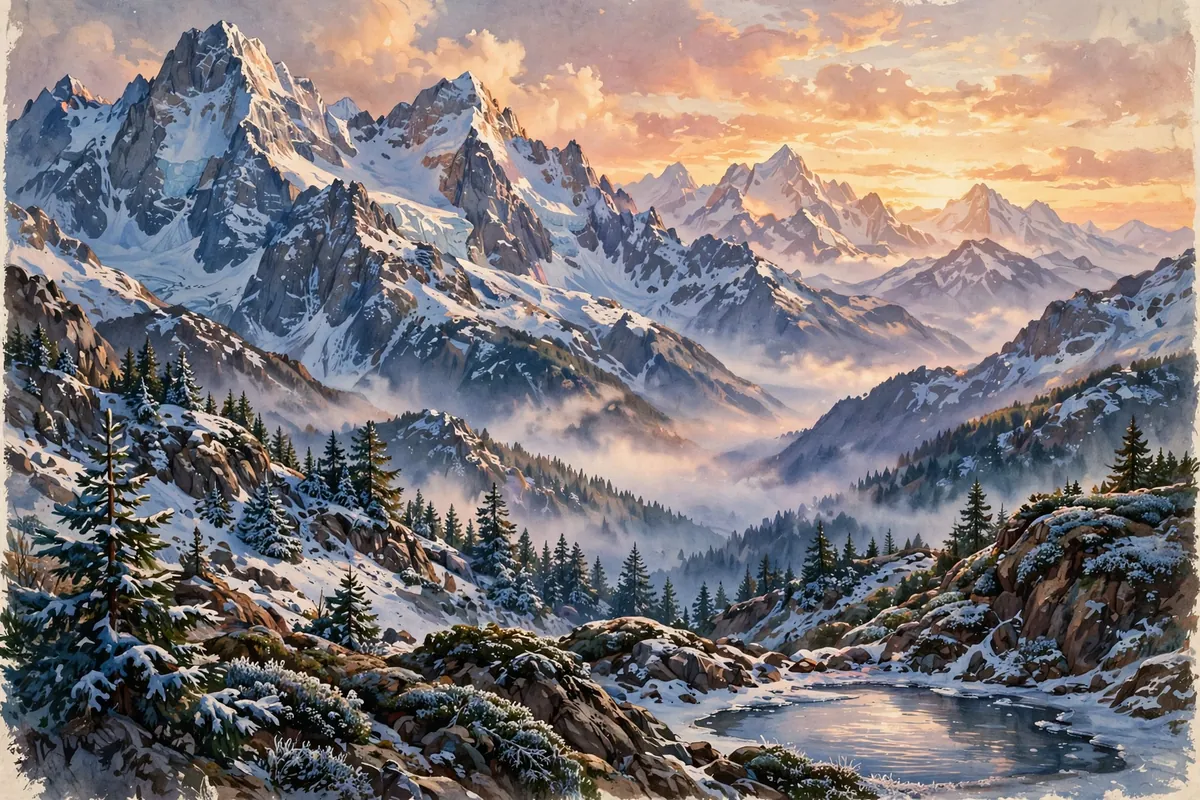
Mountains feel permanent. They've stood on the horizon for as long as anyone can remember, and they'll be there long after us. But every peak on Earth had a beginning. So how does flat ground end up miles high?
Here's the short answer: mountains are built mostly by the slow movement of tectonic plates, the giant slabs that make up Earth's outer shell. When plates collide, the crust can crumple and fold upward. When it cracks, blocks of rock can tilt and rise. And where molten rock reaches the surface, volcanoes pile up mountains of their own.
When Continents Collide
Geologists usually describe five main types of mountains: volcanic, fold, plateau, fault-block, and dome. The biggest ranges on the continents are mostly fold mountains. They form when two plates push into each other and the crust buckles, a bit like a rug shoved against a wall.
The Himalayas are the classic example. They rose after the Indian plate, which had drifted north, collided with the Eurasian plate around 60 million years ago. The upper layers of Indian crust folded and stacked up, while deeper layers slid underneath Eurasia. The result is a mountain arc about 1,500 miles long. At its widest, in the west, the range stretches about 220 miles across.
That's why the highest rocks on the planet hold a surprise. The summit of Mount Everest contains fossil-bearing marine limestone, rock that formed under an ancient sea and was lifted all the way to the roof of the world.
Still Growing Today
Mountain building isn't over. In parts of the Himalayas, geologists estimate that deeply buried rocks are rising by about seven millimeters a year. That's barely a quarter of an inch, but over a million years it adds up to more than four miles.
Cracks, Blocks, and Volcanoes
Not all mountains come from collisions. When the crust is stretched, it can crack into giant blocks. Some drop down while others are pushed up or tilted, creating fault-block mountains. Geologists call the raised blocks horsts and the sunken troughs between them grabens. California's Sierra Nevada is one example, and its steep eastern side forms the highest mountain front in the continental United States.
Volcanoes build mountains by piling up layer after layer of erupted rock. Runny lava creates broad, gently sloping shield volcanoes such as Mauna Loa in Hawaii. Thicker, stickier material builds steep cones, such as Mount Fuji, Mount Rainier, and Mount Hood.
Which Mountain Is Really Tallest?
Mount Everest is the highest point above sea level, at about 29,032 feet. But Hawaii's Mauna Kea, a dormant volcano, has a sneaky claim to fame. Its peak is only 13,803 feet above sea level, yet measured from its base deep under the ocean, it rises about 30,610 feet. Some authorities call it the tallest mountain in the world from its underwater base.
Not every mountain mystery is solved, either. Scientists still don't have a widely accepted explanation for some high ranges along quiet coastlines, such as the Scandinavian Mountains and Australia's Great Dividing Range.
So the next time you gaze at a snowy peak, remember that you're looking at a moment in a very long story. The ground beneath it has been pushed, folded, cracked, or built up for millions of years, and in many places, it's still on the move.