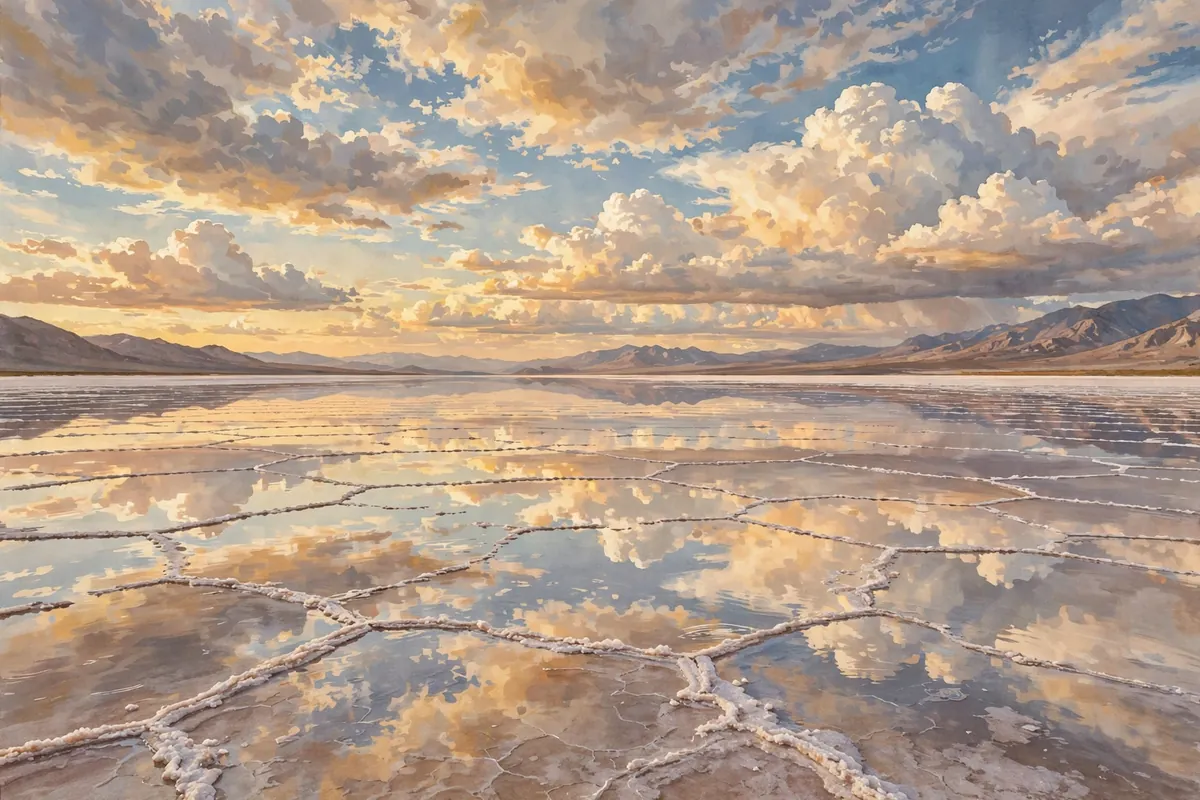
Imagine standing in a place where the ground and the sky look exactly the same. Clouds float above you and below you. The horizon disappears. People walking in the distance seem to be strolling on air. This isn't a dream or a special effect. It's a real place in South America.
It's called Salar de Uyuni, and it's the largest salt flat in the world, high in the Andes Mountains of southwestern Bolivia. The surface is so incredibly flat that after a rain, a thin, perfectly still layer of water turns the whole area into the world's largest mirror, about 80 miles across.
Flatter Than Almost Anywhere
Salar de Uyuni covers about 4,086 square miles and sits at an elevation of nearly 12,000 feet above sea level. It's roughly 100 times the size of Utah's Bonneville Salt Flats. Across that entire area, the average elevation varies by less than one meter, about three feet.
That extreme flatness is the secret behind the mirror. With a huge area, clear skies, and almost no bumps, the salt flat is also ideal for calibrating the instruments on Earth-observing satellites that measure height from space.
Made From Ancient Lakes
Tens of thousands of years ago, this area was covered by a giant prehistoric lake. Over time, a series of lakes came and went as the climate changed. As they dried up, they left behind thick deposits of salt. Today the Salar is covered by a salt layer several meters thick.
Beneath the crust lies a pool of brine, very salty water, which is exceptionally rich in lithium, the metal used in many batteries. A few islands rise from the middle of the flat. They are the tops of ancient volcanoes that were once submerged by the old lake.
Local Aymara legend has its own explanation. It says the surrounding mountains were once giants, and that a grieving giant named Tunupa wept while nursing her son. Her tears mixed with milk and formed the salt flat.
When the Mirror Appears
The region is quite dry most of the year. Rainfall is only a sliver of an inch per month from April to November. In January, the wettest month, it can climb to about 3 inches. That's when visitors hope for the perfect thin sheet of calm water.
Hotels Made of Salt and a Train Graveyard
Since normal building materials are scarce, some hotels near the flat are built almost entirely from salt blocks, including the walls, roof, and even furniture. The first one stood in the middle of the flat, but waste problems forced it to close, and it was taken down in 2002. A newer salt hotel now sits at the eastern edge.
Just outside the nearby town of Uyuni sits an eerie train cemetery. British engineers built rail lines here between 1888 and 1892 to haul minerals to Pacific ports. When the mining industry collapsed in the 1940s, many trains were simply abandoned, left to rust in the desert.
The flat is full of life, too. Every November, it becomes a breeding ground for three kinds of flamingos, including the rare James's flamingo, which feed on tiny brine shrimp.
So if you ever dream of walking on the sky, Salar de Uyuni might be the closest you can get. Just bring sunglasses, a warm coat for the chilly nights, and plenty of room on your camera.