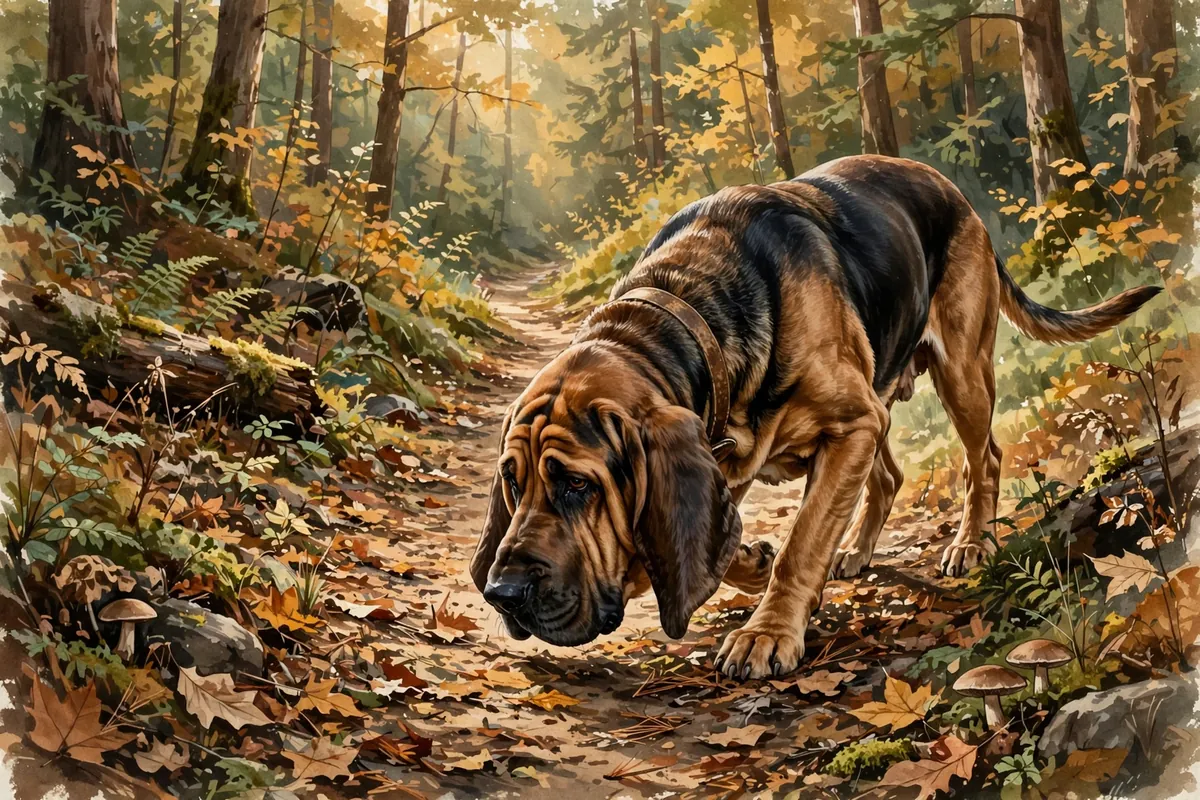
Take your dog for a walk and you'll spend half the time waiting while it sniffs a single blade of grass. To us, it looks like a whole lot of fuss over nothing. To a dog, that patch of grass may be packed with news about who passed by and when.
Dogs have such powerful noses because their whole body plan is built around smell. They have roughly forty times more smell-sensitive receptors than humans, ranging from about 125 million to nearly 300 million in breeds like bloodhounds. And while the human brain is dominated by a large area for vision, the dog brain is dominated by a large area for processing smell.
More Nose Inside the Nose
Inside the nose is a patch of special tissue called the olfactory epithelium, where smells are actually detected. Humans have about 1.6 square inches of it. Some dogs have about 26 square inches, and a dog's version is packed with a hundred times more receptors per square centimeter.
Put all that together and the numbers get dizzying. Dogs in general are estimated to have a sense of smell roughly ten thousand to a hundred thousand times more acute than ours. That doesn't mean they're overwhelmed by every odor. It means they can pick up a scent that's far more diluted in the air than anything we could notice.
The Bloodhound, Champion of Sniffers
Some dogs are even more impressive. Scent hounds as a group can smell one to ten million times more acutely than a human. Bloodhounds, which have the keenest sense of smell of any dog, have noses estimated at ten to one hundred million times more sensitive than ours.
Bloodhounds were originally bred for hunting deer, wild boar, and rabbits, and since the Middle Ages they've been used to track people. They can follow a scent trail that's a few days old. Today police and rescue teams around the world use them to find fugitives, missing people, and even lost pets.
The silver medal for sniffing goes to the basset hound, which was bred to track rabbits and other small animals.
Built for the Trail
Even a dog's neck is designed for sniffing. All living members of the dog family have a special ligament that supports the weight of the head without any muscle effort. That lets dogs carry their heads low for long distances, such as when they follow a trail with their nose to the ground, without wearing themselves out.
Dogs' ears are sharp, too. Their hearing is up to four times better than ours, and they can pick up faint sounds from about 1,300 feet away, compared with about 300 feet for people.
Noses That Go to Work
People have put these noses to work in all kinds of ways. Detection dogs are trained to find explosives, drugs, currency, and even contraband cell phones. They can pick out individual scents even when those scents are mixed together or covered up by other odors.
Some of their jobs are surprising. Dogs help wildlife scientists find the droppings of animals like caribou and killer whales. In California, they sniff out invasive quagga mussels on boats. Others are trained to find bed bugs hiding in cracks and furniture.
So the next time your dog lingers over a fence post, try to be patient. It isn't wasting time. It's reading the neighborhood news in a language our noses will never fully understand.