Imagine stepping off a train in Queens, New York, in the summer of 1939. The country is still shaking off the Great Depression, and war is brewing in Europe. Ahead of you rises a gleaming white spire and a giant globe. Everywhere you look, someone is promising to show you the future.
Here's the short answer. The 1939 New York World's Fair was themed The World of Tomorrow. Over two seasons, slightly more than 45 million people came to see exhibits from 62 nations and more than 1,400 companies. Visitors saw television demonstrations, a talking robot, and a giant model of an American future linked by superhighways, an idea that helped shape the real Interstate system.
A Fair Built on an Ash Dump
The fairground at Flushing Meadows had once been a wetland and then an ash dump. Parks Commissioner Robert Moses had long dreamed of turning it into a grand park, and the fair gave him the chance. To build excitement beforehand, businessman Howard Hughes named an airplane after the fair and flew it around the world in 1938.
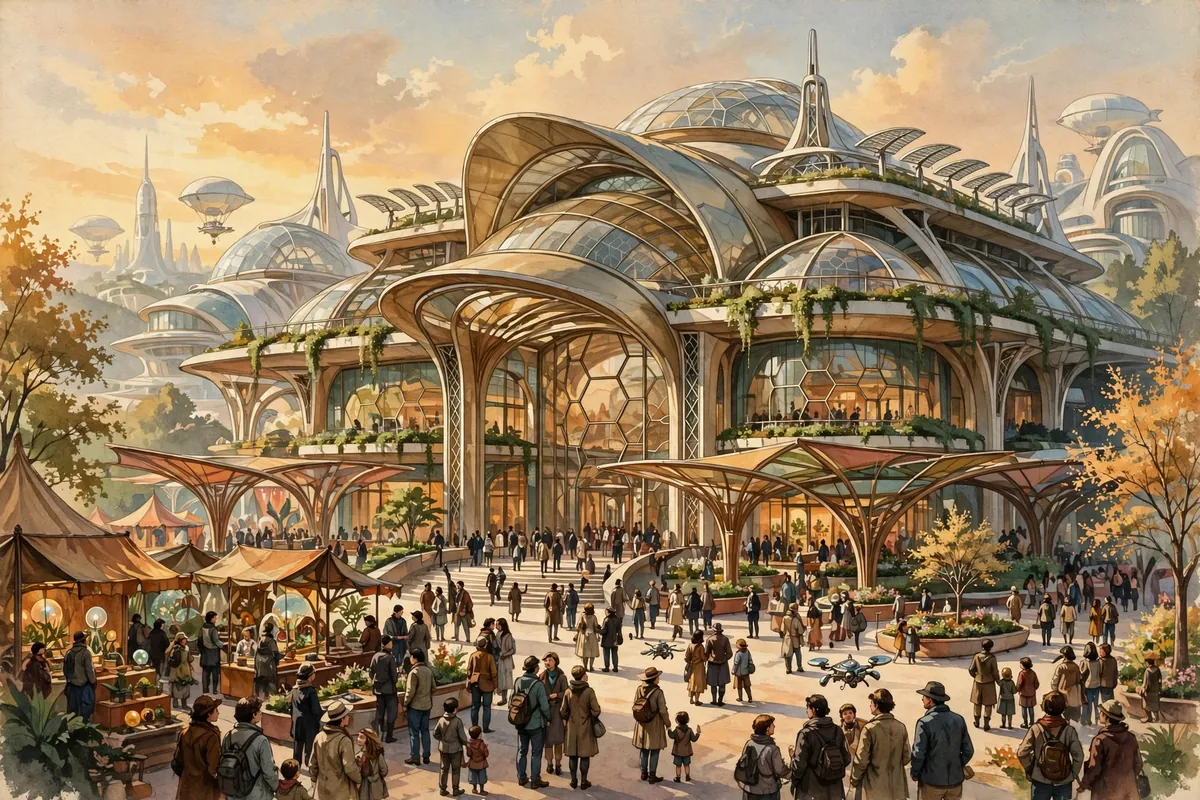
The fair opened on April 30, 1939, exactly 150 years after George Washington's first inauguration, with a speech by President Franklin D. Roosevelt. At its center stood the Trylon, a 610-foot spire, and the Perisphere, a sphere 180 feet wide. Inside the sphere, an exhibit called Democracity imagined a planned city of tomorrow.
Futurama: A Ride Into 1960
The most famous attraction was Futurama, designed by Norman Bel Geddes and sponsored by General Motors. Visitors traveled past a model of America as it might look about 20 years later, around 1960.
The model was enormous. Covering about an acre, it held more than 500,000 individually designed buildings, a million trees, and about 50,000 model cars, 10,000 of which moved along a 14-lane highway. It featured multi-lane expressways crossing the country, semi-automated cars, and even rooftop pads for personal flying machines.
Some of it really did come true. Futurama is widely credited with introducing the American public to the idea of a national network of expressways, and its popularity helped influence the laws that led to the Interstate Highway System. The flying machines, sadly, are still waiting.
Robots, Television, and Nylon
Television was one of the stars of the fair. RCA and NBC hosted TV demonstrations, including the first televised Major League Baseball game. Westinghouse showed off Elektro the Moto-Man, a robot that talked, told colors apart, and smoked cigarettes. Bell Labs demonstrated a keyboard-operated machine that could synthesize speech.
Everyday wonders were on display too, including nylon, cellophane, and a General Electric home of tomorrow. Westinghouse buried a time capsule 50 feet below the fairground, filled with items from daily American life. It isn't meant to be opened until around the year 6900.
A Future Interrupted
Just four months after the fair opened, World War II began in Europe. Some exhibits closed or scaled back, and some foreign staff couldn't return home. Despite the huge crowds, the fair recouped only about 32 percent of its cost. It closed on October 27, 1940.
Much of the fairground became Flushing Meadows–Corona Park, which hosted another World's Fair in 1964. If you've ever driven an interstate or watched a ballgame on TV, you're living in a small piece of the future those 1939 visitors lined up to see.