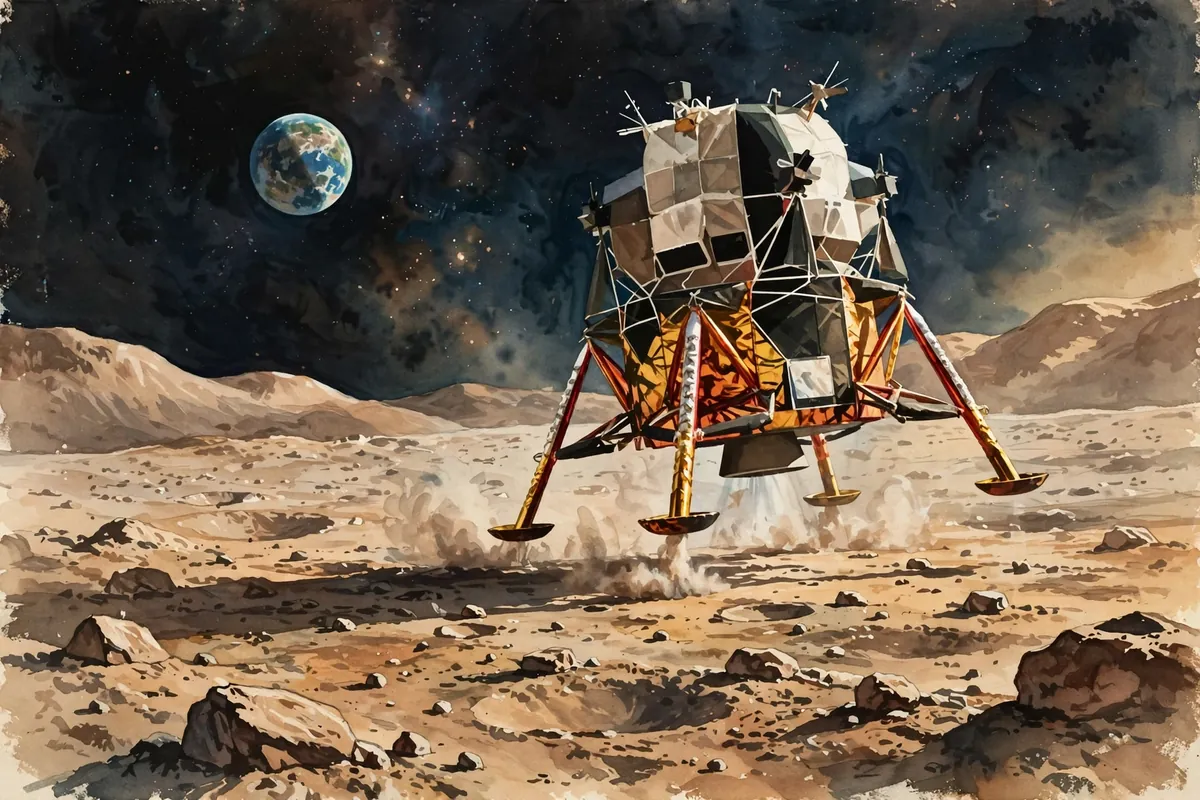
On July 20, 1969, Neil Armstrong became the first human to walk on the Moon. In photos and old TV footage, it all looks calm and carefully planned. But the road to that moment, and the landing itself, came with several heart-stopping close calls.
Here's the short version. In 1968, Armstrong ejected from a crashing training vehicle, and analysis later suggested that half a second later, his parachute wouldn't have opened in time. During the real landing, computer alarms went off, the planned landing spot was full of boulders, and fuel ran very low. Even after landing, a broken switch threatened to strand the crew, until a felt-tip pen saved the day.
The Flying Bedstead
To practice landing on the Moon, NASA built odd-looking training craft called Lunar Landing Research Vehicles, nicknamed "Flying Bedsteads." A jet engine held up most of the craft's weight to imitate the Moon's weaker gravity.
On May 6, 1968, Armstrong was about 100 feet up when his controls started to fail and the vehicle began rolling. He ejected just before it hit the ground and burst into flames. His only injury was a bitten tongue. Even so, he insisted the trainers were essential, because they gave commanders the experience they needed to land on the Moon.
It wasn't his first scare. On Gemini 8 in 1966, a stuck thruster sent his spacecraft into a dangerous roll. Armstrong used some of his re-entry fuel to steady it, and the mission had to be cut short.
Alarms on the Way Down
During the real descent, the lunar module Eagle was flying a bit too fast and long, so it would land miles past its target. Then, about 6,000 feet above the surface, the guidance computer began flashing unexpected "1201" and "1202" alarms.
The alarms meant the computer was overloaded and had to put off some tasks. Back in Mission Control, engineer Jack Garman told guidance officer Steve Bales it was safe to keep going, and that call was passed to the crew.
Running on Fumes
When Armstrong looked out the window, he saw the computer was steering them toward a boulder-strewn area near a large crater. He took over semi-manual control and hunted for a safer spot. The next patch he picked had a crater in it, too.
With about 90 seconds of fuel left by the crew's numbers, and dust from the engine blurring his view, Armstrong finally set Eagle down. Information at the time showed about 25 seconds of powered flight left before they'd have had to abort. Later analysis suggested the real margin was probably closer to 50 seconds. The fuel warning had been triggered early because the propellant sloshed around more than expected.
Saved by a Pen
After their moonwalk, there was one more scare. While moving around the cramped cabin, Buzz Aldrin accidentally damaged the circuit breaker needed to arm the engine for liftoff. There was real concern they might be stuck on the Moon.
The fix was wonderfully simple. The tip of a felt-tip pen, which doesn't conduct electricity, was enough to push in the switch.
Back on Earth, the White House had quietly prepared for the worst. Speechwriter William Safire wrote a statement, "In Event of Moon Disaster," for President Nixon to read if the astronauts were stranded. Thankfully, it was never needed. Armstrong, Aldrin, and Michael Collins splashed down safely in the Pacific on July 24, 1969, after a mission that came closer to the edge than most people ever knew.