Look at any diagram of the solar system and you'll notice something tidy. All the planets march around the Sun in the same direction, in the same flat plane. It seems like a rule of nature. So is there any planet that goes the other way?
Here's the short answer: yes, but not in our neighborhood. In 2009, astronomers announced WASP-17b, a giant planet about 1,000 light-years away. It was the first planet discovered with a retrograde orbit, meaning it circles its star in the opposite direction to the way the star spins. In our own solar system, all eight planets orbit the same way, though two of them, Venus and Uranus, spin backward.
Meet WASP-17b
WASP-17b sits in the constellation Scorpius. Its discovery was announced on August 11, 2009, by a team led by David Anderson of Keele University in England, using telescopes at the South African Astronomical Observatory. Its catalog name comes from the SuperWASP group of universities, which counted it as the 17th planet the group had found.
It's a strange world in more ways than one. It's one of the largest planets ever found by diameter, yet it has only about half the mass of Jupiter. In 2010, that made it the puffiest planet known. In 2013, scientists using the Hubble Space Telescope reported detecting water in its atmosphere.
Its backward orbit surprised researchers because it challenged traditional ideas about how planets form. It didn't stay alone for long, though. A second such planet, HAT-P-7b, was announced just a day later.
How Do You Know Which Way It Goes?
WASP-17b is far too distant to watch directly. Instead, astronomers studied it as it passed in front of its star. By measuring tiny shifts in the star's light during that crossing, they could tell which direction the planet was moving compared with the star's spin. The answer was the wrong way. Astronomers at the Observatory of Geneva used similar shifts in the star's light to work out the planet's mass.
Our Solar System's Rebels
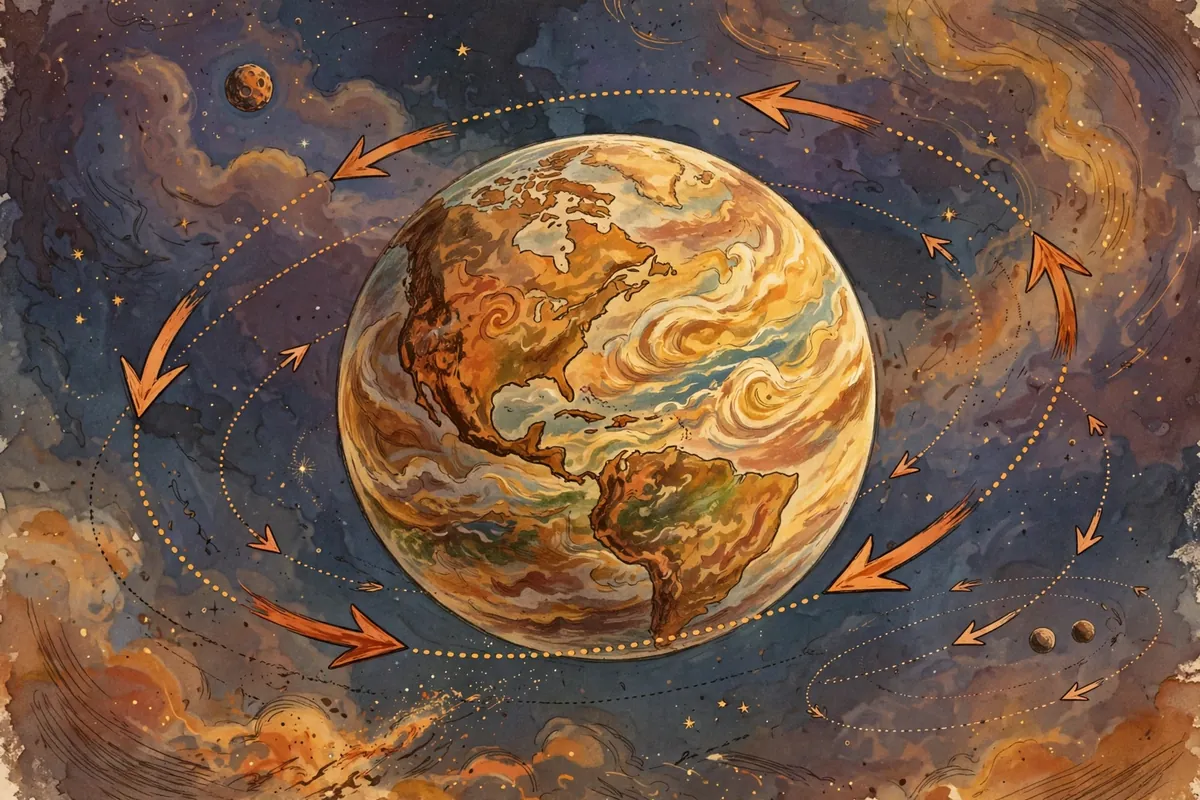
Closer to home, every planet orbits the Sun counterclockwise when seen from above the Sun's north pole. Six of them also spin on their axes in that same direction. Venus and Uranus are the exceptions.
Venus is tilted 177 degrees, which means it rotates almost exactly opposite to its orbit. It's also incredibly slow. A full solar day on Venus lasts about 117 Earth days, and because of that backward spin, the Sun there would rise in the west and set in the east. Uranus, tilted almost 98 degrees, essentially rolls around the Sun on its side.
A Moon That Goes the Wrong Way
Moons can be rebels too. Neptune's largest moon, Triton, orbits backward, and it's the only large moon in the solar system that does. Scientists think backward-orbiting moons formed elsewhere and were later captured by their planets.
Then there's the backward motion you can see for yourself. From Earth, planets like Mars sometimes seem to stop and reverse across the night sky. It's an illusion caused by our own moving viewpoint, but it gave us the word retrograde, from Latin for backward step.
So the next time you spot Venus glowing as the evening star, remember that it's spinning the wrong way. And somewhere out in Scorpius, a puffy giant is circling its star backward, proving the universe doesn't always follow our tidy diagrams.