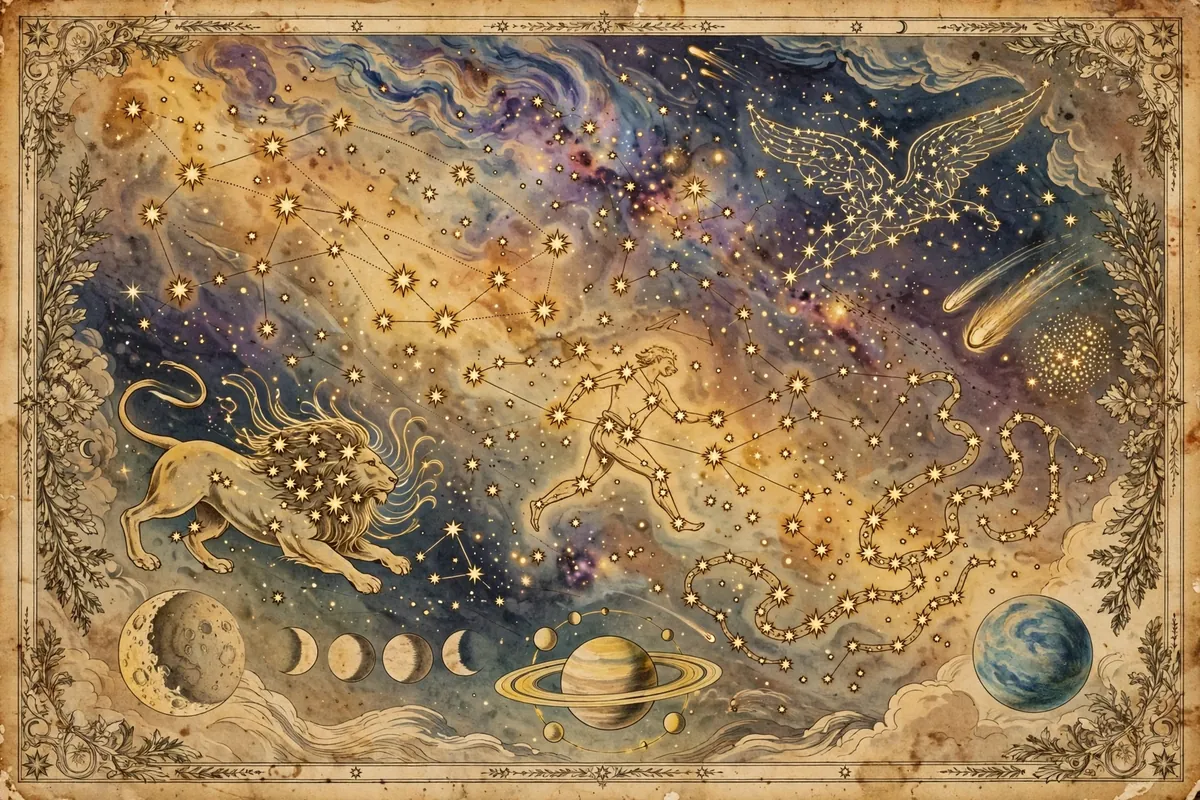
Orion, the Big Dipper, Scorpius: people have been tracing shapes in the stars for thousands of years. So you might expect the list of constellations to be ancient and fixed. In fact, the official count of 88 was only settled about a century ago.
The short answer is that astronomers needed order. For centuries, different countries and mapmakers used their own constellations, some overlapping and sharing the same stars. In the 1920s, the International Astronomical Union agreed on a single list of 88, and by 1930 official boundaries divided the entire sky among them, so every point in the sky belongs to exactly one constellation.
The Ancient Starting Point
Most of the northern constellations we use today came from the ancient Mesopotamians and later the Greeks. In the second century, the astronomer Ptolemy, working in Alexandria, Egypt, listed 48 constellations in a book known as the Almagest. That list stayed the standard for well over a thousand years, in both Europe and the Islamic world.
Because so many came down through Greek and Roman tradition, every modern constellation has a Latin name, from Leo to Ursa Major.
Filling the Southern Sky
Ptolemy's list had a big gap: the far southern sky, which can't be seen from the Mediterranean. Starting around the 15th century, European explorers sailing south began charting those stars, and astronomers invented new constellations to fill them in.
One of the busiest was French astronomer Nicolas Louis de Lacaille. Working from the Cape of Good Hope in present-day South Africa in the early 1750s, he observed more than 10,000 stars with a refracting telescope and introduced 14 new constellations that are still in use. His additions include Telescopium, named after the telescope, and Mensa, named after Table Mountain near Cape Town. It's the only constellation named after a feature on Earth.
Too Many Cooks
The trouble was that nobody was in charge. Countries like England, France, and the Netherlands promoted their own star patterns. Some astronomers squeezed new constellations into gaps between bright ones. In some cases, different constellations covered the same patch of sky.
In 1922, the newly formed International Astronomical Union adopted a list with three-letter abbreviations. In 1928, it formally accepted 88 constellations, and Belgian astronomer Eugène Delporte drew their borders along straight lines of celestial longitude and latitude. The final version was published in 1930. The new borders removed any confusion between astronomers in different countries. Now, when a star or galaxy is said to be “in” a constellation, everyone means exactly the same patch of sky.
The Ones That Didn't Make the Cut
Plenty of old constellations were dropped. Argo Navis, a giant ship from Ptolemy's original list, was so large that Lacaille split it into three: Carina, the keel; Puppis, the stern deck; and Vela, the sails. It's the only one of Ptolemy's 48 no longer officially recognized.
Others vanished entirely, though some left clues behind. Antinous, which Ptolemy mentioned as part of Aquila, the eagle, appeared on star charts until the 1922 shake-up. The Quadrantids meteor shower is named after Quadrans Muralis, a constellation created in 1795 that no longer exists.
Of the 88 that survived, 36 lie mostly in the northern sky and 52 mostly in the southern. So when you look up on a clear night, you're seeing a sky that's ancient and, at the same time, neatly organized by a committee less than a hundred years ago.