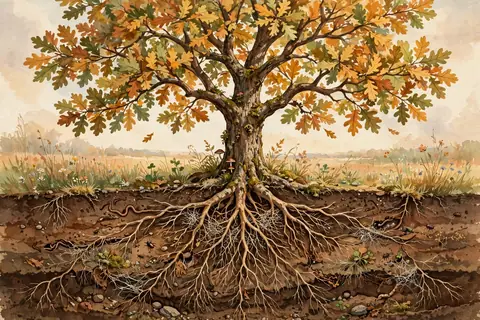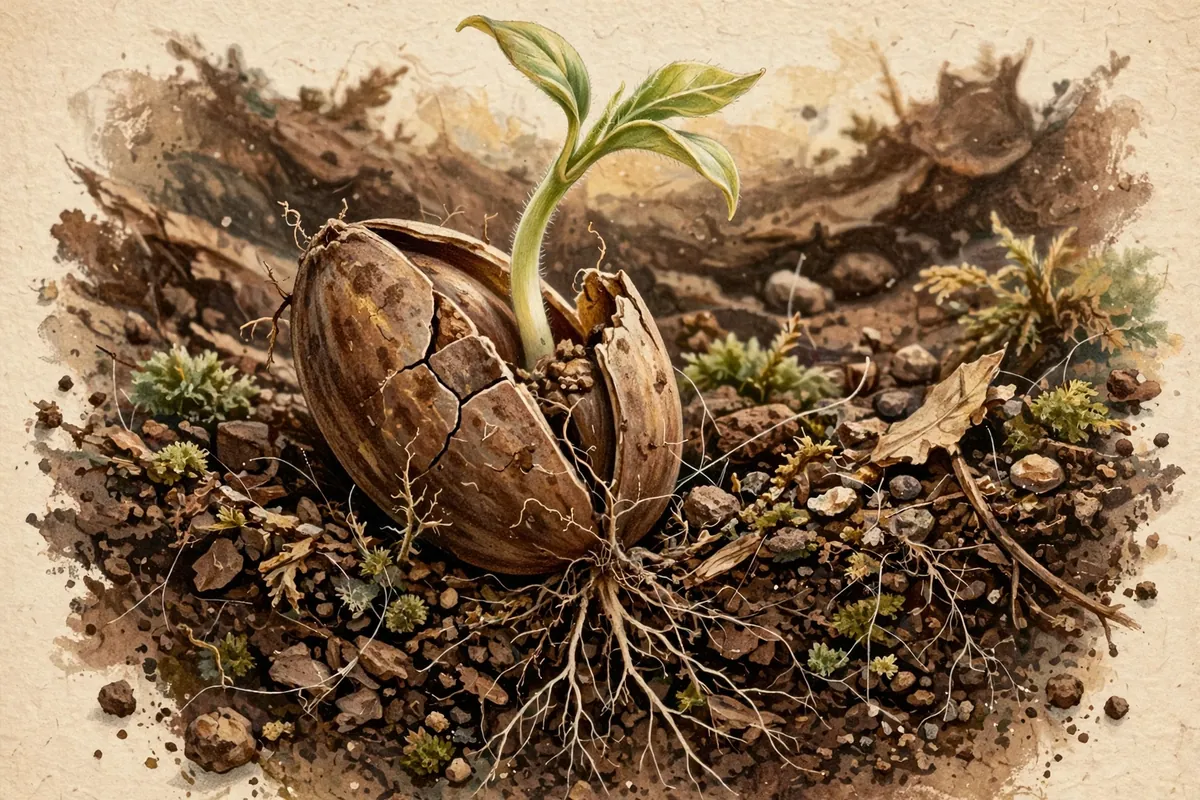
When you push a seed into the garden, you probably don't check which end is up. You just drop it in and cover it with soil. Yet a few days later, the root dives downward and the shoot climbs toward the surface, even though it's pitch dark underground. How does the seed know?
The short answer is gravity. Plants can sense which way gravity is pulling, and they grow in response to it. This is called gravitropism. Roots grow toward the pull of gravity, downward, while stems grow the opposite way, upward. Once the shoot reaches daylight, light helps guide it too.
Darwin Was on the Case
Charles Darwin, famous for his work on evolution, was one of the first to scientifically document this behavior. He showed that roots grow downward with gravity and stems grow upward against it.
You can see it for yourself with any potted plant. Lay it on its side and wait. Within a short time, the growing tips of the stem begin curving back upward. Most of that turn happens because the plant grows more on one side than the other, not because the stem simply bends.
Tiny Starch Grains That Act Like a Level
So how does a plant feel gravity? One of the main ways is through tiny dense grains called statoliths. They're small structures inside cells that make and store starch. Because they're heavier than the fluid around them, they settle toward the bottom of the cell, wherever down happens to be.
These grains sit in special cells, including cells in the cap at the very tip of the root. When the root is tilted, the grains slide to a new "bottom." Scientists think that movement triggers a signal telling the plant how it's oriented, a bit like the bubble in a carpenter's level.
Experiments back this up. Plants with genetic changes that make these grains less dense are less sensitive to gravity.
The Hormone That Does the Steering
Sensing is only half the job. The plant also needs to turn. That's where a plant hormone called auxin comes in. In the 1920s, two scientists working separately, Nikolai Cholodny in Kyiv and Frits Went at the California Institute of Technology, proposed how it works.
When a root is tipped sideways, auxin moves toward its lower side. In roots, extra auxin slows growth, so the top side grows faster and the root curves downward. In stems, it's the opposite: more auxin on the lower side speeds up growth there, so the stem curves upward. The same hormone produces opposite results in roots and shoots.
Growing Toward the Light
Once a sprout breaks through the soil, it gets a second guide: light. Growing toward light is called phototropism. Auxin is involved here too, building up on the shaded side and making those cells stretch longer, so the shoot leans toward the sun. Together, gravity and light keep a plant growing in the right direction.
Growing plants in space is a real challenge partly because of how gravity shapes root growth. Still, in 1982, cosmonauts aboard the Soviet Salyut 7 space station grew a small plant called Arabidopsis that became the first plant to flower and produce seeds in space.
So the next time you plant a row of beans, don't worry about which way they're facing. Each seed carries its own built-in compass, and it has been finding its way up for a very long time.