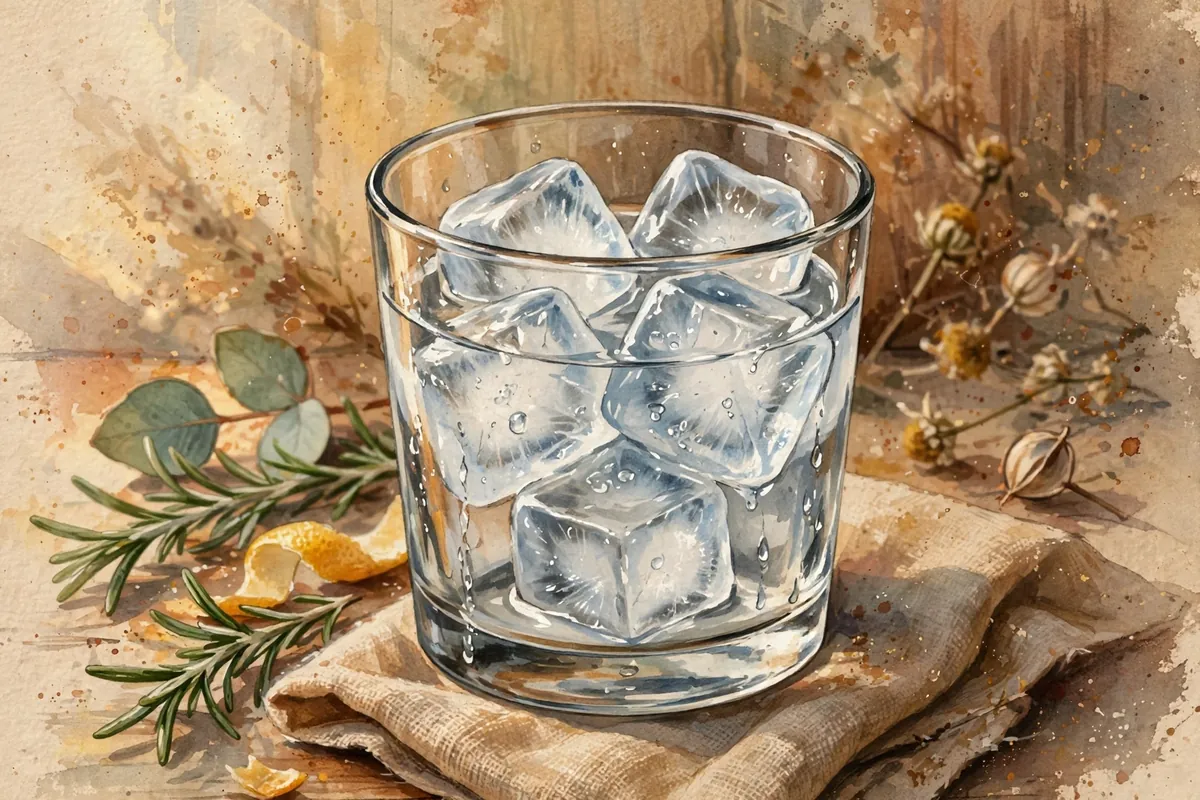
Hold a homemade ice cube up to the light, and you'll usually see a cloudy white patch in the middle, sometimes with tiny streaks or specks. Now picture the ice in a fancy cocktail bar, as clear as a pane of glass. It's all just frozen water. So why do they look so different?
The cloudiness is mostly trapped air. Tap water contains dissolved gases and minerals. As water freezes, those gases can no longer stay dissolved, so they form microscopic bubbles. In a freezer tray, the ice forms quickly and traps those bubbles inside, creating the cloudy look. Clear ice is made in ways that let the bubbles and impurities escape before they get locked in.
How a Cloudy Cube Forms
When water cools to its freezing point and ice begins to form, the gases dissolved in it come out as tiny bubbles. Ice floats, so a layer of ice forms across the top of the water first. Once that lid of ice is in place, the bubbles have nowhere to go. As the cube keeps freezing, they end up trapped in the ice.
Freezing speed makes a big difference. Ice frozen quickly is more likely to be cloudy. Water that is high in dissolved solids, like minerals, also tends to make cloudier ice.
It's not just ice cubes. Natural ice can range from transparent to an opaque bluish white, depending on impurities such as air bubbles or bits of soil.
How Clear Ice Is Made
Commercial ice makers have a clever solution. Many use a flowing stream of purified water over a cold surface, with the cooling at the bottom. As the cube grows, the moving water washes bubbles and leftover solids away instead of locking them in. Some machines remove up to 98 percent of the solids, making very hard, nearly pure, clear ice.
For really big, glassy blocks, some specialty machines use directional freezing. The water sits in a tub with the cooling unit underneath, while a pump keeps the surface moving so it can't freeze over. The ice grows from the bottom up, and the dissolved gases escape from the top. That's the kind of ice used in high-end bars and for ice sculptures.
Clear ice isn't just prettier. Ice without air bubbles is denser and tends to melt more slowly, which is why some bars prize it for drinks.
A Short History of the Ice Cube
Ice cubes are a product of mechanical refrigeration. In 1844, American physician John Gorrie built a refrigerator to make ice, hoping to cool sickrooms. Back then, bad air was thought to cause disease, and he believed cooler rooms could help patients. His machine made ice that hung from the ceiling in a basin, cooling the air of the room below it.
The flexible ice tray came later. Inventor Lloyd Groff Copeman noticed in 1928 that slush and ice flaked right off his rubber boots while he was out collecting maple sap. That observation led him to experiment with rubber cups and patent several kinds of trays that made it easy to pop cubes free. Later twist trays added a spring-loaded lever that flips and flexes the tray in one motion.
So the next time you notice a cloudy center in your drink, you'll know you're looking at a tiny cloud of trapped air. It's a nice reminder that even plain tap water carries more than meets the eye.