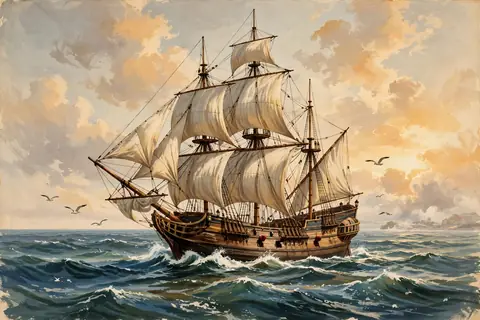
You may have heard that during World War II, American shipyards could build a cargo ship in just four days. It's one of the great stories of the home front, and it shows just how hard the country worked to win the war. But the full story is a little more complicated.
Here's the truth. One ship, the SS Robert E. Peary, was launched 4 days and 15 and a half hours after its keel was laid, a record. But it was a publicity stunt that wasn't repeated, and plenty of work remained after launch. Still, the real numbers are astonishing. By 1943, the typical Liberty ship took about 39 days to build, and three were being finished every day.
A British Design, Built the American Way
The Liberty ship began as a British idea. In 1940, Britain ordered 60 simple cargo ships from American yards to replace ships lost in the war. The design was based on a cheap-to-build, cheap-to-run British tramp steamer. Britain wanted coal-fired engines, since it had plenty of coal but little oil of its own.
American officials modified it to be even quicker and cheaper to make. A key change was replacing much of the riveting, which had made up a third of labor costs in earlier designs, with welding, and switched to oil-fired boilers. Production went to a group of West Coast companies led by industrialist Henry J. Kaiser, known as the Six Companies. Each ship was designed to carry 10,000 long tons of cargo, though in wartime they often carried much more.
Ships on an Assembly Line
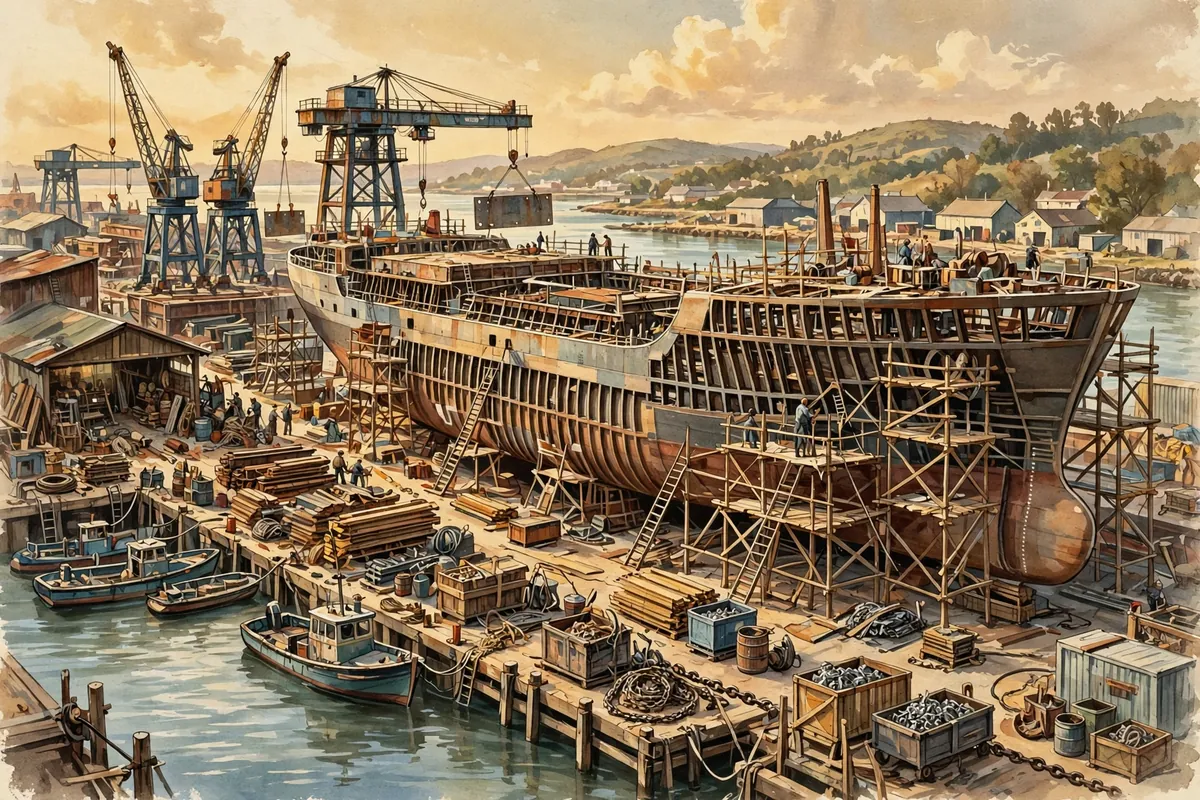
The ships were built assembly-line style from prefabricated sections welded together. Riveted ships had taken several months to build. The first Liberty ships needed about 230 days, but as workers gained experience, building times dropped fast.
Eighteen American shipyards built 2,710 Liberty ships between 1941 and 1945, an average of three ships every two days. That's by far the largest number of ships ever built to a single design. Many workers were newly trained, and as men left to fight, shipyards hired women to take their place.
The Ugly Duckling Gets a Name
At first, the public wasn't impressed by the ships' plain looks. President Franklin D. Roosevelt called the design "a dreadful looking object," and Time magazine dubbed it an "Ugly Duckling."
To win people over, September 27, 1941, was declared Liberty Fleet Day, when the first 14 ships were launched. The first was the SS Patrick Henry. Roosevelt quoted Henry's famous line, "Give me liberty or give me death!" and said these ships would bring liberty to Europe. The name stuck. Most were named after famous Americans, and 17 honored outstanding African Americans, including Booker T. Washington and Harriet Tubman.
Cracks, Lessons and Survivors
Speed came with problems. Early Liberty ships suffered hull and deck cracks, and three broke in half without warning. Researcher Constance Tipper of Cambridge University showed the cause wasn't the welds themselves, but steel that turned brittle in very cold water.
Built to last just five years, some served far longer. Two still sail today as museum ships, the SS John W. Brown and the SS Jeremiah O'Brien. In 1994, the Jeremiah O'Brien steamed from San Francisco to Europe for the 50th anniversary of D-Day. Not bad for an ugly duckling.