In the early days of flying, crossing the Atlantic Ocean in a small plane was a terrifying gamble. There were no satellites, no modern weather forecasts, and nowhere to land for nearly 2,000 miles. Charles Lindbergh had famously made the trip alone in 1927. Who would be the first woman to do the same?
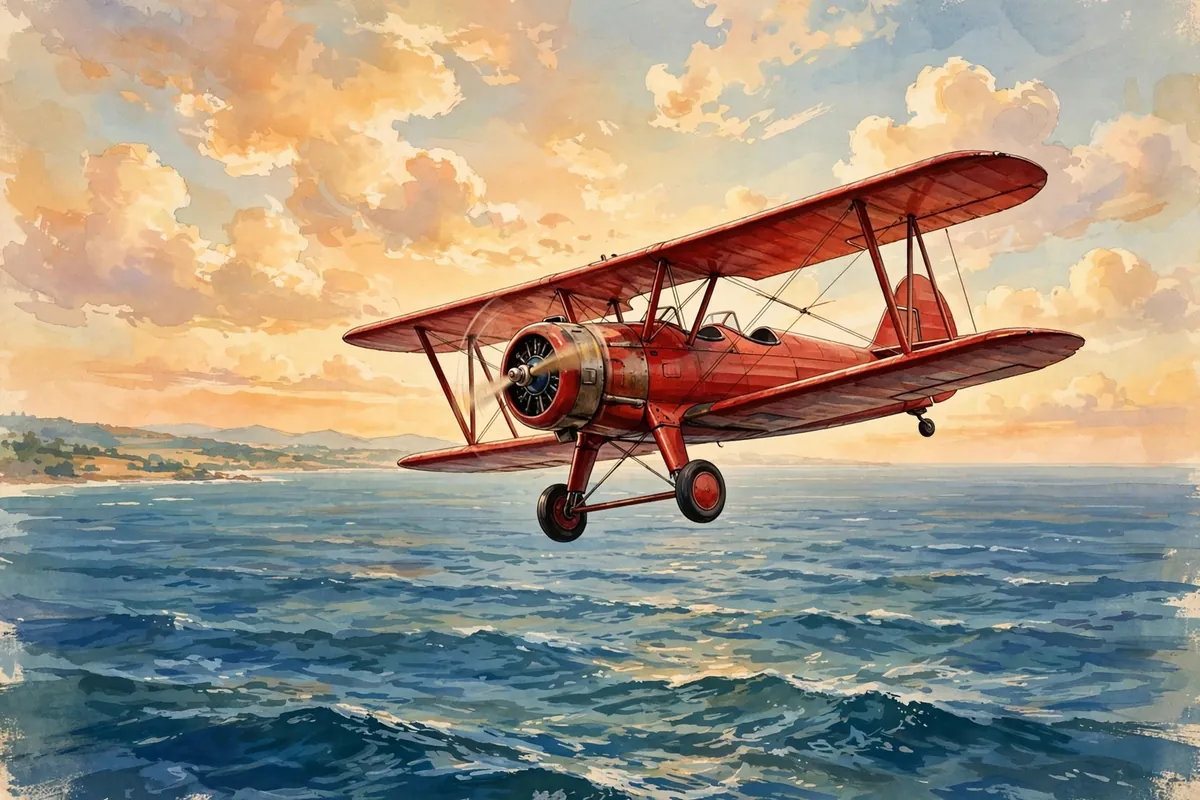
The answer is Amelia Earhart. On May 20, 1932, she took off from Harbour Grace, Newfoundland, in a single-engine Lockheed Vega 5B. Almost 15 hours later, after battling strong winds, ice, and mechanical trouble, she landed in a pasture near Derry, Northern Ireland. She became the first woman to fly nonstop and solo across the Atlantic.
"Just Baggage"
Earhart came to flying the hard way. She took her first lesson on January 3, 1921, from instructor Neta Snook, after working as a photographer, a truck driver, and a telephone company stenographer to save $1,000. Just to reach the airfield, she rode a bus and then walked four miles.
Four years earlier, in 1928, Earhart had already become the first woman to cross the Atlantic by airplane. But she wasn't flying. She rode along in a plane named Friendship, piloted by Wilmer Stultz with mechanic and co-pilot Louis Gordon.
The press made her a star anyway, but Earhart insisted the credit belonged to the pilots. "Bill did all the flying, had to," she said. "I was just baggage, like a sack of potatoes... maybe someday I'll try it alone."
The Solo Flight
In 1932, she kept that promise. At 34, Earhart set out to repeat Lindbergh's solo crossing, hoping to reach Paris. Before takeoff, a journalist gave her a copy of the local newspaper to prove the date of her flight.
Her technical adviser, the Norwegian-American aviator Bernt Balchen, helped prepare the plane. He also served as a decoy for reporters, who thought he was getting the Vega ready for his own Arctic flight.
The flight lasted 14 hours and 56 minutes. Earhart fought strong northerly winds, icy conditions, and mechanical problems. Instead of Paris, she came down in a pasture at Culmore, just north of Derry.
"From America"
Her arrival produced one of aviation's most charming moments. A farmhand walked up and asked, "Have you flown far?" Earhart replied, "From America." The landing was witnessed by two local men, Cecil King and T. Sawyer, who had a front-row seat to history.
Honors poured in. Congress awarded her the Distinguished Flying Cross, France made her a Knight of the Legion of Honor, and President Herbert Hoover presented her with the National Geographic Society's Gold Medal. That same year, she also became the first woman to fly nonstop across the United States, coast to coast.
A Pioneer for Women Pilots
Earhart used her fame to promote aviation, especially for women. She helped found the Ninety-Nines, an organization for women pilots, and wrote best-selling books about her flights. She became good friends with First Lady Eleanor Roosevelt, who even got a student pilot permit after flying with her.
Her story has a sad ending. On July 2, 1937, Earhart and navigator Fred Noonan disappeared over the Pacific Ocean while trying to fly around the world. But her 1932 crossing still stands as a landmark moment, proof that the young woman who once called herself baggage could take the controls and cross an ocean on her own.