For more than a century, Mount St. Helens was a postcard-perfect peak in southwestern Washington, with a snowy, symmetrical cone and a sparkling lake at its foot. People hiked its trails, fished Spirit Lake, and stayed at the lodges nearby. Then, in the spring of 1980, the mountain woke up. What happened on that famous Sunday morning?
The short answer is that at 8:32 a.m. on May 18, 1980, an earthquake caused the mountain's swollen north face to collapse in the largest landslide in recorded history. That suddenly released gas-charged molten rock, which blasted sideways toward Spirit Lake. About 57 people were killed, and it's often considered the most disastrous volcanic event in U.S. history.
Two Months of Warnings
Mount St. Helens had been quiet since the 1840s and 1850s. Then, in March 1980, small earthquakes began, signaling that magma might be moving underneath. On March 27, steam explosions blasted a new crater in the summit and sent ash thousands of feet into the air.
Magma pushing up at a shallow depth created a large bulge on the mountain's north slope. Earthquakes kept coming through April and May, at times several a day of magnitude 4 or above. State officials ordered people out of the danger zone, except for a few scientists and security workers. Yet at dawn on May 18, the measurements showed no clear sign that a catastrophe was minutes away.
The Morning the Mountain Fell
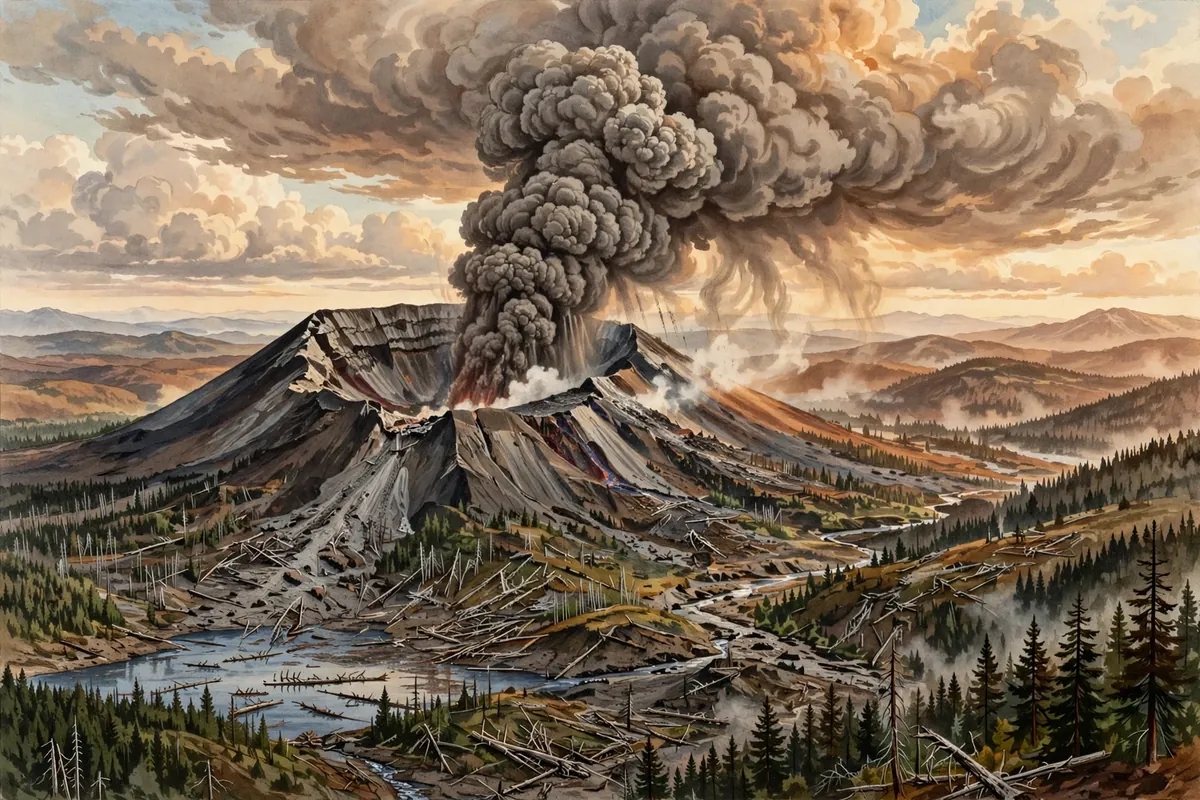
At 8:32 a.m., a magnitude 5.1 earthquake shook loose the weakened north face. As the slope slid away, the pressure on the magma inside was released all at once, like popping the cork on a shaken bottle. A hot blast of rock and gas raced north, overtaking the landslide itself.
An eruption column rose about 80,000 feet into the sky and dropped ash across 11 states and parts of Canada. Snow and whole glaciers melted, creating mudflows called lahars that reached the Columbia River, nearly 50 miles away. The mountain's summit dropped from 9,677 feet to 8,363 feet, leaving a horseshoe-shaped crater a mile wide.
The People Lost
Among the roughly 57 people who died was David A. Johnston, a U.S. Geological Survey volcanologist on duty at an observation post about six miles north of the mountain. Photographers Reid Blackburn and Robert Landsburg were also killed.
Perhaps the most famous victim was Harry R. Truman, a World War I veteran who ran a lodge near Spirit Lake. He refused every plea to leave, including one final attempt by law enforcement the day before. He and his 16 cats, whom he considered family, were buried under the avalanche.
A Landscape Reborn
The eruption destroyed 200 homes, 47 bridges, 15 miles of railway, and 185 miles of highway, and caused more than $1 billion in damage. The heat energy it released was equal to 26 megatons of TNT. Hundreds of square miles became wasteland, and thousands of animals died.
Yet nature bounced back in surprising ways. The ash actually helped many lakes and streams, and within six years most lakes in the area had returned to normal. The area is now protected as the Mount St. Helens National Volcanic Monument, and Washington marks May as Volcano Awareness Month. The mountain that blew its top has become one of the best places on Earth to watch a landscape heal.