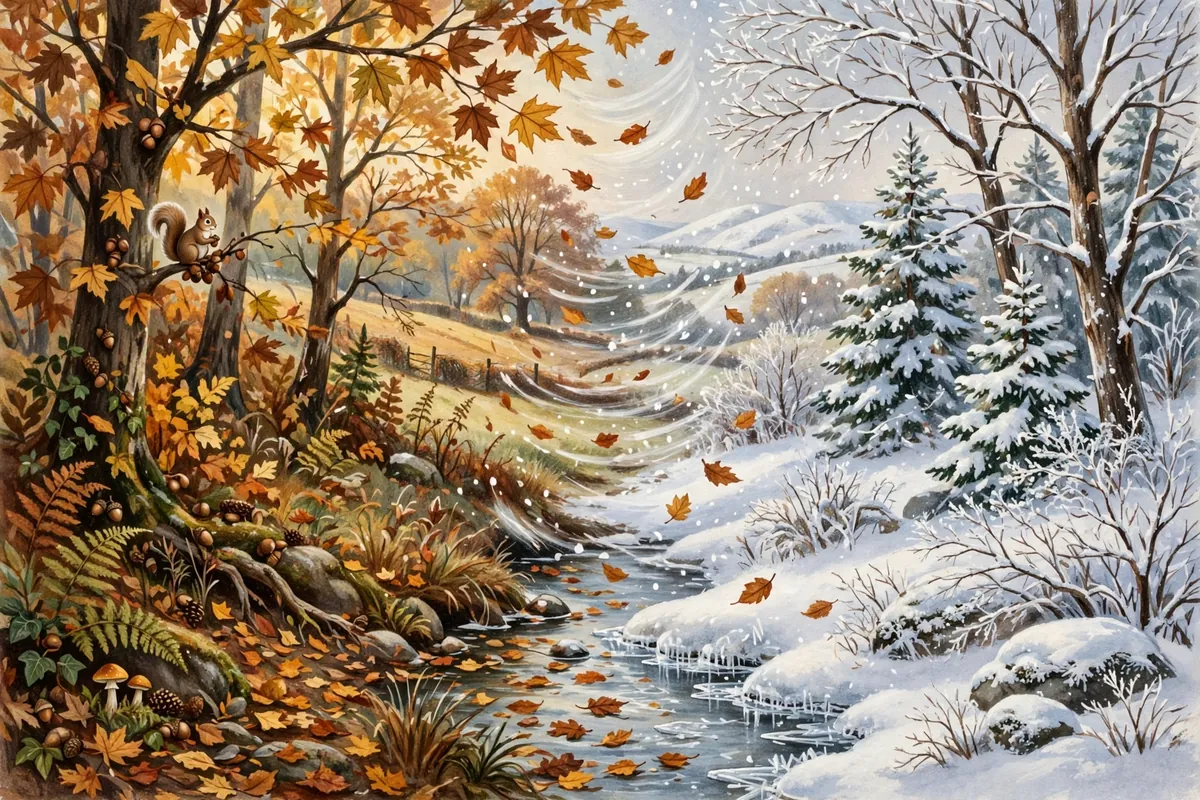
Every year it seems to happen faster. The leaves turn, you finally pull out a favorite sweater, and then, almost overnight, it's snowing. Many people swear that autumn is the shortest season. So is that just a feeling, or is fall really shorter in some places?
The short answer is that it's partly real. Measured from the September equinox to the December solstice, autumn in the Northern Hemisphere lasts about 89.85 days, nearly four days shorter than summer. That's because Earth's orbit isn't a perfect circle, and Earth moves faster when it's closer to the Sun. On top of that, local climate can make autumn feel much shorter in some places, especially far north.
Earth Speeds Up in Winter
Earth travels around the Sun in a slightly stretched-out path called an ellipse, as Johannes Kepler discovered. It reaches its closest point to the Sun, called perihelion, in early January, and its farthest point, aphelion, in early July. When Earth is nearer the Sun, it moves faster along its orbit.
That means the stretch of the year around northern winter goes by more quickly. Right now, it takes about 92.75 days to go from the March equinox to the June solstice, 93.65 days to reach the September equinox, 89.85 days to reach the December solstice, and just 88.99 days to get back to the March equinox. Northern summer is the longest season, and northern autumn and winter are the shortest.
It's Flipped Down Under
In the Southern Hemisphere, the calendar is reversed. Autumn there runs from the March equinox to the June solstice, which takes about 92.75 days. So astronomical autumn in places like Australia and Argentina is nearly three days longer than autumn in the United States.
This won't last forever. Over thousands of years, the timing of Earth's orbit slowly shifts. About ten thousand years from now, northern winter will happen when Earth is farthest from the Sun, and the season lengths will change along with it.
When Weather Decides
Of course, nobody feels the exact date of an equinox. What we notice is the weather. Some countries define seasons by temperature instead of by the calendar. In Sweden and Finland, autumn officially begins when the average daily temperature drops below 50°F and stays there, and winter begins when it stays below freezing.
Under that system, the seasons begin on different dates in different parts of the country, and they're only known after the fact. In a cold northern spot, the gap between those two temperature lines can be short, so autumn may seem to come and go in a hurry.
Meanwhile, many places near the equator barely have an autumn at all. Earth's tilt doesn't change their sunlight much through the year. Instead, many tropical regions have a wet season and a dry season.
Who Decides When Fall Starts?
Even the start date depends on who you ask. Weather forecasters count autumn as September, October, and November. Astronomers start it at the September equinox. And in old English tradition, autumn ran from Lammas Day in early August to around Halloween.
So if fall always feels too short, you're not entirely wrong. Earth really does hurry through this part of its orbit. The best advice is the oldest: enjoy the apple cider, the bright leaves, and the crisp mornings while they last.