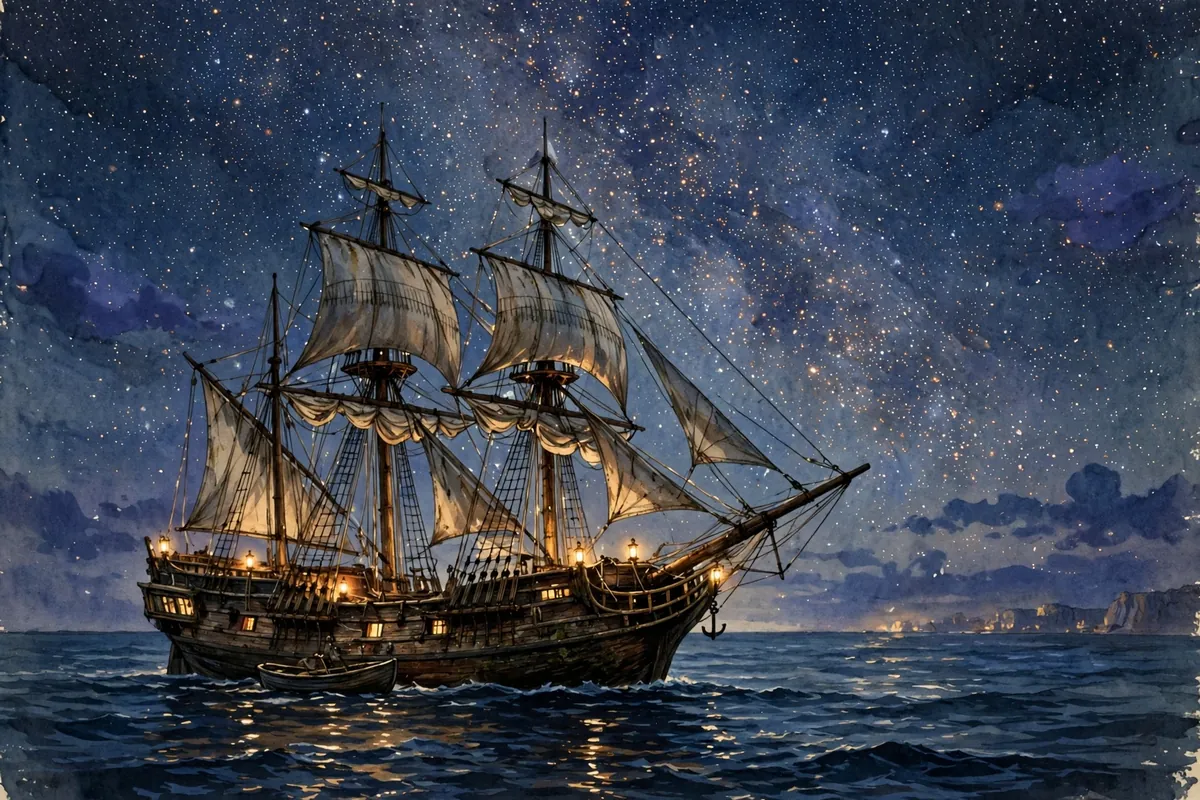
Picture an old sailing ship far out at sea, nothing but water in every direction. Above it, the stars glitter and twinkle. It's a romantic image, and it's true that sailors relied on those stars to find their way. But did the twinkling itself help?
The short answer: no. Twinkling is caused by Earth's restless atmosphere bending starlight, and it played no helpful part in navigation. What guided sailors was the position of the stars. By measuring the angle between a star and the horizon, a navigator could work out where the ship was. That practice is called celestial navigation.
Why Stars Twinkle at All
Stars are so far away that they appear as tiny points of light. On its way to your eyes, that light passes through layers of moving air at different temperatures. Those layers act like shifting lenses and prisms, nudging the light this way and that. The result is the flicker we call twinkling, or scintillation.
Twinkling is always strongest near the horizon. Light from a star low in the sky has to travel through much more atmosphere than light from a star overhead. That's why stars low in the sky tend to sparkle the most.
The North Star Trick
The simplest star method was finding latitude, your position north or south of the equator. Sailors in the Northern Hemisphere could measure the height of Polaris, the North Star, which always stays within about one degree of the north celestial pole.
The rule is wonderfully simple. If Polaris sits 10 degrees above the horizon, you're about 10 degrees north of the equator. Navigators then refined that number using tables. The catch is that Polaris can't be used in the Southern Hemisphere, where it's not visible above the horizon.
The Harder Problem: Longitude
Figuring out how far east or west you are was much tougher. Celestial navigation can only find longitude if the navigator knows the exact time at the prime meridian. Every four seconds of clock error can throw the position off by about one nautical mile.
That's why accurate shipboard clocks, called chronometers, became so important. When a reliable clock wasn't available, navigators could use the lunar distance method, measuring the Moon against other bodies to work out the time.
Navigators measured these angles with an instrument called a sextant. Today's nautical almanacs list the Sun, Moon, planets, Polaris, and 57 other navigational stars for this purpose.
Each sighting gives a line on the chart, and the ship is somewhere along it. Take a sight on a second star and you get a second line. Where the two lines cross is where you are. Most navigators liked to use three or more sights to be safe.
Stars Versus Planets
Twinkling does offer one handy bit of sky lore. Planets usually don't flicker much. Because they're much closer, they appear as tiny disks rather than single points, and the jiggles from different parts of the disk average out. A steady, bright light in the night sky is often a planet.
An Old Skill That Came Back
You might think satellite navigation made star sightings obsolete. For a while, it seemed that way. The U.S. Naval Academy dropped celestial navigation from its formal curriculum in 1998.
But in 2015, worried that satellite systems could be hacked, the Academy brought the course back. So the next time you see the stars twinkling, enjoy the sparkle, then remember that the real magic was in their steady, predictable places in the sky.