A day is 24 hours. It's one of those facts that feels permanent, like the sunrise itself. But the length of a day hasn't always been the same, and it isn't standing still now. Something is very gradually stretching it, and the culprit is the Moon.
Here's the short version. The Moon's gravity raises tides in Earth's oceans, and the friction from those tides acts like a gentle brake on our planet's spin. As Earth slows down, our days get longer. At the same time, the Moon drifts slowly farther away. Atomic clocks show the modern day is about 1.7 milliseconds longer than it was a few centuries ago.
A Tug-of-War With the Tides
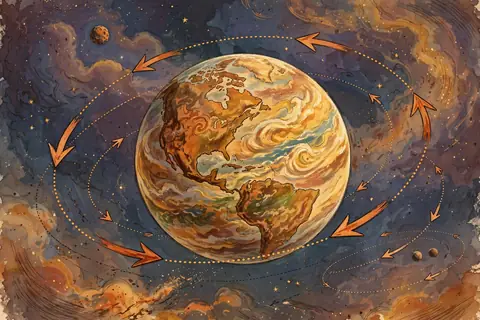
The Moon pulls on Earth's oceans, creating a bulge of water. Because Earth spins much faster than the Moon orbits, that bulge gets dragged a little ahead of the Moon. The Moon's gravity tugs back on the bulge, and the resulting friction slowly steals some of Earth's spin.
That energy doesn't vanish. Some is turned into heat, much of it in shallow seas like the waters around the British Isles, off Argentina, and in the Bering Sea. The rest is handed to the Moon, which moves into a higher orbit. Measurements using lasers bounced off reflectors on the Moon show it's spiraling away from Earth at about 3.8 centimeters a year, roughly an inch and a half.
Clues From Ancient Eclipses
How do we know this has been going on for a long time? One clue comes from ancient astronomers. Babylonian and Chinese sky-watchers recorded solar and lunar eclipses starting in the 8th century BC.
If you calculate where and when those eclipses should have been seen, assuming the day has always been the same length, the answers come out wrong by hours and thousands of kilometers. The records only make sense if Earth was spinning a bit faster back then. Analysis of these records suggests the day has grown by about 2.3 milliseconds per century since then.
When a Day Was About 22 Hours
The rocks tell an even bigger story. Along some coastlines, strong tides lay down alternating layers of sand and silt called tidal rhythmites. These layers record daily, monthly, and seasonal cycles, almost like tree rings.
Rhythmites from about 620 million years ago suggest that back then, a day lasted only about 21.9 hours, and a year held about 400 days. The Moon was closer, too. On average, it has been receding at about half today's rate since then. Scientists think the current faster rate may be because of how our ocean basins happen to resonate with the tides right now.
Will Days Keep Growing Forever?
In theory, the slowdown would continue until Earth's day matched the Moon's month, with the Moon hovering over one spot on the planet. Pluto and its moon Charon are already locked that way. But on Earth, it won't get that far. In about 1 to 1.5 billion years, the brightening Sun will likely boil away the oceans, removing most of the tidal brake.
Earth's spin also wobbles in the short term. In 2020, it began rotating slightly faster, and on June 29, 2022, it set a record by completing a rotation 1.59 milliseconds short of 24 hours. Timekeepers even introduced leap seconds in 1972 to keep clocks in step with Earth's uneven spin.
So the next time you wish there were more hours in the day, take heart. The Moon is working on it. It's just going at a very, very relaxed pace.