Most living things would last only moments in outer space. There's no air, no pressure, and the Sun's ultraviolet light blasts down without any filter. So it's startling to learn that one animal has been sent into space, exposed to all of it, and come home alive.
That animal is the tardigrade, also called the water bear or moss piglet. Tardigrades have survived exposure to outer space by drying out and shutting their bodies down almost completely. They aren't invincible, though. The vacuum barely bothered them, but strong ultraviolet light from the Sun killed most of them.
Meet the Water Bear
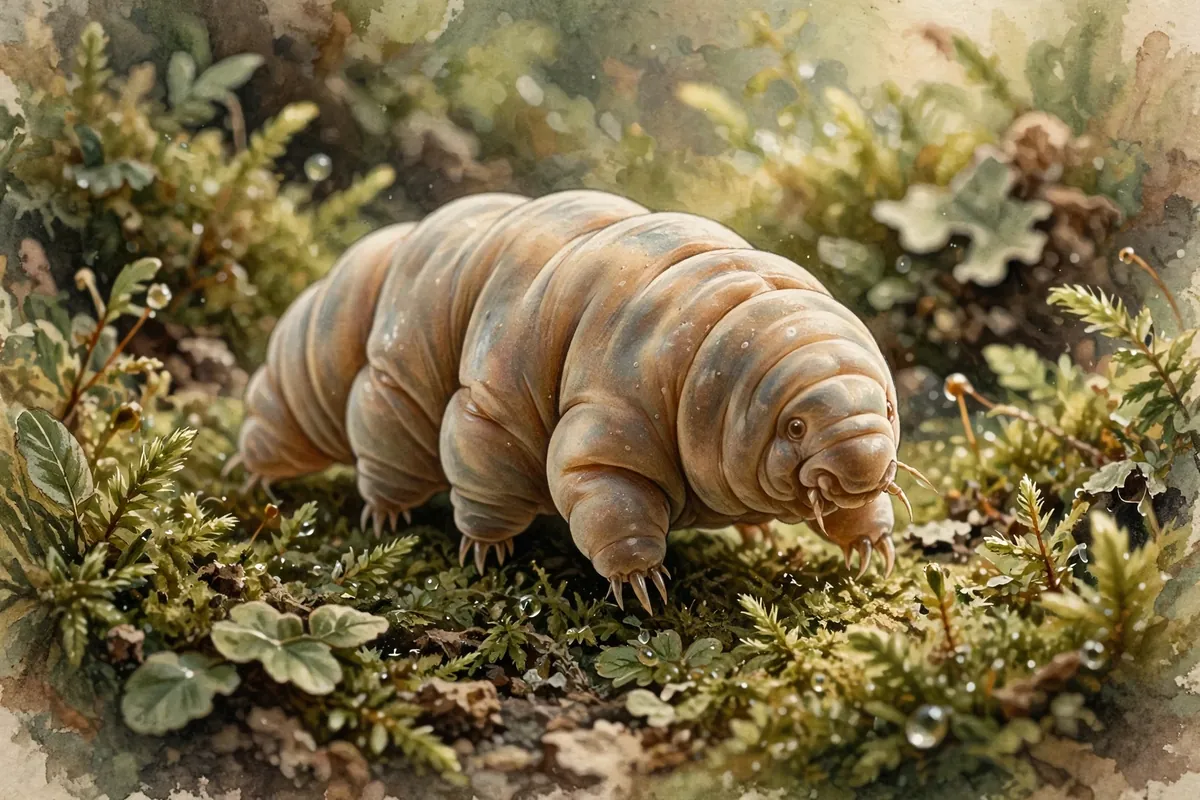
Tardigrades are micro-animals with plump, segmented bodies and eight stubby legs, each ending in claws. Most are between 0.05 and 0.5 millimeters long, so you'd need a microscope to see one clearly. The largest species reach only about 1.3 millimeters.
They were first described in 1773 by the German zoologist Johann August Ephraim Goeze, who called them "little water bears" because of the way they walk, which looks a bit like a bear's lumbering gait. A few years later, the Italian biologist Lazzaro Spallanzani gave them the scientific name Tardigrada, meaning "slow walkers."
Today scientists know of about 1,500 species. They live almost everywhere, from mountaintops and tropical rainforests to the deep sea and Antarctica. Your best chance of meeting one is in a damp clump of moss.
The Secret: Playing Dead, Very Dry
The tardigrade's superpower is a state called cryptobiosis. When the moss or pond it lives in dries out, a tardigrade pulls in its legs and shrivels into a dry little barrel called a tun. In this state, no measurable metabolic activity takes place. It can go without food or water for several years.
As a tun, a tardigrade becomes remarkably tough. It can handle temperatures from about minus 458°F to 300°F, at least for short periods, along with lack of oxygen, vacuum, radiation, and high pressure. Add water later, and it can come back to life.
Tardigrades also carry a special protein nicknamed Dsup, short for "damage suppressor." It binds to their DNA and helps protect it from radiation damage. Medical researchers are interested in proteins like this one for their protective potential.
The Trip to Space
In 2007, dried-out tardigrades and their eggs flew aboard a European mission called FOTON-M3. For 10 days, some were exposed to the vacuum of space alone, while others faced vacuum plus different amounts of the Sun's ultraviolet light.
Back on Earth, scientists added water and watched. The vacuum by itself had no significant effect, which is astonishing on its own. Ultraviolet light was another story. Many of the animals exposed to it died, and full-strength solar UV was especially deadly. Only three individuals of one species survived that test.
In 2011, tardigrades went up again on a Space Shuttle mission to the International Space Station, showing they could handle microgravity and cosmic radiation. In 2019, a capsule of dried tardigrades was even aboard the Israeli lunar lander Beresheet, which crashed on the Moon.
Small, Ancient, and Surprisingly Clever
Tardigrades have been around a very long time. The oldest known fossil dates to the Cambrian period, about 500 million years ago. They've also shown they can learn. In one experiment, a species was trained to curl into its protective tun shape in response to a blue light.
So the next time you step over a patch of moss, remember that it may be home to some of the toughest animals on the planet. They're tiny, slow, and a little chubby, and they've been to space and back. Not bad for a moss piglet.