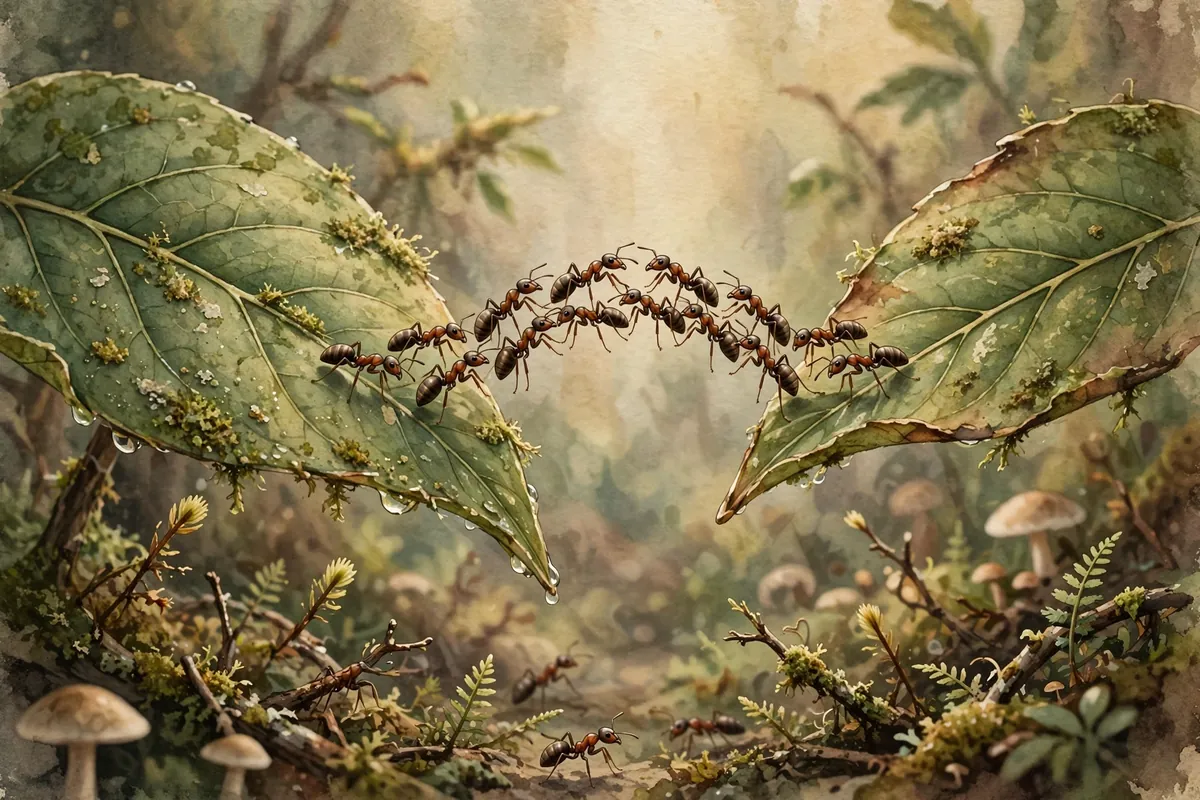
An ant is small enough that a twig, a crack in the bark or a gap between two leaves can look like a canyon. You might expect a busy column of ants to stall out at every obstacle. Some species, though, have a stunning trick for getting across.
They build the bridge out of themselves. Certain ants grab hold of one another and link their bodies into chains that span small gaps, so their nestmates can walk right over them. The same knack for holding on lets ants build rafts, pull leaves together and even create living nests.
The Army Ants Who Become the Road
Army ants are the best-known bridge builders. One species from the American tropics, Eciton hamatum, is known for making living bridges with its bodies over small gaps. It hunts in columns, often up in the trees, where it raids the nests of wasps and other ants for their young.
Army ants are unusual in other ways too. Instead of sending out a few scouts, they send out a cooperative, leaderless crowd of foragers that finds and overwhelms prey all at once. Their colonies can number in the millions, all descended from a single queen, so there's never a shortage of bodies to plug a gap.
A Nest Made of Ants
Army ants don't keep a permanent home. During their traveling phase, they move by day and settle down at dusk, changing camp almost daily. When they stop, they build a living nest called a bivouac.
The ants hold onto each other's legs and form a kind of ball, often in a tree trunk or a burrow. It may look like a messy heap, but it's actually well organized. Older workers stay on the outside, younger workers stay inside, and tunnels run through the middle to chambers holding food, eggs, larvae and the queen. At the slightest disturbance, soldiers with powerful jaws gather on top to defend it.
Weaver Ants and Their Leaf-Pulling Chains
Weaver ants use living chains for construction. They build nests in trees out of living leaves. First, workers test leaves by tugging on the edges with their jaws. Once a few ants manage to bend a leaf, others nearby pitch in.
When two leaves are too far apart for one ant to reach, the workers form chains by grabbing one another at the waist. Several chains working together can ratchet large leaves into place. Then comes the clever part. Workers carry larvae to the seam and tap them on the head, which makes the larvae release silk that stitches the leaves together. A large nest can go up in well under a day.
Rafts That Ride Out a Flood
Linking up isn't only for crossing gaps. Some ants form chains to bridge spaces over water, underground or through plants. Others form floating rafts that help them survive floods, and scientists think these rafts may even help ants reach and settle new islands.
The red imported fire ant is famous for this. When it senses rising water, the colony builds a raft and floats. That matters, because a mature fire ant colony can hold anywhere from about 500,000 to 2 million ants.
Teamwork Without a Boss
What makes all this so impressive is that no single ant is in charge. Ants communicate largely through chemical signals, and each worker responds to what's going on around it. Weaver ants, for example, are more likely to join a leaf-pulling effort when the group already working is large.
So the next time you see a trail of ants on the sidewalk, take a closer look. Somewhere in the world, their cousins are holding on tight, turning themselves into bridges, boats and buildings, one tiny body at a time.