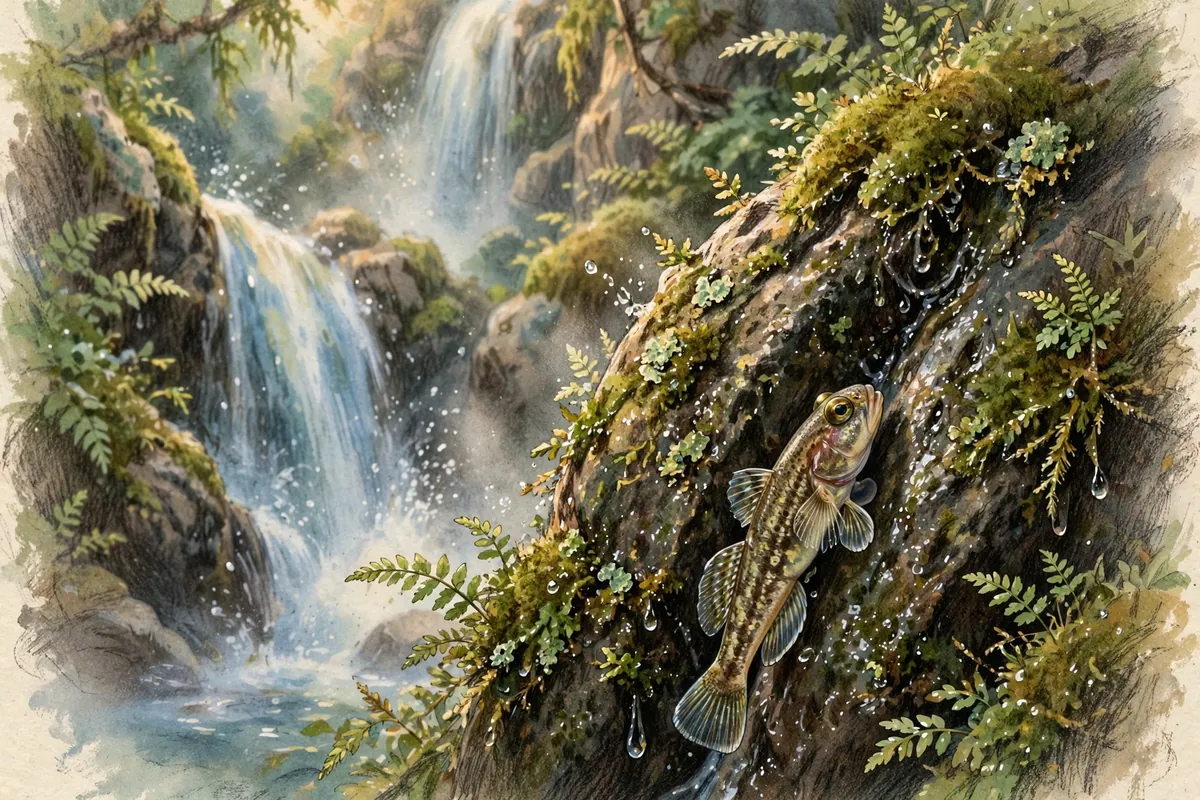
Stand at the bottom of a tall Hawaiian waterfall and you'll see water crashing down onto the rocks. It's hard to imagine anything living going the other way. Yet some tiny fish do exactly that, inching their way up the wet stone beside the falls.
The climbers are gobies, small fish found only in Hawaii. Several species have suction disks on their bellies, formed from their pelvic fins, that let them cling to slippery rock. One of them, the Hawaiian freshwater goby, has even been found above the 442-foot Akaka Falls on the Big Island.
A Round Trip From the Mountains to the Sea
Why would a fish bother? It's all about their unusual life cycle. These gobies are amphidromous, which means they split their lives between fresh water and the ocean.
Adults live and spawn in clear, fast mountain streams. When the eggs hatch, the tiny larvae are swept downstream into the sea, where they drift as part of the plankton. Once they grow a bit, the young fish head back into the streams and start the long trip home, up every waterfall in their way.
Two Ways to Climb a Cliff
The Hawaiian freshwater goby, also called the ʻoʻopu, uses what scientists describe as a powerburst. The fish pushes off with its pectoral fins, wiggles its body rapidly from side to side, and shoots upward. Then it grabs on again with its belly sucker. This method lets it climb faster and reach farther upstream than other freshwater fish in Hawaii.
Its cousin, the Nopili rock-climbing goby, takes a slower approach and uses its mouth. Before it climbs, the young fish goes through a quick makeover. In about two days, its mouth moves from the front of its head to underneath its body. Then it inches up the rock using both a mouth sucker and a belly sucker, almost like a tiny climber with two sets of hands.
That same downward-facing mouth changes what the fish eats. As a baby at sea it filtered plankton from the water. As a climber, it grazes almost entirely on algae growing on the rocks.
Snacks on the Way Up
Climbing a waterfall takes a lot of energy, and these fish seem to have a built-in solution. They eat algae, and the wet rock faces of waterfalls are covered in it. Scientists think the gobies may be able to refuel by grazing on the falls as they climb.
Once they reach the quiet pools upstream, Nopili gobies settle in for several years. They tend little gardens of algae on the tops of stones and boulders, and the males guard these patches fiercely. During breeding season, the males show off brilliant blue and red colors that shift with the fish's mood.
A Fragile Way of Life
Hawaii has only seven native freshwater fish species, and five of them are gobies. Three are built for steep mountain torrents, while two others can't get past the steep falls at all.
Their lifestyle comes with a catch. Because these fish depend on clean streams that run all the way from the mountains to the sea, they are extremely sensitive to anything that disturbs that path. The Nopili goby, for example, has become rare on Oahu, although some reports suggest the Hawaiian freshwater goby's numbers have been rising.
They're not alone on the climb, either. A Hawaiian shrimp called the ʻōpaekalaʻole has also evolved to climb Akaka Falls and live in the stream above it.
So the next time you see a waterfall, take a closer look at the wet rocks along the edges. Somewhere in the world, a fish no bigger than your finger is making its way up, one determined little hop at a time.