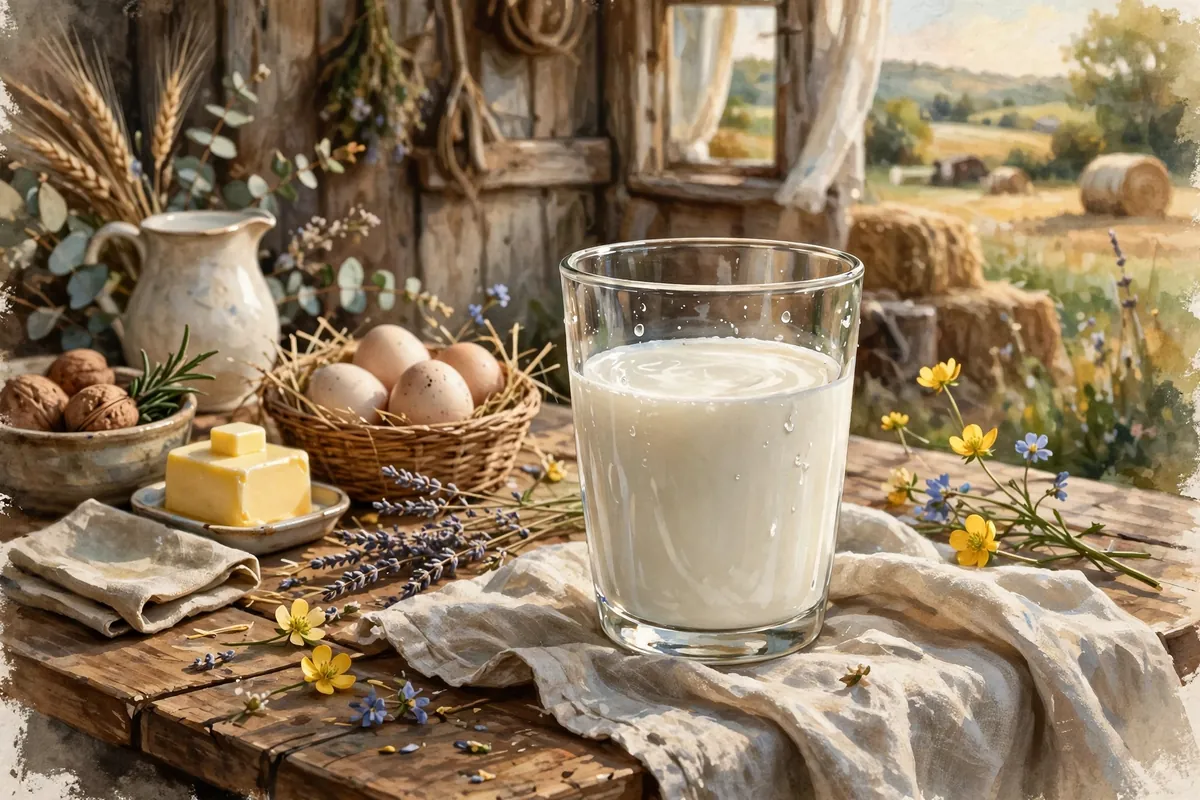
Pour a glass of water and you can see right through it. Pour a glass of milk and it's a solid, creamy white. Milk is mostly water, after all. So why does it look so different?
Here's the short answer: milk is full of microscopic particles floating in water. The two big ones are tiny droplets of butterfat, called fat globules, and even smaller clusters of milk protein, called casein micelles. They're just large enough to deflect light. Light bounces off them in every direction instead of passing straight through, and all that scattered light makes milk look opaque and white.
A Liquid Full of Tiny Bits
Scientists describe milk as an emulsion or colloid. That means it's a water-based fluid with butterfat globules spread throughout, along with dissolved sugar and clumps of protein and minerals. Raw cow's milk holds even more surprises, including living white blood cells, various bacteria, and a large number of active enzymes.
In cow's milk that hasn't been homogenized, the fat globules average just two to four micrometers across. A micrometer is a thousandth of a millimeter, so you'd need a microscope to see one. The casein micelles are smaller still. Countless numbers of these little particles act like a crowd of tiny mirrors, scattering light until the whole glass glows white. Casein, by the way, is the same protein that makes up a major part of cheese.
Why Skim Milk Looks Blue
Here's a fun test. Next time you have skim milk, hold it up to the light. It may have a slightly bluish tint.
That's because fat-free milk has only the casein micelles left to scatter light. These small particles tend to scatter shorter, bluer wavelengths more than red ones, which gives skim milk its faint blue cast.
Milk has other hidden colors, too. The fat globules carry a bit of yellow-orange carotene. In some breeds of cattle, such as Guernseys and Jerseys, there's enough to give their milk a golden or creamy hue. And riboflavin, a vitamin in the watery part of milk, has a greenish color that can sometimes be spotted in skim milk or whey.
How Homogenizing Changes It
Left alone, fresh milk separates, and a layer of cream rises to the top. Homogenization prevents that. Milk is pumped at high pressure through very narrow tubes, which breaks the fat globules into much smaller ones, averaging around 0.4 micrometers.
Those smaller, more numerous particles make homogenized milk whiter. It also feels creamier in the mouth, though it tastes a bit blander than unhomogenized milk. The process was invented in the late 1800s and shown off by Auguste Gaulin at the 1900 World's Fair in Paris. Within 40 years, it had spread to other countries.
Milk Through the Ages
People have long been fascinated by milk's color. In the Middle Ages, it was sometimes called white blood, based on a mistaken belief that it was blood redirected to the breast. It was also nicknamed the virtuous white liquor.
Not all milk is pure white, either. Depending on the animal, it can come in shades of yellow, cream, pink, or brown.
So the next time you pour milk over your cereal, take a second to admire it. That cheerful white is really a light show, put on by countless tiny particles too small to see.