When the Hubble Space Telescope launched in 1990, it was supposed to give us the clearest view of the universe ever seen. Then the first images arrived, and they were fuzzy. Somewhere along the way, something had gone badly wrong, and the telescope was already hundreds of miles above Earth.
The problem was Hubble's main mirror, which had been ground to the wrong shape. The fix came in December 1993, when the crew of the space shuttle Endeavour caught up with the telescope and made five spacewalks to repair it. They installed a corrective device and a new camera with built-in correction, which brought Hubble's vision up to its intended quality.
A Tiny Mistake With Huge Consequences
Hubble's mirror was one of the most precisely shaped mirrors ever made, smooth to about 10 nanometers. But its outer edge was too flat by about 2,200 nanometers, roughly 1/11,000 of an inch. That small error caused spherical aberration, where light from the edge of the mirror focuses at a different point than light from the center.
An investigation found the culprit. A testing device used to guide the mirror's final polishing had been assembled incorrectly, with one lens out of position by 1.3 millimeters. So the mirror was polished very precisely, just to the wrong shape. A few earlier tests had actually flagged the problem, but those results were dismissed.
Glasses for a Telescope
Many people feared Hubble would be abandoned. Instead, NASA astrophysics director Charles Pellerin pulled together a team and found $60 million for a repair mission. Luckily, Hubble had been designed from the start to be serviced by astronauts. It's the only telescope built to be maintained in space that way.
Since the mirror couldn't be replaced, engineers worked around it. They built a device called COSTAR, with mirrors shaped to cancel out the error, a bit like a pair of glasses for the telescope. To make room for it, astronomers sacrificed one of Hubble's original instruments. They also built a new main camera, the Wide Field and Planetary Camera 2, with its own correction built inside.
Five Record-Setting Spacewalks
The mission, called STS-61, lasted almost 11 days. When Endeavour approached, astronaut Jeffrey Hoffman spotted Hubble through binoculars and noticed that one of its solar panels was bent at a 90-degree angle.
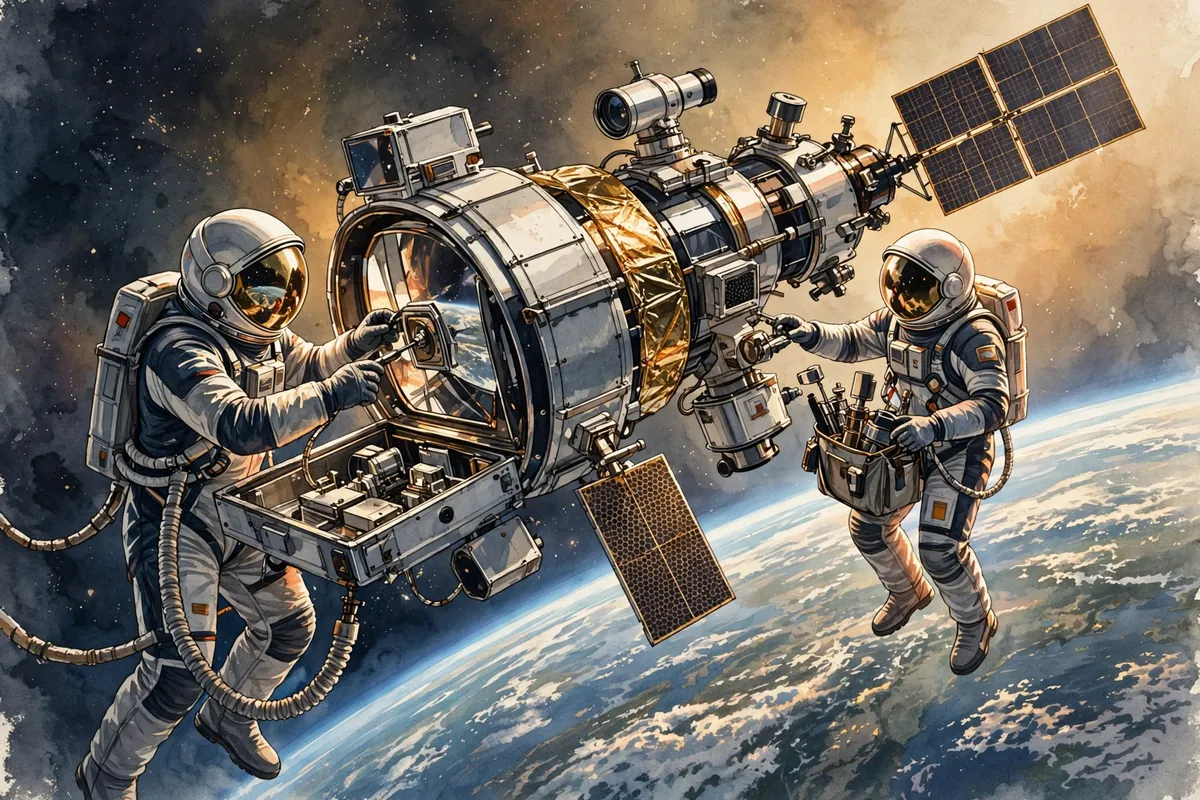
The crew made five spacewalks, a record at the time, with two pairs of astronauts taking turns to avoid exhaustion. Story Musgrave and Jeffrey Hoffman replaced gyroscopes that keep Hubble pointed in the right direction. Kathryn Thornton and Tom Akers swapped out the wobbly solar panels. Over the following days, the crew installed the new camera and COSTAR. Hoffman even spun a dreidel for Hanukkah for a live audience watching by satellite.
Repairs That Kept Going
That first trip was just the beginning. In all, five space shuttle missions repaired and upgraded Hubble, eventually replacing all five of its main instruments. Newer instruments had their own built-in correction, so by 2002 COSTAR was no longer needed. It came home in 2009 and is now on display at the Smithsonian's National Air and Space Museum.
The last servicing mission, flown by Atlantis in May 2009, replaced all six gyroscopes, installed new batteries, and added two new instruments. Hubble passed 30 years of operation in 2020, a remarkable comeback for a telescope that once looked like a costly mistake.