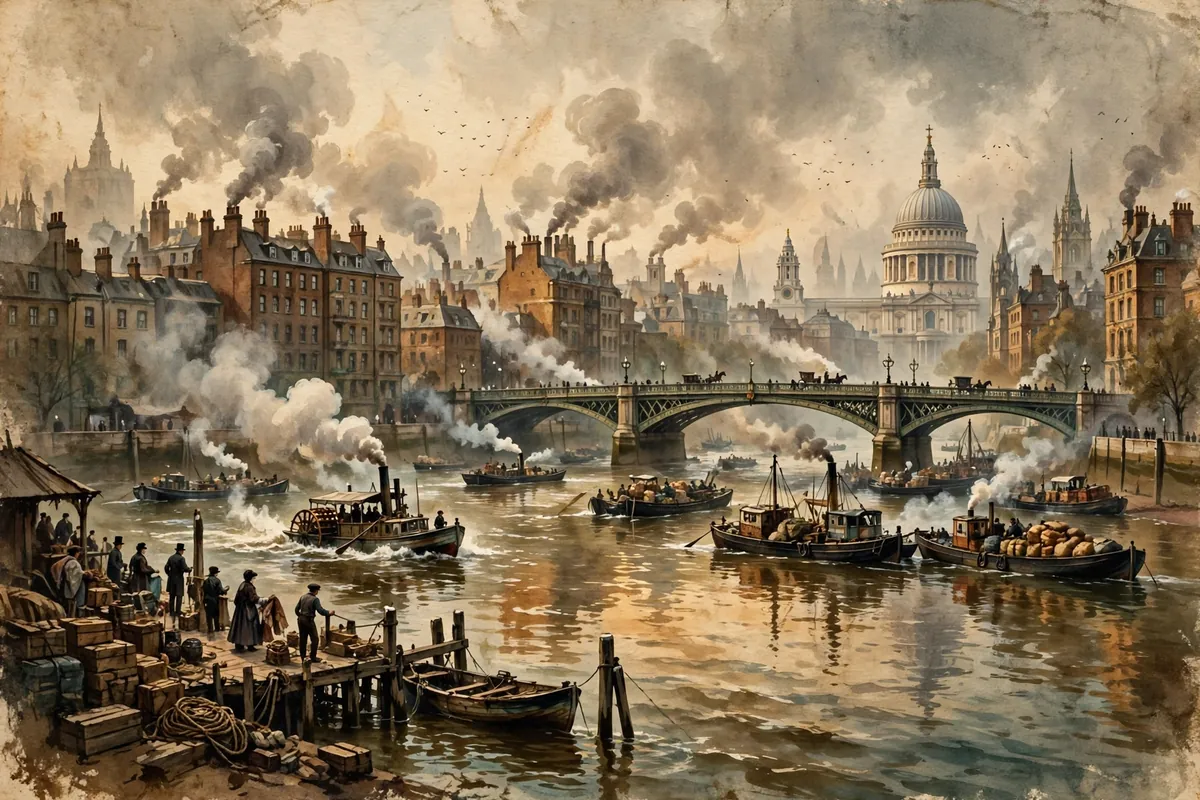
Picture London in the summer of 1858. It's sweltering, and the River Thames, flowing right past the Houses of Parliament, is giving off a smell so awful that people can barely stand near it. Lawmakers rush out of meetings with handkerchiefs pressed to their faces. The newspapers have a name for it: the Great Stink.
Here's what happened. For years, London's old, overwhelmed sewers had been emptying raw human waste and factory runoff straight into the Thames. During the hot, dry weather of July and August 1858, the river dropped and the filth baked on its banks. The smell became so unbearable that Parliament finally approved a massive new sewer system, designed by engineer Joseph Bazalgette, which still serves London today.
How the River Got So Bad
London had grown from just under one million people to three million. Flushing toilets had become popular, sending more water and waste into sewers that were already failing. The city also had around 200,000 cesspits, and factories and slaughterhouses added their own waste. Most of it ended up in the Thames.
The famous scientist Michael Faraday was so shocked that in 1855 he dropped pieces of white paper into the river to test how murky it was. He wrote to The Times that the whole river had become a real sewer. Charles Dickens described the Thames as a deadly sewer in place of a fine, fresh river.
A Heat Wave Made It Unbearable
In June 1858, temperatures in the shade averaged 93 to 97 degrees Fahrenheit. Combined with a long dry spell, the river level dropped, leaving raw sewage on its banks. Queen Victoria and Prince Albert tried to take a pleasure cruise on the Thames but turned back within a few minutes because of the smell.
Parliament sat right on the river, and it suffered badly. The curtains on the river side of the building were soaked in lime chloride to block the stench, but it didn't work. There was even talk of moving the government to Oxford or St Albans. Benjamin Disraeli, leader of the House of Commons, was reported leaving a committee room with his handkerchief clamped to his nose.
Workers spread hundreds of tons of lime near the sewer outlets to fight the smell. Meanwhile, The Times observed that Parliament had been all but compelled to act by the force of sheer stench. A new law passed on August 2, 1858.
The Fear Behind the Smell
The stench wasn't just unpleasant. Many Victorians believed in the miasma theory, the idea that diseases spread through foul-smelling air. London had suffered three deadly cholera outbreaks, killing thousands of people, and many blamed the bad air from the river.
One doctor saw it differently. Physician John Snow argued that cholera spread through contaminated water, not bad air. During an 1854 outbreak in Soho, he had the handle removed from a local water pump, and deaths dropped. Few people paid attention to his ideas at the time.
The Engineer Who Saved London
Bazalgette's plan carried the sewage east, away from the center of London, through huge tunnels that sloped gently toward outlets beyond the city. The project included about 1,100 miles of new street sewers feeding into 82 miles of main sewers, plus pumping stations to lift waste from low-lying areas. Work ran from 1859 to 1875.
He also built three riverside embankments, the Victoria, Chelsea, and Albert Embankments, with the sewers running inside them. The new system ended the dumping of sewage onto the shores of the Thames and brought an end to the cholera outbreaks. His work is thought to have saved more lives than the efforts of any other Victorian official.
So the next time you flush and forget about it, spare a thought for London's terrible summer of 1858. Sometimes it takes a truly unforgettable smell to get people to fix a problem for good.