Picture a muddy battlefield in Belgium in December 1914. Lines of trenches face each other across a strip of ground called no man's land, where stepping into the open could get you killed. Then, on Christmas Eve, candles start to flicker along the enemy trench.
The Christmas truce really happened. Around Christmas 1914, a series of unofficial ceasefires broke out along the Western Front of World War I. In many places, British, German, and French soldiers stopped shooting, sang carols, met in no man's land, traded food and souvenirs, and even played soccer. No generals ordered it. The soldiers did it themselves.
A War That Was Supposed to Be Short
The war had begun just five months earlier. By November, the armies had dug continuous lines of trenches running from the North Sea all the way to the Swiss border. The fighting had settled into a deadly stalemate, and both sides were running low on men and supplies.
There had been calls for peace. On December 7, 1914, Pope Benedict XV begged the warring governments for an official truce, asking that the guns fall silent at least on the night the angels sang. Both sides refused. The men in the trenches would take matters into their own hands.
Carols Across No Man's Land
Small, quiet truces had already been popping up for weeks. Soldiers on both sides would hold their fire while rations were brought up after dark, and some units paused each evening to recover their dead.
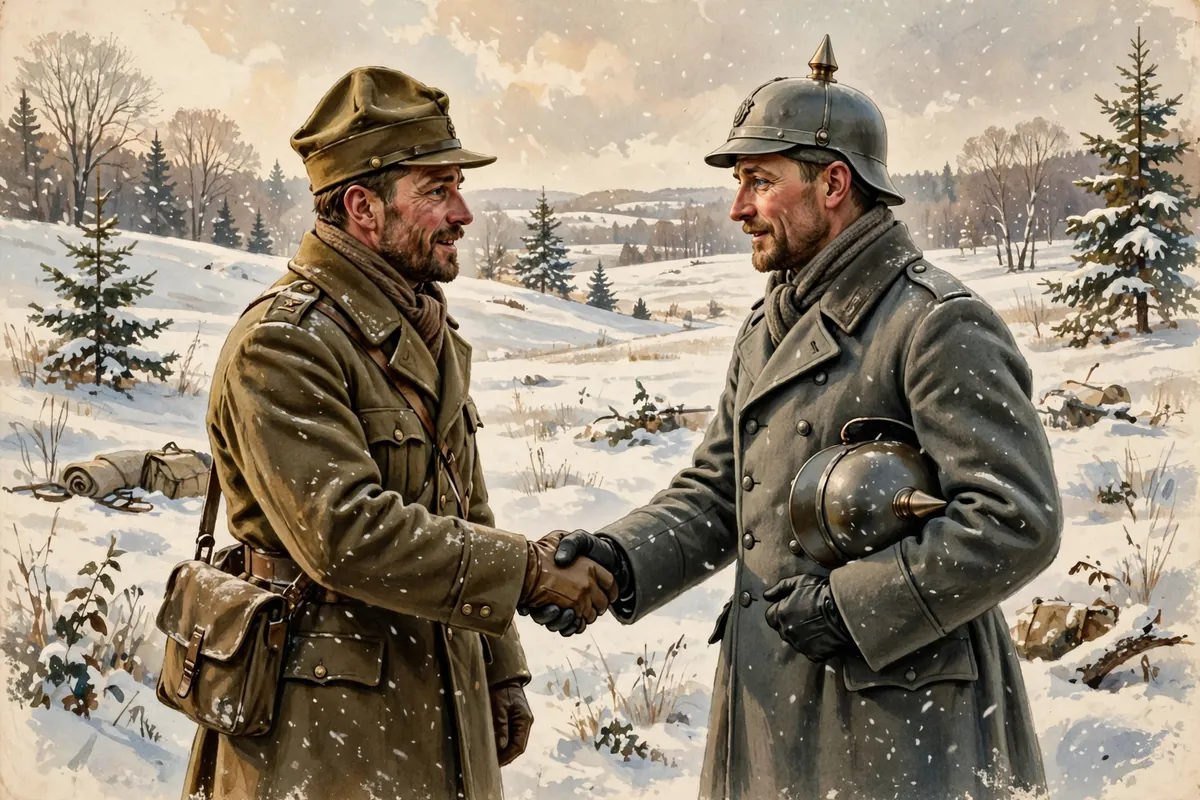
At Christmas, it grew into something much bigger. Roughly 100,000 British and German troops were involved. The Germans placed candles on their trenches and on Christmas trees and sang carols. The British answered with carols of their own. Soon men were climbing out, crossing the open ground, and shaking hands with the people they'd been shooting at days before.
They swapped food and souvenirs, held joint burial services for fallen comrades, and in some places even exchanged prisoners. On the Eastern Front, Russian soldiers left three Christmas trees in no man's land for their Austro-Hungarian enemies, with notes wishing them a Merry Christmas.
The Famous Soccer Games
Many accounts mention soccer matches played between the trenches. One of the earliest came in a doctor's letter published in The Times of London on January 1, 1915, describing a match played in front of the trench. In one report, a ration tin was used as the ball, and one Scottish regiment was said to have won 4 to 1.
Historians are careful with these stories, since some details have grown over the years. Writer Robert Graves, who served as an officer in the war, published a fictional version in 1962 in which the Germans won 3 to 2. Still, enough letters describe games that most agree some kind of soccer took place.
It Never Happened Quite Like That Again
The truce wasn't everywhere. Fighting carried on in some sectors, and in others the two sides only agreed to collect their dead. The next Christmas, a few units arranged ceasefires, but commanders had issued strict orders against them. By 1916, after the terrible losses of 1915, the war had grown too bitter for that kind of goodwill.
That's what makes 1914 so special. For one brief Christmas, in one of the most violent wars in history, ordinary men chose kindness. It's a story still told in songs, films, and even a Pulitzer Prize-winning opera, and it's a lovely reminder of what the season can bring out in people.