We remember Abraham Lincoln as the president who led the nation through the Civil War. We picture the tall hat, the beard, and the Gettysburg Address. Fewer people know that Honest Abe was also an inventor, with official paperwork to prove it. So how did a frontier lawyer end up with a patent?
The short answer is that Lincoln kept running into a very practical problem: boats getting stuck in shallow rivers. In 1849, he received a patent for a device to lift boats over sandbars and other obstacles using inflatable air chambers. It was never produced for real use, but it makes Lincoln the only U.S. president ever to hold a patent.
A Young Man on the River
As a young man, Lincoln worked on the water. In his late teens, he took a flatboat down the Ohio and Mississippi Rivers from Indiana all the way to New Orleans as a hired hand. A few years later, after moving to Illinois, he made another flatboat trip loaded with merchandise.
That second trip nearly ended early. Near the old town of Sangamon, the boat got hung up on a milldam. Lincoln unloaded some cargo, then drilled a hole in the bow with a borrowed auger so the water could drain out. He plugged the hole back up, and with local help, the empty boat was hauled over the dam. The trip to New Orleans went on.
The Steamboat That Sparked the Idea
Years later, in 1848, Lincoln saw another boat stuck on a shoal, according to his law partner and biographer William Herndon. The captain had his crew shove empty barrels, boxes, and loose planks under the sides of the steamboat to float it over the shallow spot. After a lot of hard work, the boat finally swung free.
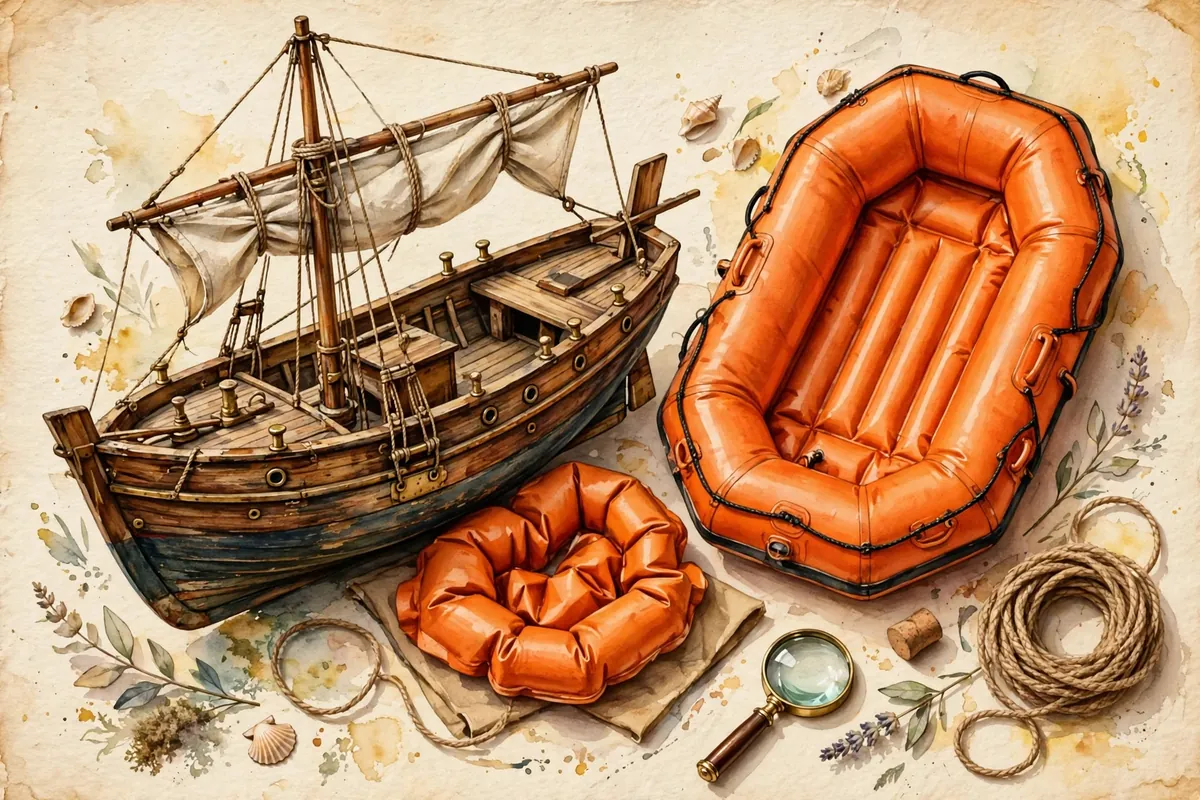
These experiences got Lincoln thinking. What if a boat carried its own floats? His answer was a set of waterproof fabric bladders mounted along the sides of a vessel. When a boat was stuck, or about to hit a shallow spot, the accordion-shaped air chambers could be inflated to lift it higher in the water.
Patent Number 6,469
Lincoln called his invention Buoying Vessels Over Shoals. He filed the application on March 10, 1849, and it was issued as Patent No. 6,469 on May 22 that same year. To go with it, he designed a scale model of a boat fitted with the device, built with help from a Springfield mechanic named Walter Davis. That model is now on display at the Smithsonian Institution.
Lincoln wasn't a stranger to the patent world. He sometimes worked as a patent attorney. He and his future Secretary of War, Edwin Stanton, both served as lawyers for inventor John Henry Manny in a lawsuit over the mechanical reaper.
Would It Have Worked?
Probably not very well. The device was never made for practical use, and a curator of maritime history at the Smithsonian concluded it would have needed too much force to operate as intended. Even so, the original documents for Lincoln's patent were rediscovered in 1997, giving historians a fresh look at this side of him.
Lincoln loved clever machines his whole life and gave speeches on inventions before he became president. In 1858, he observed, "Man is not the only animal who labors; but he is the only one who improves his workmanship."
So the next time you see a picture of Lincoln, add one more title to the list. Lawyer, president, and, for one hopeful moment in 1849, inventor of a boat that could float itself off a sandbar.