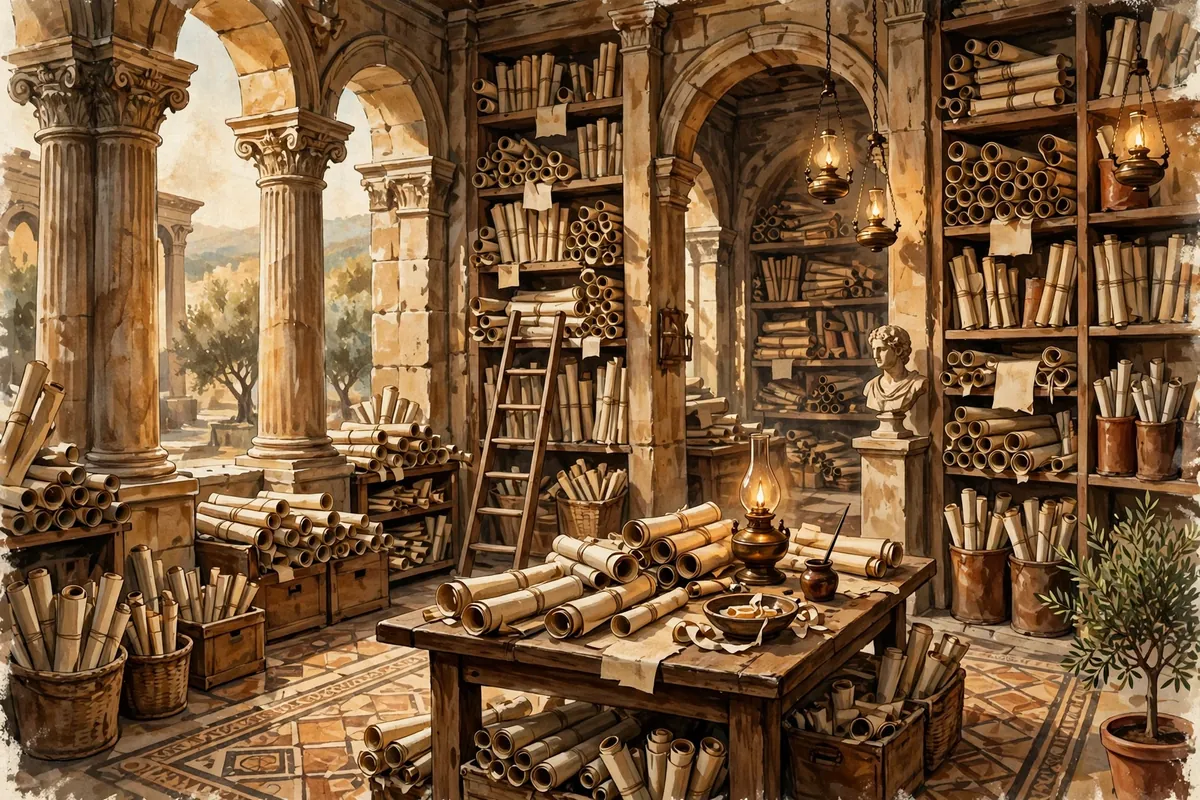
It's one of history's great "what ifs." Picture a vast hall in ancient Egypt packed with scrolls holding the knowledge of the world, and then picture it going up in flames. The burning of the Library of Alexandria has become a symbol of lost wisdom. But did it really happen that way?
The short answer is no, not in a single fire. Historians now think the Library declined gradually over several centuries. A fire set during Julius Caesar's war damaged part of it, but it survived. Lack of money, political purges, and later wars wore it down until little or nothing was left.
A Library That Wanted Every Book
The Library was founded in Alexandria, Egypt, under the Ptolemies, the Greek-speaking dynasty that ruled after Alexander the Great. Sources disagree on whether it was started under Ptolemy I or his son Ptolemy II. Its rulers aimed to collect all knowledge.
They went about it aggressively. Royal agents were sent out with large sums of money to buy texts on any subject. Older copies were favored, since they were assumed to be closer to what the author originally wrote. According to the ancient writer Galen, books found on ships arriving in port were taken to the Library and copied. The Library kept the originals and gave the owners the copies.
Brilliant minds worked there. Eratosthenes calculated the circumference of the Earth within a few hundred kilometers of accuracy. Callimachus wrote the Pinakes, sometimes considered the world's first library catalog.
Caesar's Fire Wasn't the End
In 48 BC, Julius Caesar was trapped in Alexandria during a civil war. His soldiers set fire to ships in the harbor, and the flames spread toward the docks. One ancient account claimed 40,000 scrolls from the Library were destroyed.
But the ancient writers don't agree on the damage. The historian Cassius Dio wrote that warehouses of grain and books near the docks burned, which scholars read as storage buildings rather than the Library itself. A few decades later, the geographer Strabo visited the research institution the Library belonged to, so it clearly survived in some form.
A Slow Fade
The decline had started even before Caesar. In 145 BC, a purge of intellectuals under Ptolemy VIII drove the head librarian into exile, and other scholars fled too. Under Roman rule, the Library's fortunes sank along with the city's status, and funding dried up.
Its membership appears to have ended by the 260s AD. Then, between 270 and 275 AD, an invasion and a counterattack probably destroyed whatever remained. A smaller "daughter library" in a temple called the Serapeum may have lasted longer, but the Serapeum was demolished in 391 AD. Whether it still held a real library by then isn't recorded.
The Legend That Came Later
There's also a famous story that an Arab army burned the books in 642 AD to heat the city's baths. Historians are skeptical. The tale first appeared roughly 500 years after the event, and the Library was likely long gone by then.
There's a hopeful note, too. Some historians think much of the Library's knowledge may have survived through other great libraries, eventually reaching Europe from the 12th century onward. The story of Alexandria isn't just about loss. It's a reminder that knowledge lasts when people keep copying, sharing, and caring for it.