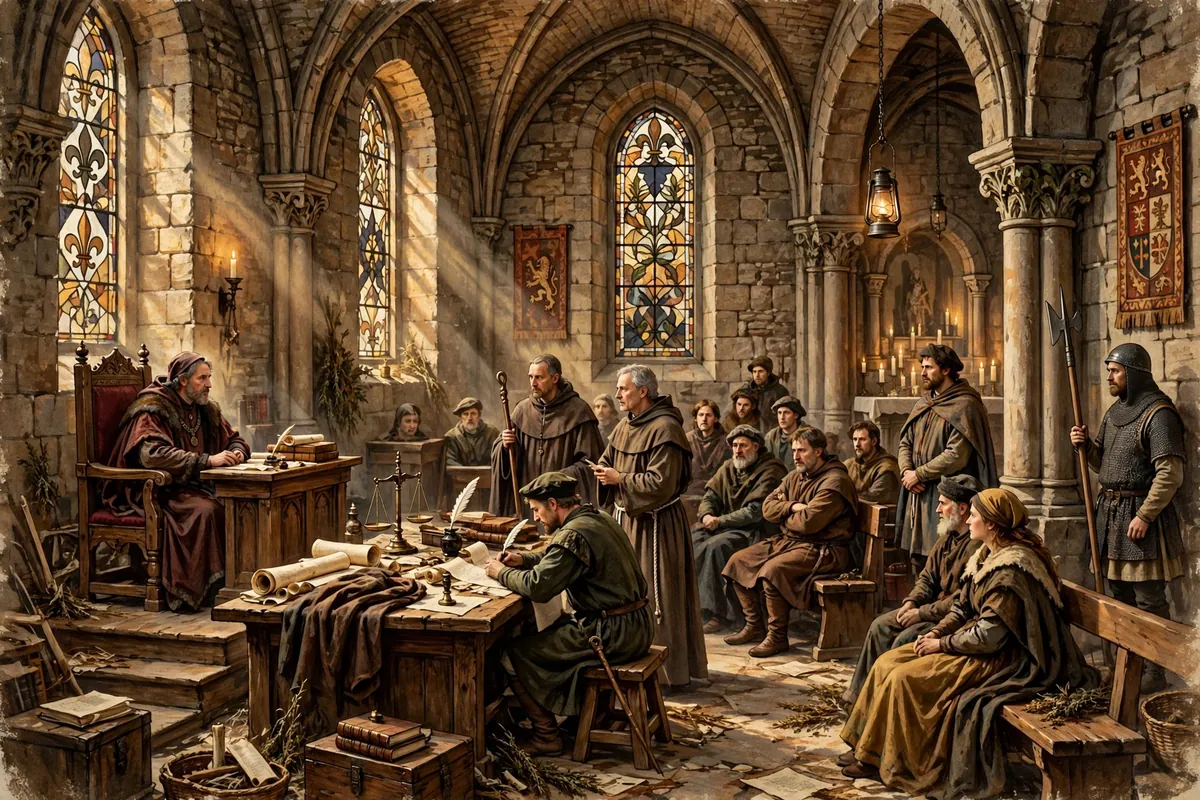
Imagine walking into a grand church in Rome and finding a trial underway. The judge is the pope. The defendant is also a pope, dressed in papal robes and seated on a throne. There's just one problem: the defendant has been dead for months.
It really happened. In January 897, Pope Stephen VI had the body of Pope Formosus, who had died about nine months earlier, dug up and brought before a church court at the Basilica of St. John Lateran. The corpse was found guilty and his entire papacy was declared null. The event became known as the Cadaver Synod.
A Very Turbulent Time
The trial took place during a stretch of serious political instability in Italy. Between 872 and 965, two dozen popes were appointed. From 896 to 904, Rome averaged about one new pope a year, often because of scheming between rival local factions.
Formosus had a long and complicated career before becoming pope in 891. Decades earlier, he had quarreled with Pope John VIII, been accused of plotting against him, and been excommunicated. After John died, Formosus returned to his post as bishop and eventually rose to the top. He also got tangled up in the politics of who would wear the imperial crown, crowning one ruler and later inviting a rival to invade Italy.
The Trial of a Corpse
Formosus died in 896. His successor, Boniface VI, died just two weeks later. Then came Stephen VI, who ordered his predecessor's predecessor removed from his tomb.
With the corpse propped up on a throne, a deacon was appointed to answer for him. Formosus was accused of perjury, of serving as a bishop while actually a layman, and of illegally moving between church posts. According to the historian Liutprand of Cremona, Stephen demanded to know why Formosus had usurped the Roman See in such a spirit of ambition. Formosus, of course, said nothing.
The verdict was guilty. According to Liutprand and other sources, the body was stripped of its papal garments and the three blessing fingers of the right hand were cut off. Formosus was buried in a graveyard for foreigners, then dug up again, tied to weights, and thrown into the Tiber River.
The Backlash
The gruesome spectacle turned public opinion in Rome against Stephen. When Formosus's body washed up on the riverbank, rumors spread that it was performing miracles. A public uprising removed Stephen from power and threw him in prison, where he was strangled in the summer of 897.
Later that year, Pope Theodore II held a synod that cancelled the Cadaver Synod and restored Formosus's good name. His recovered body was reburied in St. Peter's Basilica in full papal robes. In 898, Pope John IX went further, ordering the trial's records destroyed and forbidding any future trial of a corpse.
Why Did It Happen?
Historians generally agree the trial was politically motivated, but they still debate exactly who was pulling the strings. For a long time, the blame fell mainly on Lambert of Spoleto, who had his own claim to the imperial crown, and his mother. Later scholars pointed out that Lambert approved of reversing the trial in 898, and one historian has argued that his cousin, Guy IV of Spoleto, was the more likely driving force.
More than a thousand years later, the Cadaver Synod remains one of the strangest episodes in church history. If you ever think a meeting at work has gotten out of hand, just remember: at least nobody had to cross-examine a corpse.