It's one of the most famous buildings in the world, and its color is right there in the name. But why white? Many Americans have heard a neat little explanation: after British troops burned the building during the War of 1812, it was painted white to cover up the scorch marks.
That story is a myth. The house was already white years before the fire. When construction finished around 1800, its porous sandstone walls were coated with whitewash, a mixture of lime, rice glue, casein, and lead. That coating gave the house its familiar color, and people were calling it the White House by 1811, three years before the British arrived.
Built of Stone, Coated in Lime
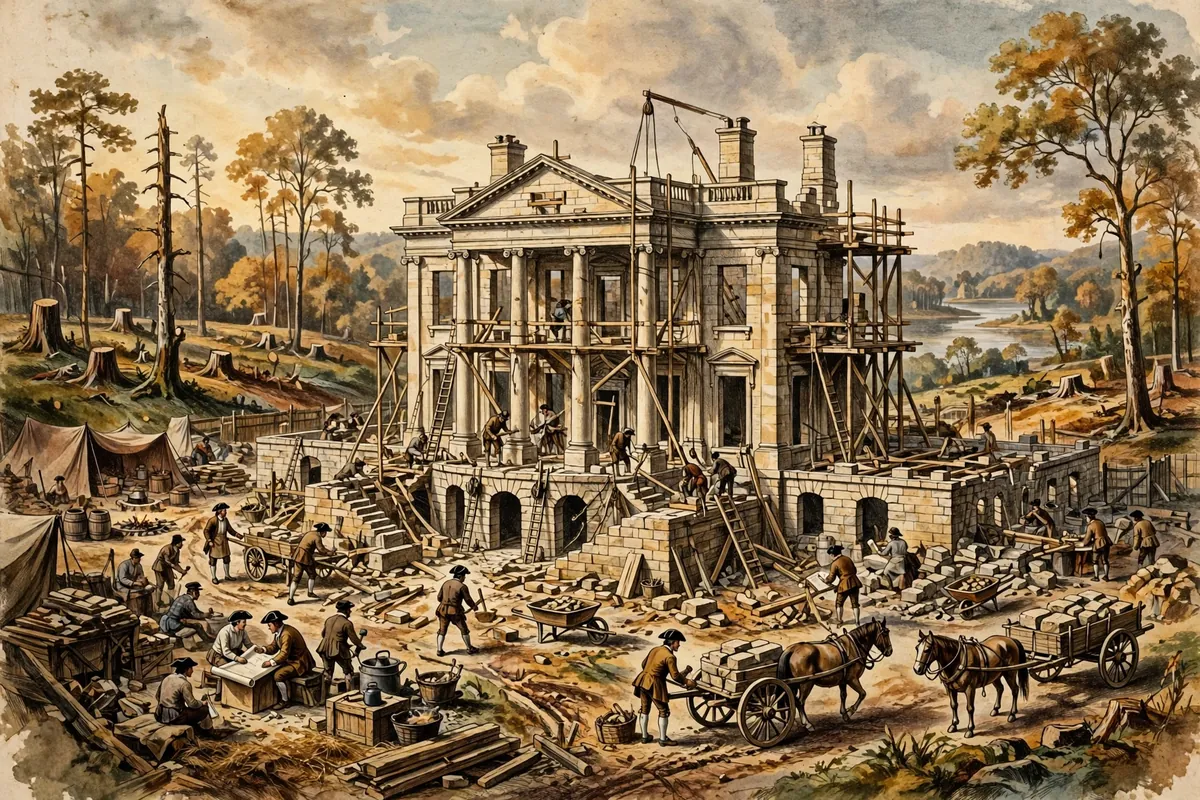
The house was designed by Irish-born architect James Hoban, who modeled it on Leinster House in Dublin. George Washington had seen a courthouse Hoban designed in Charleston, South Carolina, during a 1791 tour, and the next year he summoned the architect to meet him in Philadelphia. It was built between 1792 and 1800 with walls of sandstone from Aquia Creek in Virginia.
Sandstone is porous, and whitewash is a good match for that kind of stone. Masonry soaks it up easily, and a chemical reaction with the air hardens it into a protective layer. So the white coat wasn't only about looks. It was a practical choice for the walls.
The building was also scaled down from early dreams. Pierre L'Enfant had imagined a grand palace five times larger. Partly because of shortages of materials and workers, the finished house had two main floors instead of three.
The Night Washington Burned
On August 24, 1814, British forces set fire to the White House during the Burning of Washington. The blaze destroyed the interior and charred much of the outside. Only the exterior walls survived, and most of them had to be torn down and rebuilt because the fire and the weather had weakened them.
After the fire, President James Madison had to live elsewhere in the city. Rebuilding started almost right away, and President James Monroe moved into the partly rebuilt house in October 1817. The house came back just as white as before, so it's easy to see how the cover-up story caught on.
A Nickname That Became Official
In its early years, the building went by several names, including the President's Palace, the Presidential Mansion, and the President's House. White House was the public's nickname, and it stuck.
For official business, though, it was called the Executive Mansion for nearly a century. That changed in 1901, when President Theodore Roosevelt made The White House its formal name by executive order. The familiar letterhead, with Washington centered beneath the name, dates to the administration of Franklin D. Roosevelt.
A Few Survivors of the Fire
When the British sacked the house, they carried off many objects. Only three are known to have been recovered. In 1939, a Canadian man returned a jewelry box to President Franklin Roosevelt, saying his grandfather had taken it from Washington. That same year, descendants of a Royal Navy officer returned a medicine chest that had belonged to President Madison.
During the fire itself, White House staff and enslaved workers saved a copy of the famous full-length portrait of George Washington.
So the White House didn't turn white to hide a painful chapter. It was white from the start, and the name the public gave it simply outlasted every official title that came after.