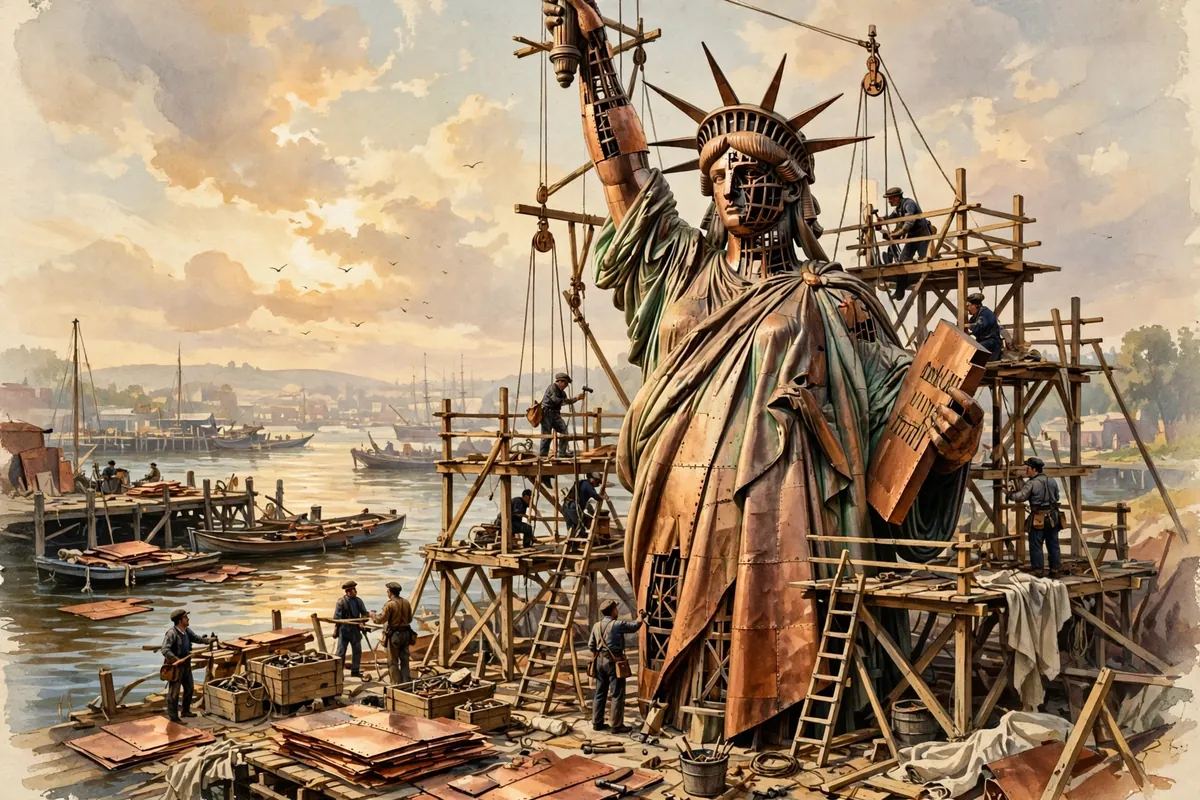
Her green robe is as American as apple pie. It's on postcards, souvenirs, and coffee mugs, and it's the color most of us would grab if we had to draw her. But the Statue of Liberty didn't start out that way. Early visitors saw a very different lady standing in New York Harbor.
Here's the short answer: the statue is covered in a thin skin of copper. When it was built, it was reddish-brown and shiny, like a new penny. Over about twenty years, air, water, and pollution reacted with the copper and formed a green coating called a patina, or verdigris. That coating also protects the metal underneath.
Why Copper?
The statue was a gift from the people of France, designed by sculptor Frédéric Auguste Bartholdi. He chose copper over bronze or stone because it was cheaper, lighter, and easier to ship across the ocean. Its inner iron framework was built by Gustave Eiffel, the same engineer behind the Eiffel Tower.
The copper skin is astonishingly thin, only about 2.4 millimeters, less than a tenth of an inch. Workers shaped the sheets by heating them and hammering them with wooden mallets, a technique called repoussé. That kept the giant statue light for its size.
Building it in Paris was a spectacle of its own. By 1882, the statue was finished up to the waist, and Bartholdi celebrated by inviting reporters to lunch on a platform built inside it. The completed statue was later taken apart and packed into crates for its ocean voyage to New York.
The Slow Change to Green
The statue was dedicated on October 28, 1886. For a while, it kept its dull copper color. Then, shortly after 1900, a green film began to spread across the surface. Newspapers mentioned it as early as 1902, and by 1906 it had covered the entire statue.
This happens to copper everywhere. Old copper roofs and church steeples turn green for the same reason. Instead of rusting away the way iron does, copper forms a stable layer that shields the metal underneath from further corrosion.
The Paint Job That Almost Happened
Not everyone understood that at first. Congress believed the green coating was a sign of corrosion, so it set aside $62,800 for repairs, including a plan to paint the statue inside and out.
The public didn't like that idea at all, and there was considerable protest. The Army Corps of Engineers studied the patina and concluded it actually protected the skin. In their words, it "softened the outlines of the Statue and made it beautiful." In the end, only the inside got painted.
A Facelift in the 1980s
By the 1980s, Lady Liberty needed real help. She was closed to the public in 1984 for a major restoration, surrounded by what was then the world's largest free-standing scaffold. Workers used liquid nitrogen to strip decades of paint from the inside of the copper skin, then blasted away old coal tar with baking soda.
Some damaged copper had to be replaced. The new pieces came from a copper rooftop at Bell Labs, whose patina closely matched the statue's. The torch, which had been leaking water since alterations made in 1916, was swapped for a replica in 1986, with a flame covered in 24-karat gold.
So the green we love is really a weathered coat earned over more than a century of wind, water, and city air. Lady Liberty didn't lose her shine. She simply traded it for a color that suits her even better.