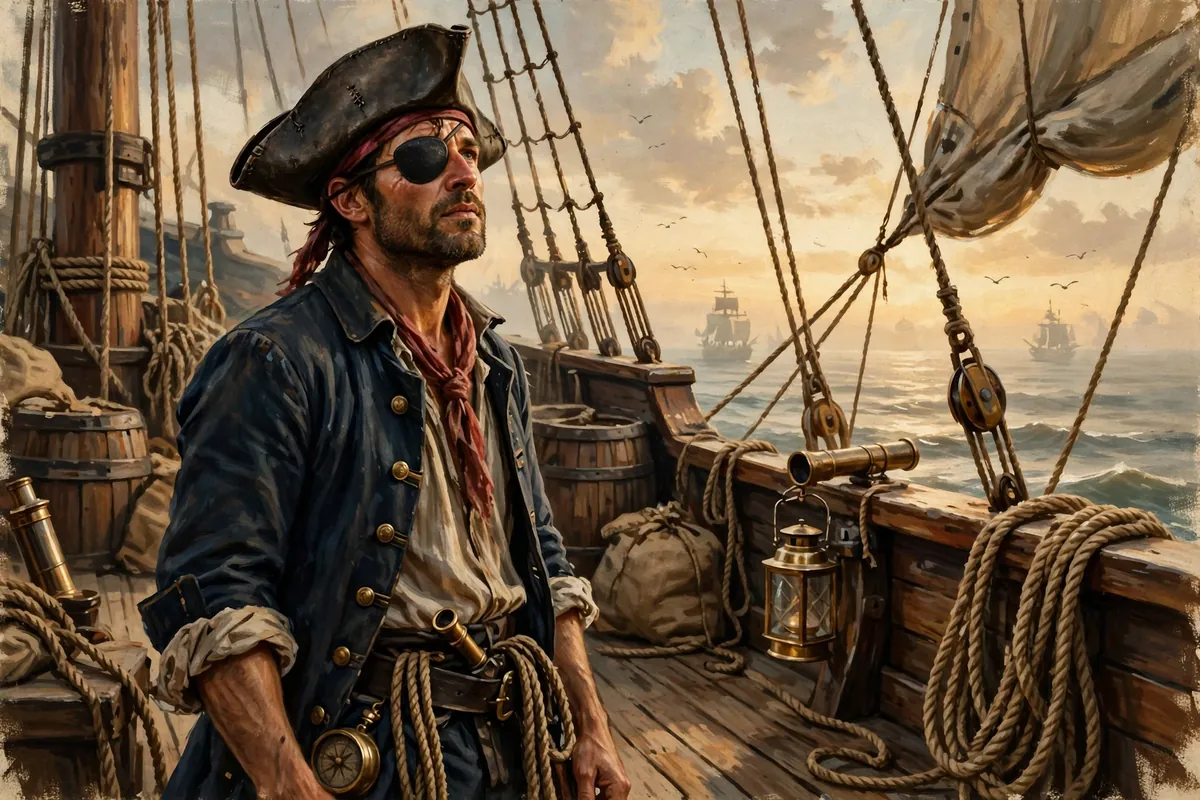
Every storybook pirate seems to come with the same outfit: a big hat, a cutlass, and a black patch over one eye. In recent years, a clever explanation has made the rounds. The patches supposedly weren't about missing eyes at all. They kept one eye adjusted to the dark, so a pirate could fight below deck the moment he climbed down.
Here's the truth: it's a neat theory, but there's no historical record of pirates actually doing it. In fact, there's no evidence that pirates commonly wore eye patches at all before several popular novels of the 1800s. Patches were for people who had lost or injured an eye, and pirates rarely wore them while aboard ship.
Who Really Wore Eye Patches
Before modern medicine and surgery, an eye patch was the usual way to cover a lost or injured eye. Patches were especially common among people in dangerous jobs, such as soldiers and sailors, who could lose an eye in battle.
Some former sailors living ashore wore patches for exactly that reason. So a one-eyed old seaman in a port town wouldn't have been unusual. A whole crew of patch-wearing pirates, though, is a picture painted mostly by fiction.
The Night Vision Theory
The idea behind the theory is real science. Your eyes take roughly 20 to 30 minutes to fully adjust from bright sunlight to complete darkness, and once they do, they become thousands of times more sensitive. Before electric lighting, the space below a ship's deck would have been dim, so a covered eye could, in principle, be ready for it.
The concept even has a medical pedigree. In 1934, Charles Sheard of the Mayo foundation wrote that wearing a patch, which he called the pirate's patch, over one eye would keep that eye ready for night vision. The U.S. Navy explored the technique during World War II, and a 2007 episode of MythBusters found the idea plausible.
The catch is that plausible isn't the same as proven. This use of an eye patch has never been documented in any historical naval manual.
A Real One-Eyed Pirate
There were exceptions. Rahmah ibn Jabir al-Jalhami, who lived from about 1760 to 1826, was a feared pirate and ruler in the Persian Gulf. He lost an eye in battle and wore a patch afterward, making him the earliest documented pirate to wear one. An English traveler of his day called him perhaps the most successful pirate that ever infested any sea.
How Fiction Built the Pirate
Much of what we picture about pirates comes from books. A two-volume work called A General History of the Pyrates, published in London in 1724, shaped how the public imagined the so-called Golden Age of Piracy. One naval historian noted it has been said that its author created the modern idea of pirates.
That book inspired later stories, most famously Robert Louis Stevenson's Treasure Island and J. M. Barrie's Peter Pan, which have been retold on stage and screen for more than a century. The Pirates of the Caribbean films, starting in 2003, pushed the image even further.
So go ahead and wear the eye patch for your next costume party. Just know that the real pirates of history were far more likely to have two good eyes, and the clever dark-vision trick, while scientifically sound, belongs more to modern imagination than to the high seas.