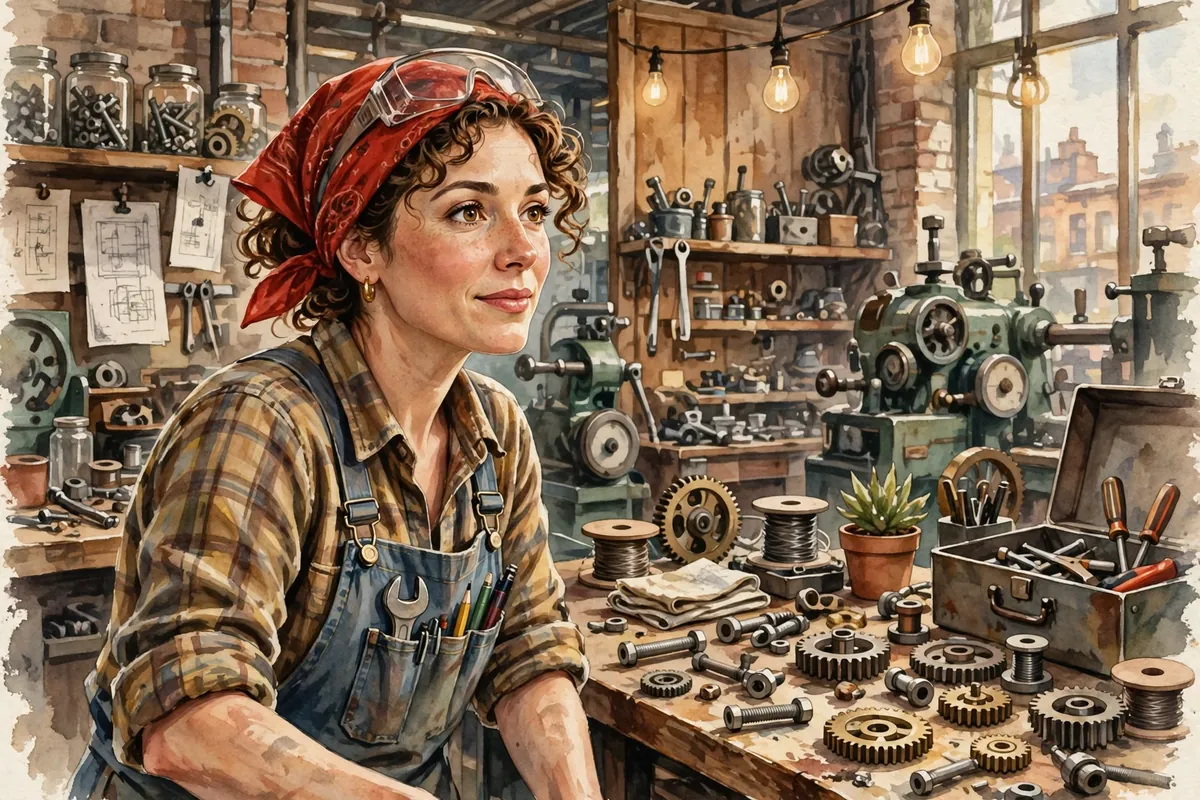
She's one of the most recognizable faces in American history: sleeves rolled up, arm flexed, red bandana tied over her hair. Rosie the Riveter stands for the millions of women who went to work during World War II. But the story behind her image is full of surprises.
Here's the short version. Rosie the Riveter started as a popular 1942 song. In 1943, Norman Rockwell painted a famous “Rosie” for a magazine cover. The red bandana “We Can Do It!” poster most people picture today was a different image entirely. It wasn't called Rosie during the war, was shown only briefly to one company's workers, and became famous decades later.
It Started With a Song
The idea of Rosie the Riveter came from a 1942 song written by Redd Evans and John Jacob Loeb. The tune caught on, and before long the name “Rosie” stood for women working in war factories.
Real women carried the name, too. Rose Will Monroe, a riveter building B-24 bombers at the Willow Run Aircraft Factory in Michigan, was chosen to portray Rosie in a promotional film about the war effort at home. Years later, at age 50, she fulfilled a dream by earning her pilot's license.
Norman Rockwell's Rosie
On May 29, 1943, Memorial Day, Norman Rockwell's “Rosie the Riveter” appeared on the cover of The Saturday Evening Post. His Rosie is a brawny woman on her lunch break, a rivet gun across her lap and a sandwich in her hand. Her lunch box reads “Rosie,” and readers instantly connected her to the song.
Rockwell based her pose on Michelangelo's painting of the prophet Isaiah on the Sistine Chapel ceiling. His model was 19-year-old Mary Louise Doyle, a Vermont telephone operator, not a riveter. She was paid $10. Rockwell made her look much larger than she really was and later apologized, writing, “I did have to make you into a sort of a giant.” The painting sold at Sotheby's in 2002 for nearly $5 million.
The Poster Nobody Saw
In 1942, Pittsburgh artist J. Howard Miller was hired by the Westinghouse company to create posters for the war effort. One became the famous “We Can Do It!” image.
Here's the twist. The poster was displayed only to Westinghouse employees in the Midwest for about two weeks in February 1943. Its goal wasn't to recruit women, but to motivate workers of both sexes already on the job. Then it disappeared for nearly forty years. It was rediscovered in the early 1980s, became a symbol of women's strength, and was often mistakenly called “Rosie the Riveter.”
Even the woman who inspired it was misidentified for years. Miller is thought to have based the poster on a wartime photo of a young worker. More recent evidence shows the photo was of Naomi Parker, later Naomi Parker Fraley, taken at Alameda Naval Air Station in California.
The Real Rosies
Nearly 19 million women held jobs during World War II. Many had already been working in lower-paying jobs or were returning after losing work during the Depression. Only about three million were new to the workforce during the war.
So Rosie the Riveter wasn't one woman, one poster, or one painting. She was a song, a magazine cover, a film role, and above all a tribute to the millions of real women who kept the country running.