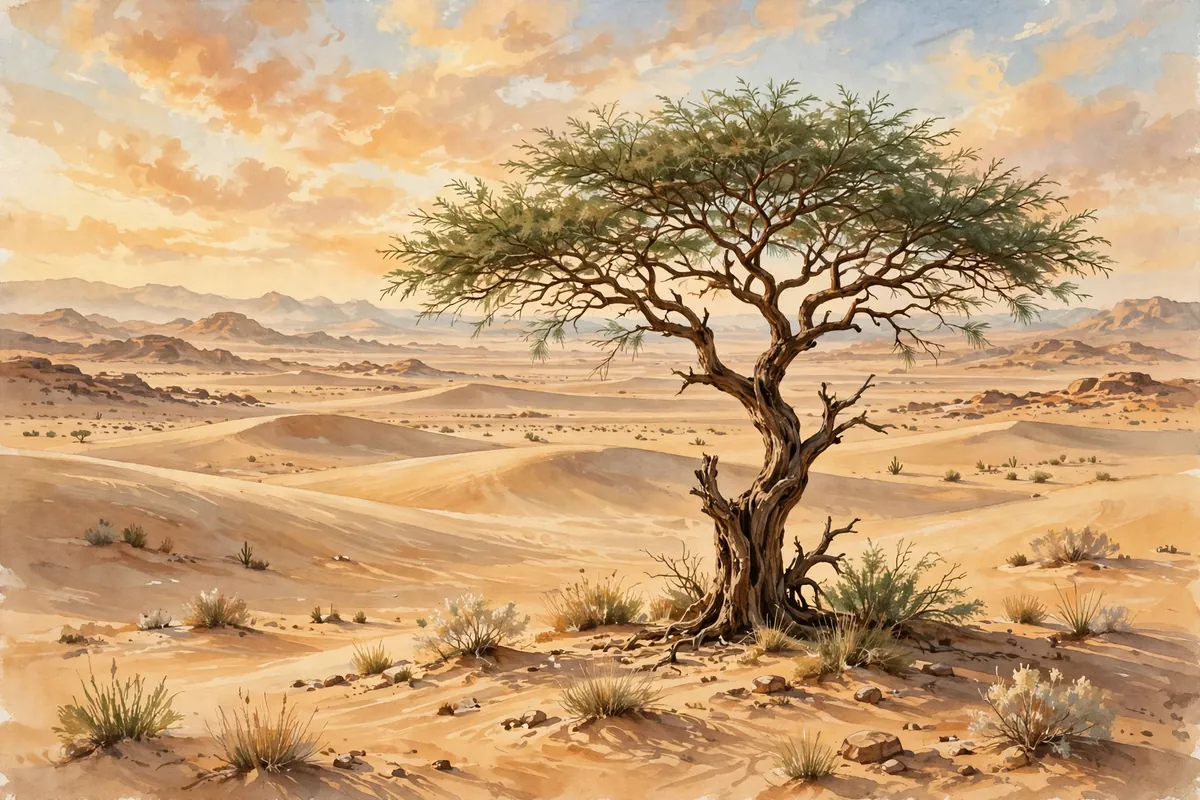
Imagine crossing a sea of sand in the Sahara, hour after hour, with nothing on the horizon. Then, finally, a single tree appears. For travelers in the Ténéré region of Niger, that tree was real, and for a long time it was considered the most isolated tree on Earth.
It was called the Tree of Ténéré, a lone acacia estimated to have stood for about 300 years. It survived heat, drought, and countless passing camels. But in 1973, it was knocked down by a truck, reportedly driven by a drunk driver. Today, its remains rest in a museum, and a metal sculpture marks the spot where it once grew.
The Last of Its Kind
The tree was the last survivor of a group of trees that once grew along a caravan route, back when the Sahara was less dry than it is now. Over time, the others disappeared, and this one stood alone for decades.
The Ténéré is a harsh place. Its name comes from the Tuareg word for desert, and it's a vast sandy plain covering more than 150,000 square miles, with almost no plant life. Average high temperatures stay above 104°F for about five months of the year.
The Secret of Its Survival
How did one tree survive out there? In the winter of 1938 to 1939, workers dug a well beside it and found the answer underground. The tree's roots reached all the way down to the water table, about 108 to 118 feet below the surface.
People protected it too. A French officer who saw the tree in 1939 wondered why camels never ate its leaves and why the Tuareg salt caravans never cut its branches for firewood. His answer was that the tree was taboo, a kind of sacred landmark that everyone respected. Caravans gathered around it each year before crossing the desert. He called it a living lighthouse.
Undone by Machines
Camels and nomads never hurt the tree. Vehicles did. When French explorer Henri Lhote first saw it in 1934, it had green leaves and yellow flowers. When he returned in 1959, a truck had crashed into it, and one of its two trunks was gone. “I cannot recognise it,” he wrote sadly.
In 1973, a Libyan truck driver, reportedly drunk, knocked the tree down for good. In a desert with almost nothing else around, the one obstacle for miles was the one thing he hit.
On November 8, 1973, the dead tree was moved to a special shrine at the Niger National Museum in the capital, Niamey. A simple metal sculpture now stands at its old location in the desert.
A New Loneliest Tree
With the Tree of Ténéré gone, another tree is often given the title. On Campbell Island, far south of New Zealand, a single Sitka spruce more than 100 years old stands alone. Its nearest neighbor is over 170 miles away on the Auckland Islands. It's believed to have been planted between 1901 and 1907. Some Australian researchers have even proposed it as an official marker for the start of the Anthropocene, the idea of a new age shaped by humans.
There's something moving about trees like these, standing firm where nothing else can. The Tree of Ténéré guided travelers for generations, and even now, its story is a reminder to watch the road, especially when it's the only tree for miles.