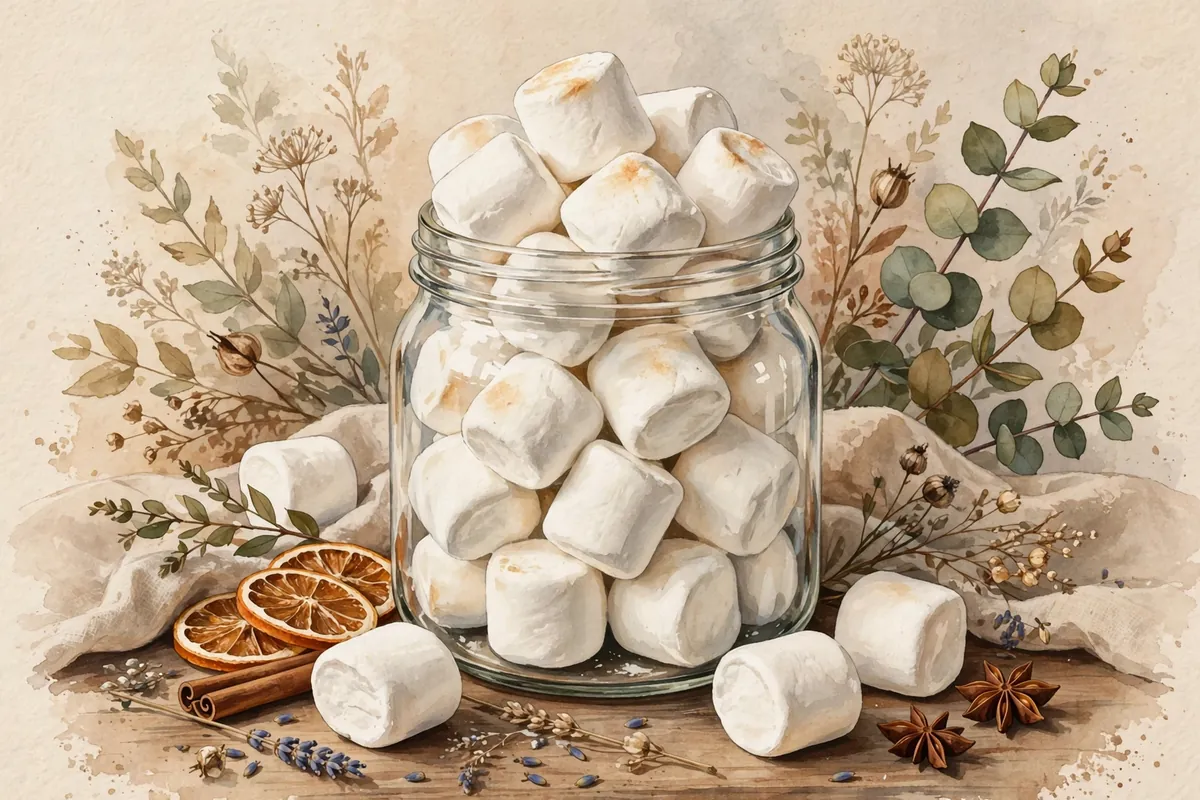
Marshmallows feel like pure fun. They float in hot cocoa, puff up over campfires, and hold together s'mores and Rice Krispies treats. It's hard to picture them as anything but candy. So it may come as a surprise that the name comes from a medicinal plant. Why were marshmallows once medicine?
The short answer is that the original marshmallow wasn't candy at all. It came from the root of the marsh-mallow plant, a wetland weed whose leaves, flowers, and root were used in traditional herbal medicine. Ancient Egyptians are said to have been among the first to use the root to soothe coughs and sore throats. Over the centuries, confectioners turned that remedy into a sweet, and eventually the plant was replaced entirely.
A Weed From the Marsh
The marsh-mallow plant, known to scientists as Althaea officinalis, grows in marshes and other damp places in parts of Europe, North Africa, and Asia. It has fleshy stems and leaves and a white flower with five petals. Even its scientific name hints at its old reputation. Althaea comes from a Greek word meaning "to heal," and officinalis marks plants that had culinary or medicinal value.
No one knows exactly when marshmallows were invented, but their history may go back as far as 2000 BC. The earliest versions were made by boiling pieces of the root pulp with honey until thick. The mixture was then strained, cooled, and used as intended.
From Remedy to French Treat
For a long time, marshmallow making stayed small. Then, in the early to mid-1800s, French confectioners took the idea in a sweeter direction. They whipped the sap of the mallow root with sugar, water, and egg whites into a soft, spongy candy called pâte de guimauve.
It was sold in bars as a lozenge, a nod to its medicinal roots. Making it took time, since drying and preparing the marshmallow could take one to two days.
Goodbye, Mallow Root
In the late 1800s, candy makers found a faster method called the starch mogul system. Trays of cornstarch were pressed with molds to make little cavities, which were filled with the whipped mixture and left to set. Around the same time, candy makers began replacing the mallow root with gelatin, which made a more stable marshmallow.
By the early 20th century, marshmallows were cheap enough to sell in tins as penny candy in the United States. In 1956, Alex Doumak patented an extrusion process that pushed the mixture through tubes into long ropes, which were cooled and cut into pieces. That's the basic idea behind the bags of marshmallows we buy today.
Modern marshmallows are made from sugar, water, air, and a whipping agent such as gelatin. Air is a big part of the recipe. About half of a marshmallow is air, which is why they're so light and squishy. And no, today's marshmallows don't contain the healing root, so they're strictly a treat.
Born to Be Toasted
Toasting marshmallows over a fire caramelizes the sugar on the outside, creating a golden crust around a melty center. In the early 1900s, a popular treat called the Marshmallow Marguerite put a buttered, toasted marshmallow on a saltine cracker. By the mid-1920s, Girl Scouts were making "Some Mores" with graham crackers and chocolate, and the name s'more caught on by the 1930s.
So the next time you toast a marshmallow until it's perfectly golden, raise your stick to the humble swamp plant that started it all. It went from healer's remedy to campfire legend, and it's still making people feel better.