It sounds like a number someone made up to win a bar bet. The Sun loses about 4 million tons of mass every single second. That's a staggering amount of material, gone in less time than it takes to say "wow."
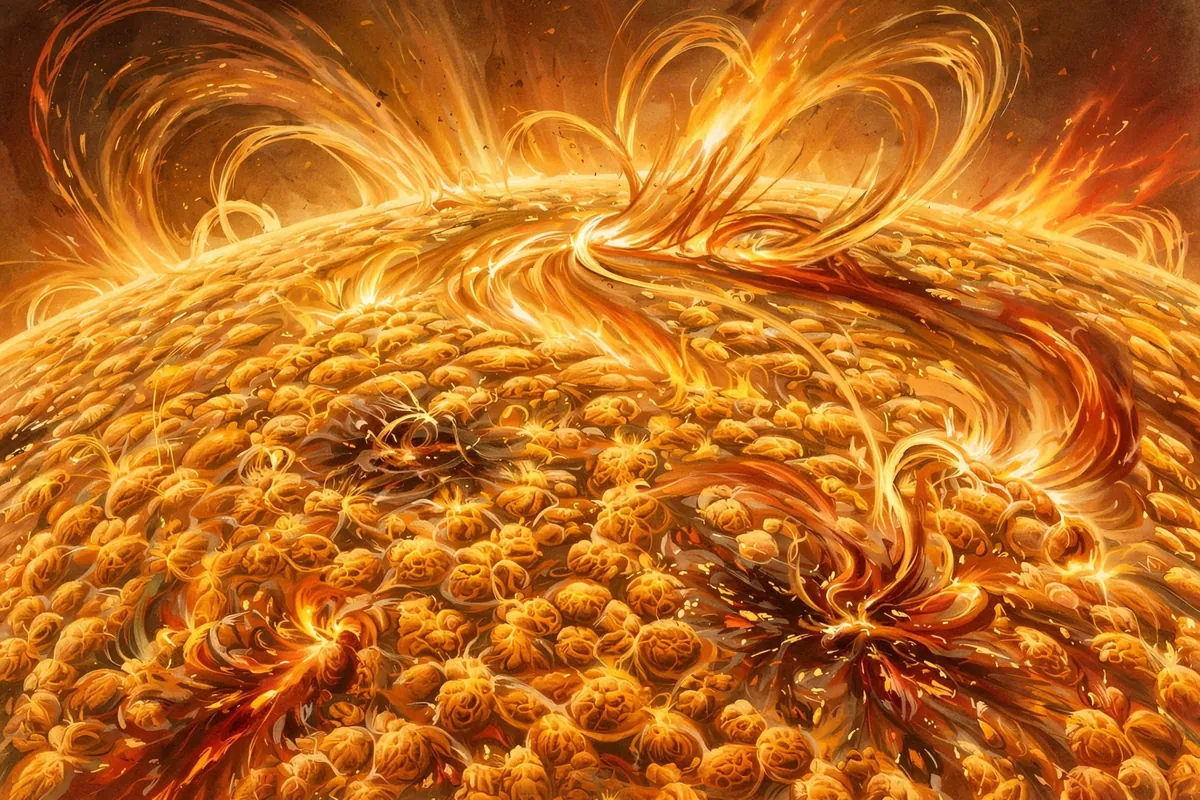
The surprising thing is that it's true. Each second, more than four billion kilograms of matter, a little over 4 million metric tons, is converted into energy in the Sun's core. That energy is what reaches us as sunlight. On top of that, the solar wind carries off another 1.3 to 1.9 million metric tons every second.
Turning Mass Into Light
Deep in the Sun's core, nuclear fusion squeezes hydrogen into helium. Every second, about 600 billion kilograms of hydrogen get fused. The helium that comes out weighs slightly less than the hydrogen that went in, and that missing mass becomes energy. The process also produces ghostly particles called neutrinos, which stream out of the Sun along with its light.
For a long time, nobody could explain how the Sun kept shining. It wasn't until 1904 that a documented answer was offered, when physicist Ernest Rutherford suggested an internal source of heat, possibly radioactive decay. He was on the right track, even though the real answer turned out to be something else.
Albert Einstein's famous equation, E = mc², provided the key clue to how this works. In 1920, the astronomer Arthur Eddington proposed that the heat and pressure in the Sun's core could fuse hydrogen into helium, producing energy from the change in mass. Physicists worked out the details in the 1930s.
A Wind That Never Stops
Fusion isn't the only way the Sun slims down. It also constantly blows out a stream of charged particles called the solar wind. The number of particles streaming away each second is so large it's written as 13 followed by 35 zeros.
Add it all up, and the solar wind alone removes roughly the mass of the Earth every 150 million years. That sounds alarming until you look at the bigger picture.
Why the Sun Isn't Wasting Away
The Sun is unimaginably huge. It holds about 99.86 percent of all the mass in the solar system. Earth, Jupiter and everything else combined make up the tiny remainder.
So even after about 4.6 billion years of burning, the Sun has converted only around 100 Earths' worth of mass into energy. That's about 0.03 percent of its total mass. The solar wind has carried off even less, only about 0.01 percent of the Sun's original mass since it formed. In other words, the Sun is losing weight, but at a pace that barely registers.
What Happens Eventually
The Sun is roughly halfway through its long, stable middle age. Altogether, it will spend about 10 to 11 billion years steadily fusing hydrogen in its core.
When the hydrogen in the core runs out, in about 5 billion years, things will change. The Sun won't explode, because it doesn't have enough mass to become a supernova. Instead, it will swell into a red giant over the following couple of billion years and grow far brighter.
That's a problem for a distant tomorrow. For now, the Sun's daily weight loss is exactly what keeps our planet bright and warm. So the next time you enjoy a sunny afternoon, remember that you're basking in millions of tons of matter turned into light.