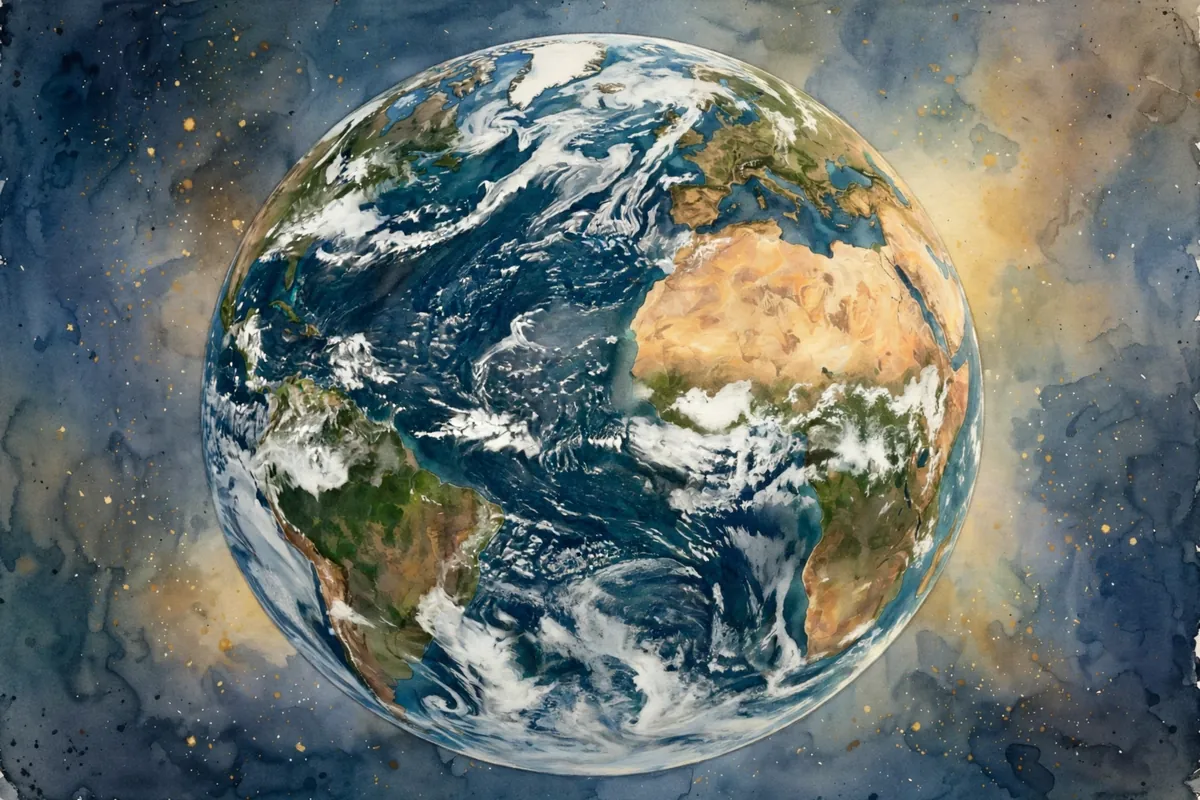
Every school globe is a perfect sphere. Photos from space show a beautiful round blue marble. So it may come as a surprise that Earth isn't actually perfectly round. It's a little bit squashed, like a ball someone gently sat on.
Here's why. Earth spins, and that spin makes the planet bulge outward around the equator and flatten slightly at the poles. As a result, Earth's diameter is about 27 miles wider across the equator than it is from pole to pole. Scientists call this shape an oblate spheroid, or simply an ellipsoid.
The Spin That Shapes a Planet
Gravity pulls a planet's matter toward its center, which naturally forms a sphere. Rotation pushes back against that, flinging material outward most strongly at the equator, where the surface is moving fastest. The result is a balance between the two: a ball that bulges in the middle. In fact, any rotating body in space tends to take this kind of shape rather than a perfect sphere, so Earth is in good company.
You can get a feel for this force on a spinning playground merry-go-round. The farther out you sit, the more you feel pulled outward. On Earth, the equator is the outer edge of that spin.
Small, But Real
Don't picture Earth as a lumpy egg. The bulge is about 1/298 of the equator's width. If Earth were shrunk to a globe about 3 feet wide, the difference would be roughly an eighth of an inch, far too small to notice by eye.
Still, it matters. That tiny difference is more than twice as large as the tallest mountains and deepest ocean trenches compared with Earth's smooth overall shape. Even GPS systems and mapmakers rely on a precise model of this squashed shape to pin down locations. The oceans actually follow this standard shape more closely than the land does, since water settles smoothly while mountains and valleys poke up and down.
Everest Loses a Title
Here's a fun consequence. Someone standing at sea level at either pole is about 13 miles closer to Earth's center than someone at sea level on the equator. That changes which mountain sticks out the farthest.
Mount Everest is still the tallest mountain measured from sea level. But the summit of Chimborazo, a volcano in Ecuador near the equator, sits on top of the bulge. That makes it the point on Earth's surface farthest from the planet's center.
The oceans bulge too. Because sea level itself rises with the bulge, Chimborazo isn't as high above sea level as Everest. It's just riding a bigger wave of planet.
How Scientists Figured It Out
The idea that Earth is shaped like an ellipsoid goes back to Isaac Newton in the 17th century. Not everyone agreed. In the 1700s, French scientists argued over whether Earth was wider at the equator or around the poles.
To settle it, King Louis XV and the French Academy of Sciences sent two expeditions. One went to Lapland near the Arctic Circle, with the Swedish physicist Anders Celsius, the man behind the Celsius temperature scale. The other went to Ecuador on the equator. The Lapland team finished first and showed that Earth is indeed flattened at the poles.
So the next time you spin a globe, remember the real thing is just a touch wider around its middle. It's a quiet reminder that our planet has been twirling for billions of years, and it shows.