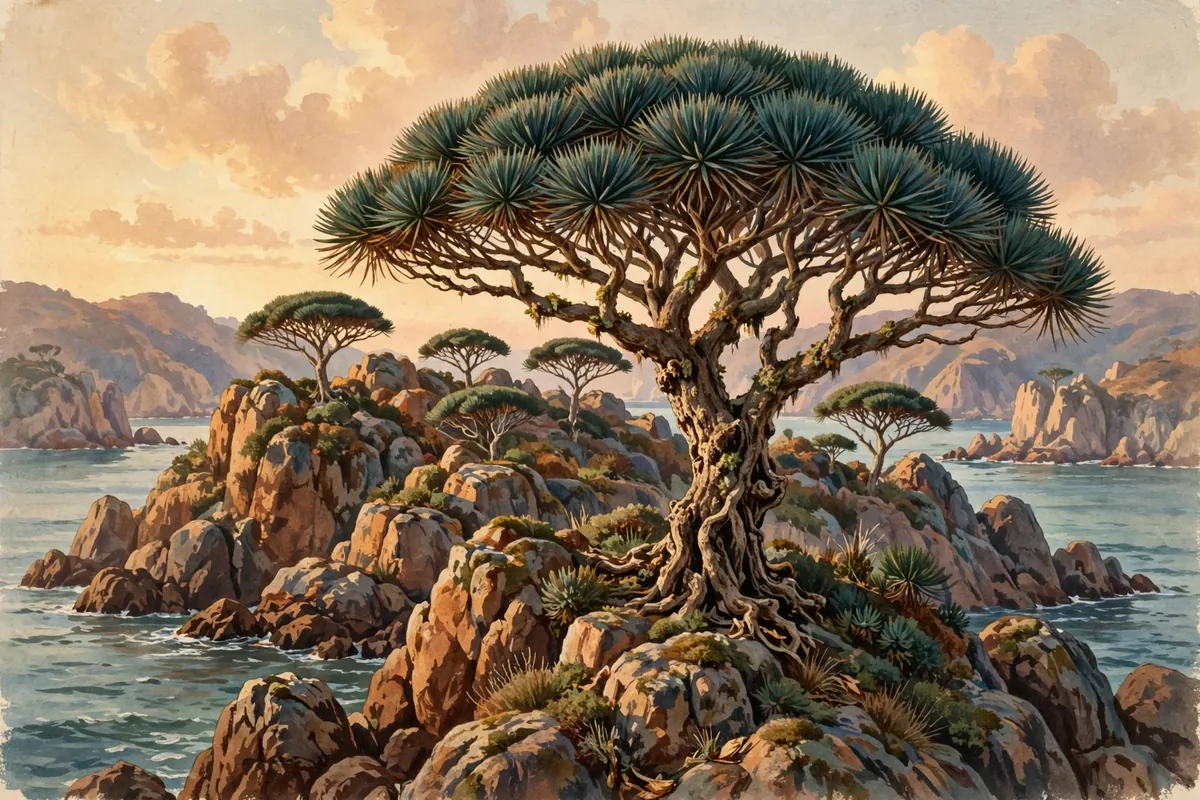
Picture a tree that looks like a giant umbrella blown inside out by the wind. Thick branches split again and again, topped by a dense, flat crown of stiff leaves. Now imagine that this tree yields a resin the color of blood. It sounds like something from a fantasy novel. So is it real?
The short answer is yes. It's the dragon blood tree, known to scientists as Dracaena cinnabari. It grows naturally only on the Socotra archipelago, a group of islands in the Arabian Sea that belongs to Yemen. The tree gets its name from its dark red resin, called dragon's blood, which people have harvested and treasured since ancient times.
A Tree Built Like an Umbrella
The dragon blood tree can grow up to about 30 feet tall, with a crown spreading as wide as 39 feet. Its branches divide in two over and over, creating that famous upturned umbrella shape. The long, stiff leaves, up to about two feet long, grow only at the ends of the youngest branches.
That dense crown isn't just for looks. It's adapted to the island's dry conditions, and the tough leaves help prevent water loss. The tree is also unusual for its plant family. Like palms, it grows from the tip of the stem, but unlike most of its relatives, its trunk can keep thickening over time. It even forms growth zones that resemble tree rings, though they can't be counted reliably to tell its age.
The Famous Red Resin
The tree's crimson resin, dragon's blood, was highly prized in the ancient world and is still used today. The tree's small berries ripen to orange and ooze a deep red resin too. Greeks, Romans, and Arabs used dragon's blood for treating wounds and many other ailments, and around the Mediterranean it has been used as a dye.
On Socotra, people have used it in all kinds of practical ways: to dye wool, glue pottery, freshen breath, and even as lipstick. Because people once believed it truly was dragon's blood, it found its way into ritual magic and alchemy as well. One theory even suggests the island's name may come from Arabic words meaning a market for dragon's blood.
An Island Like No Other
Socotra has been called the most alien-looking place on Earth. It's one of the most isolated pieces of land of continental origin, once part of the ancient supercontinent Gondwana. About 37 percent of its plant species, 90 percent of its reptiles, and 95 percent of its land snails are found nowhere else. In 2008, it was named a UNESCO World Heritage Site.
The dragon blood tree is the island's most famous resident and Yemen's national tree. Scientists think it is a survivor of ancient subtropical forests that have almost vanished elsewhere.
A Tree in Trouble, and Some Hope
Life is getting harder for this strange tree. Socotra has been slowly drying out for the last few hundred years, and the mist and clouds the trees depend on seem to be lasting for shorter periods. Goats eat the seedlings, so young trees mostly survive only on rocky outcrops. One estimate predicts a 45 percent loss of the tree's suitable habitat by 2080.
People are fighting back. Local islanders, working with groups such as the UK-based Friends of Socotra and Mendel University in Brno, have been watering young saplings and protecting them from hungry goats. As of 2022, about 600 saplings had grown strong enough to no longer need regular watering.
So somewhere on a windswept island, a new generation of dragon blood trees is slowly taking root. With a little help, those strange red-hearted umbrellas may keep standing for centuries to come.