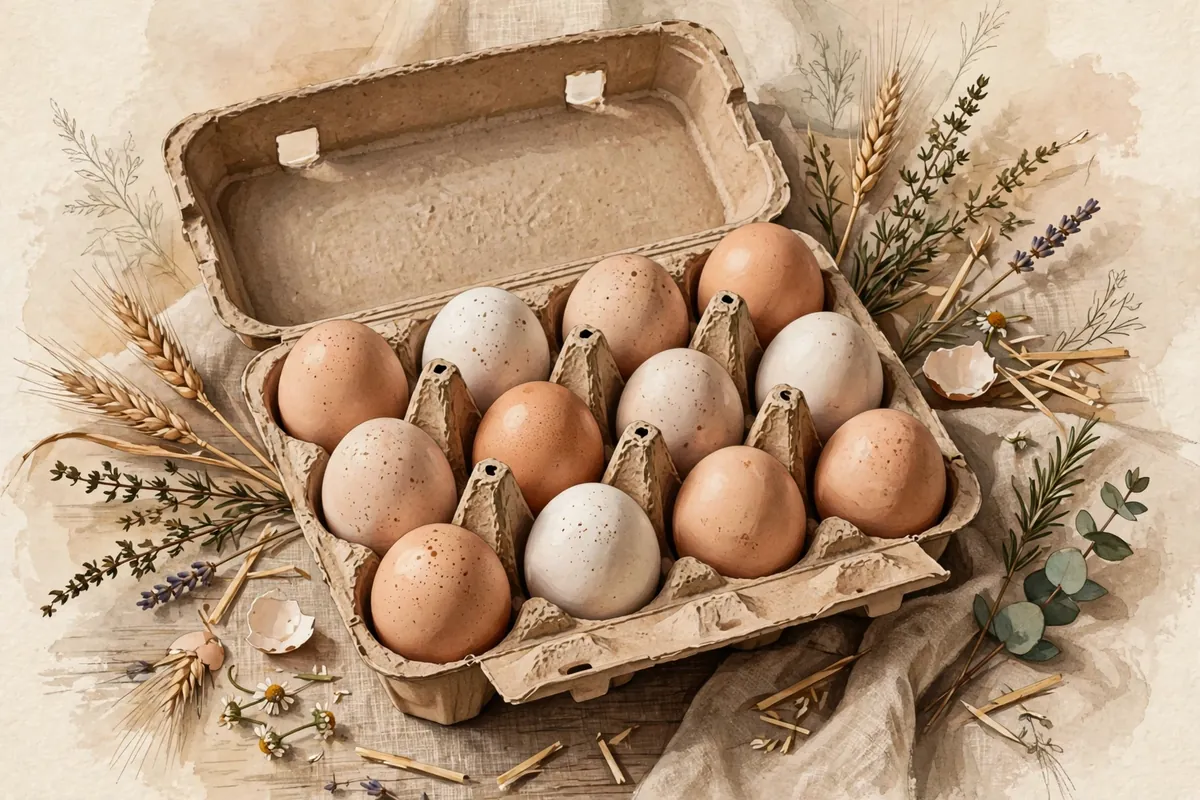
Think about how most of us count. Ten fingers, ten toes, dimes and dollars, the metric system. Ten is everywhere. So why does a carton of eggs, one of the most common things in any kitchen, hold twelve?
Here's the honest answer. There's no single official reason on record. Eggs are sold by the dozen because twelve was the traditional way to count and sell everyday goods for a very long time, especially food, and the habit stuck. Twelve is also an unusually handy number. It splits evenly into halves, thirds, quarters, and sixths, which made it easy to trade, share, and pack.
An Ancient Counting System
Counting by twelves is incredibly old. A base-twelve system, called duodecimal, originated in ancient Mesopotamia. The dozen may be one of the earliest groupings of numbers people ever used, perhaps because there are roughly twelve cycles of the Moon in a year.
One historian even suggested an ancient way of counting to twelve on one hand. Use your thumb to touch each of the three bones on your four other fingers, and you get twelve. This method is still used in many parts of Asia.
Twelve Is Everywhere
Once you notice it, twelve shows up all over daily life. There are twelve months in a year, twelve inches in a foot, twelve hours on a clock face, and twelve signs of the zodiac. The Romans used fractions based on twelve, and their word for a twelfth, the uncia, gave English both 'ounce' and 'inch.'
Money ran on twelve too. In much of western Europe, old currency systems had 12 pence to a shilling, a system first set up by Charlemagne in the 780s.
Mathematically, twelve has a special talent. It has more divisors than almost any number near it, a property it shares with numbers like 60 and 360. Ten, by comparison, can only be split evenly into halves and fifths.
The Carton Came Much Later
Before cartons, eggs were carried in baskets. The egg carton itself is a fairly modern invention. In 1906, Thomas Peter Bethell of Liverpool, England, came up with an early version, using frames of interlocking cardboard strips packed inside boxes. In 1911, a newspaper editor named Joseph Coyle in British Columbia, Canada, invented one to settle a dispute between a farmer and a hotel owner over eggs that kept arriving broken.
Later designs improved on his idea. In 1931, Francis H. Sherman of Palmer, Massachusetts, patented a pressed paper pulp carton that looks like the ones we use today. In the 1950s, a British designer added a sealable lid, making it easy to stack cartons holding 6 or 12 eggs. Cartons were built around the dozen, not the other way around.
Bonus: The Baker's Dozen
If twelve is a dozen, why is a baker's dozen thirteen? One explanation comes from medieval England, where bakers gave bread sellers thirteen loaves for the price of twelve. The extra loaf was the seller's profit. A record from the early 1400s describes this as an ancient custom.
There's even a regional cousin, the Texas dozen, which usually means fifteen. So the next time you open a carton of eggs, you're holding a little piece of very old math, one that started with the Moon, passed through Roman coins and medieval bakeries, and ended up right in your refrigerator.