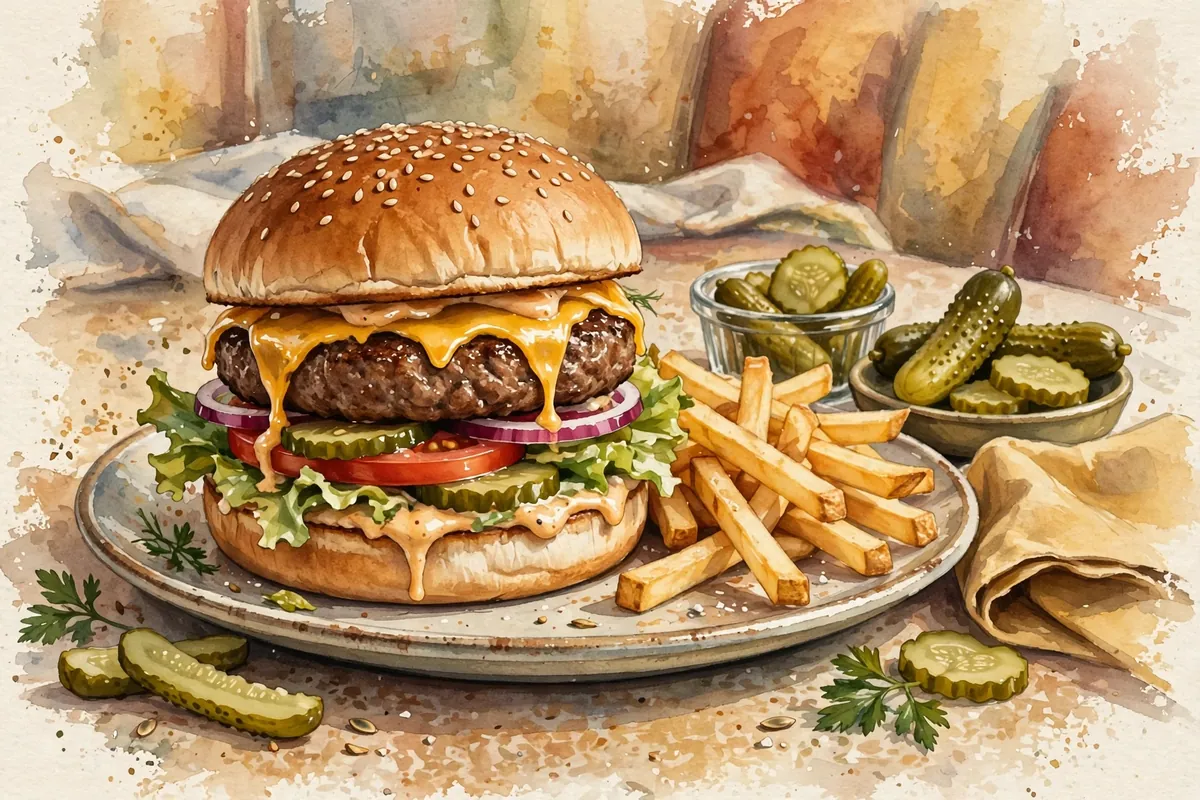
Few foods are more American than a hamburger. It's the star of backyard cookouts, ballpark lunches, and drive-through windows across the country. So you'd think we'd know exactly who made the first one.
The short answer: nobody knows for sure. The name comes from Hamburg, Germany, but the exact connection to the city is disputed. Several Americans claimed to have invented the hamburger in the late 1800s and early 1900s, and none of the claims has been proven to be the true first.
A Name From Germany
The roots go back a long way. A 1758 English cookbook by Hannah Glasse included a recipe for "Hamburgh sausage," to be served roasted with toasted bread under it. In Hamburg itself, a warm bread roll with meat was a popular snack by 1869, and emigrants supposedly ate it on their way to America.
Another theory points to the Hamburg America Line, a shipping company whose vessels carried passengers from Hamburg to New York starting in 1847. The Hamburg steak served aboard may have become so well known that the name stuck. Nobody knows which story, if any, is the real one.
The American Contenders
One of the earliest claims belongs to Charlie Nagreen, nicknamed Hamburger Charlie. In 1885, at the age of 15, he reportedly sold a meatball between two slices of bread at the Seymour Fair in Wisconsin so people could eat while walking around. Seymour's historical society credits him with the invention.
That same year, brothers Frank and Charles Menches say they ran out of pork sausage at the Erie County Fair in Hamburg, New York, and switched to ground beef. In their version, the name comes from Hamburg, New York. Oddly, Frank's obituary placed the event at an 1892 fair in Akron, Ohio.
Then there's Louis' Lunch in New Haven, Connecticut. It claims that around 1900, owner Louis Lassen ran out of steak, grilled a patty of beef trimmings, and served it between two slices of toast. Some critics argue that toast means it wasn't a true hamburger.
The fast-food chain White Castle has its own candidate: Otto Krause of Hamburg, Germany, who it says created a beef patty topped with a fried egg in 1891.
And the list doesn't end there. Other names often credited with inventing the hamburger include Oscar Weber Bilby and Fletcher Davis, each with supporters of their own.
What the Newspapers Show
Old newspapers offer harder evidence. A Boston paper mentioned a "Hamburg steak" in 1884. In 1896, the Chicago Daily Tribune described a sandwich car selling a "Hamburger steak sandwich" for five cents, with patties cooked while you wait. By the 1890s, hamburger steak sandwiches were being advertised from New York to Hawaii.
How the Burger Took Over
Ground beef had a bad reputation in the early 1900s, after books raised questions about its cleanliness. White Castle, founded in Wichita, Kansas, in 1921, changed that by cooking in full view of customers and promoting the quality of its meat. Its small square burgers became known as sliders.
In 1940, Richard and Maurice McDonald opened a restaurant in San Bernardino, California. Their Speedee Service System, introduced in 1948, set the pattern for modern fast food.
So the next time you bite into a burger, you're enjoying a dish with plenty of proud parents and no clear birth certificate. Maybe that's fitting for a food that belongs to everybody.