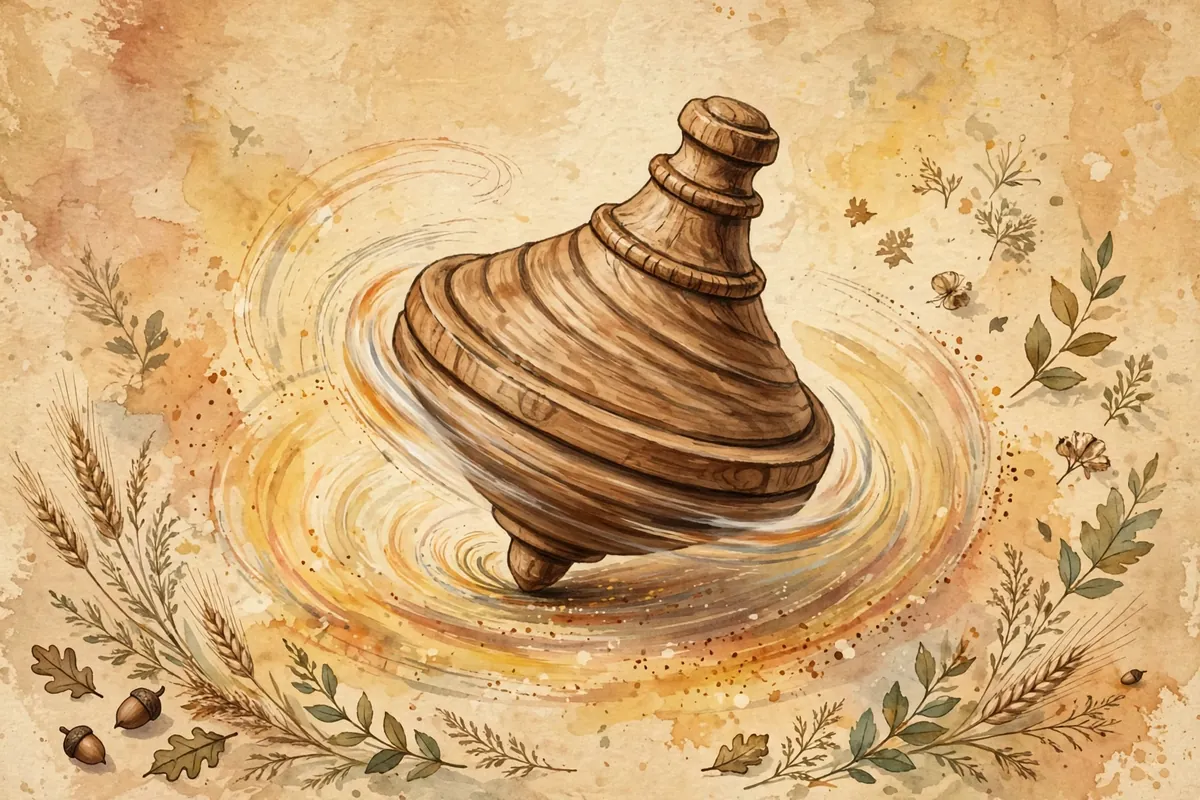
Try to stand a top on its point and it flops over instantly. But give it a quick twist or a yank of the string, and suddenly it balances on that same tiny tip, spinning smoothly as if gravity took a break. Then, slowly, it starts to wobble, circles wider and wider, and finally tumbles onto its side. What's going on?
The secret is spin. A spinning object has what physicists call angular momentum, and it tends to keep its axis pointing the same way. When gravity tries to tip the top over, the spin turns that push into a slow circling motion of the axis, called precession, instead of a fall. As friction gradually slows the spin, the wobble grows until the top can't hold itself up anymore.
Gravity Is Still Working
A spinning top doesn't cancel gravity. Its weight pulls down from its center, while the floor pushes up at the tip. Those two forces create a twisting force, or torque, that tries to tip it over.
In a top that isn't spinning, that torque simply knocks it down. But when the top is spinning fast, something counterintuitive happens. The axis moves sideways, at right angles to the direction you'd expect it to fall, tracing out a cone. That's precession, and it's why the top's handle seems to draw slow circles in the air.
Gyroscopes use the same principle. Thanks to the conservation of angular momentum, a spinning wheel's axis resists being tilted. That's why gyroscopes are used in navigation systems for spacecraft like the Hubble Space Telescope and to help stabilize ships.
The Life Story of a Spin
Watch a top closely and you'll see three stages. At first it usually wobbles for a few seconds. Then friction and torque at the tip push it to stand straight and steady. This calm, upright stage is called the sleep position, because the top looks almost motionless.
Here's a surprise that scientists have confirmed: less friction actually makes it take longer to reach that steady sleep. But once the top is sleeping, less friction helps it sleep longer. Eventually, though, friction drains its angular momentum. Precession grows, the wobble widens, and the top topples and rolls away.
One of the Oldest Toys on Earth
Tops are among the oldest toys archaeologists have found, and they've turned up on every continent except Antarctica. Tops from around 1250 BC have been found in China, and a carved wooden top was discovered in the tomb of the Egyptian king Tutankhamun. Children in ancient Rome played with them too.
Experts think the top was invented many times in many places, possibly inspired by things like spinning maple seeds or the potter's wheel. Some tops have flat sides marked with symbols and work like dice. The dreidel, spun during Hanukkah, is a famous example.
A Toy That Helped Science
Tops have even helped scientists. In the 1800s, James David Forbes and James Clerk Maxwell used spinning disks to study how colors mix. When colored sections spin fast, our eyes blend them into a single shade. Forbes found that blue and yellow spinning together don't make green, but a pinkish tint.
So the next time you spin a top for a grandchild, you're sharing a toy that's thousands of years old and a neat lesson in physics. Gravity never lets go. A fast enough spin just keeps it busy for a while.