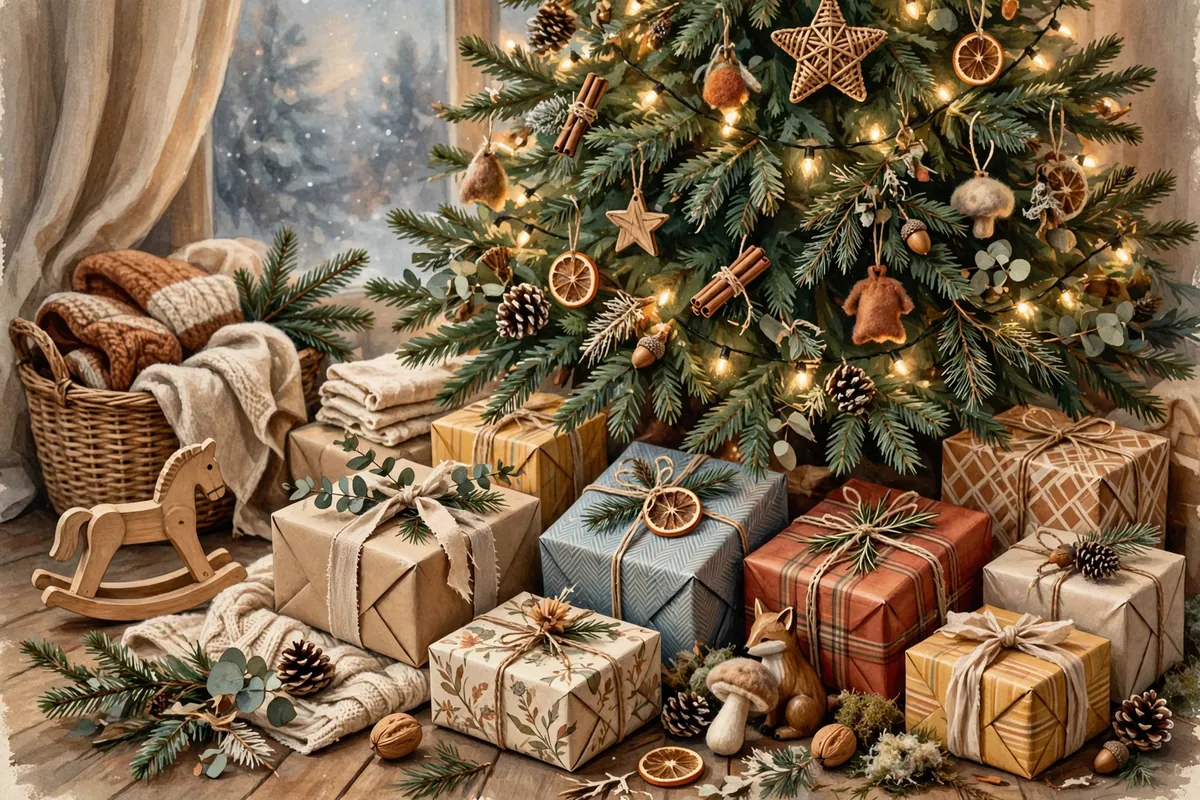
For many families, it's the picture of Christmas morning: a glowing tree in the corner and a pile of colorful packages tucked beneath it. Kids sneak peeks for weeks. But why do the presents go under the tree, of all places? Two old traditions, gift-giving and the Christmas tree, grew up separately before they met.
The short answer: decorated Christmas trees began in Germany and nearby lands, where they were hung with sweets and treats, often for children. As the custom spread in the 1800s, trees became closely tied to children and gift-giving, and presents were hung in the branches or placed around the tree. That's the tradition we still follow today.
Trees Covered in Treats
Modern Christmas trees started in Central Europe and the Baltic region, especially Germany and Livonia, now Estonia and Latvia, during the Renaissance. Some of the earliest evidence comes from guildhalls, where trees were decorated with sweets for apprentices and children to enjoy.
Early trees were decorated with paper roses, tinsel, apples, wafers, and confectionery. In other words, the tree itself was a kind of gift. A record from 1539 shows a Christmas tree placed in the Cathedral of Strasbourg, and the earliest firmly dated image of one, carved on a house in Alsace, dates to 1576.
Where Christmas Gifts Came From
Gift-giving has its own long history. Around the year 336, December 25 became established as the date of Jesus's birth, and giving gifts became tied to the story of the Magi bringing gifts to the baby Jesus. Another story, that of Saint Nicholas, a fourth-century bishop known as a gift-giver, also shaped the custom.
Around the time of the Protestant Reformation, giving gifts to children became increasingly widespread in Europe. The custom spread to the United States in the 19th century, at a time when some elites wanted to tame rowdy adult Christmas celebrations and many parents wanted to keep children safely at home.
A Princess's Christmas Eve
In Britain, a German-born queen named Charlotte introduced a Christmas tree at a children's party in 1800. The custom stayed mostly within the royal family at first. The future Queen Victoria grew up with a tree in her room every Christmas. On Christmas Eve 1832, the 13-year-old princess wrote in her journal about two trees "hung with lights and sugar ornaments," with "all the presents being placed round the trees."
After Victoria married her German cousin, Prince Albert, the custom spread quickly among middle-class families. By 1842, a newspaper ad for Christmas trees highlighted their German origins and their link to children and gift-giving.
Coming to America
German immigrants helped bring the Christmas tree to the United States, and several towns claim to have had the first one. An 1853 article about Christmas customs in Pennsylvania described a tree planted in a flower pot, with branches "covered with presents, chiefly of confectionary, for the younger members of the family."
Early trees were lit with candles, a practice started by Moravian Christians. Once homes had electricity, those candles were often replaced by electric lights. Today the tree is crowned with a star or angel, and the presents rest underneath.
So when you slide a wrapped box under the branches this year, you're carrying on a tradition that blends ancient gift-giving with an old German tree full of sweets. It's a little bit of history, wrapped up with a bow.