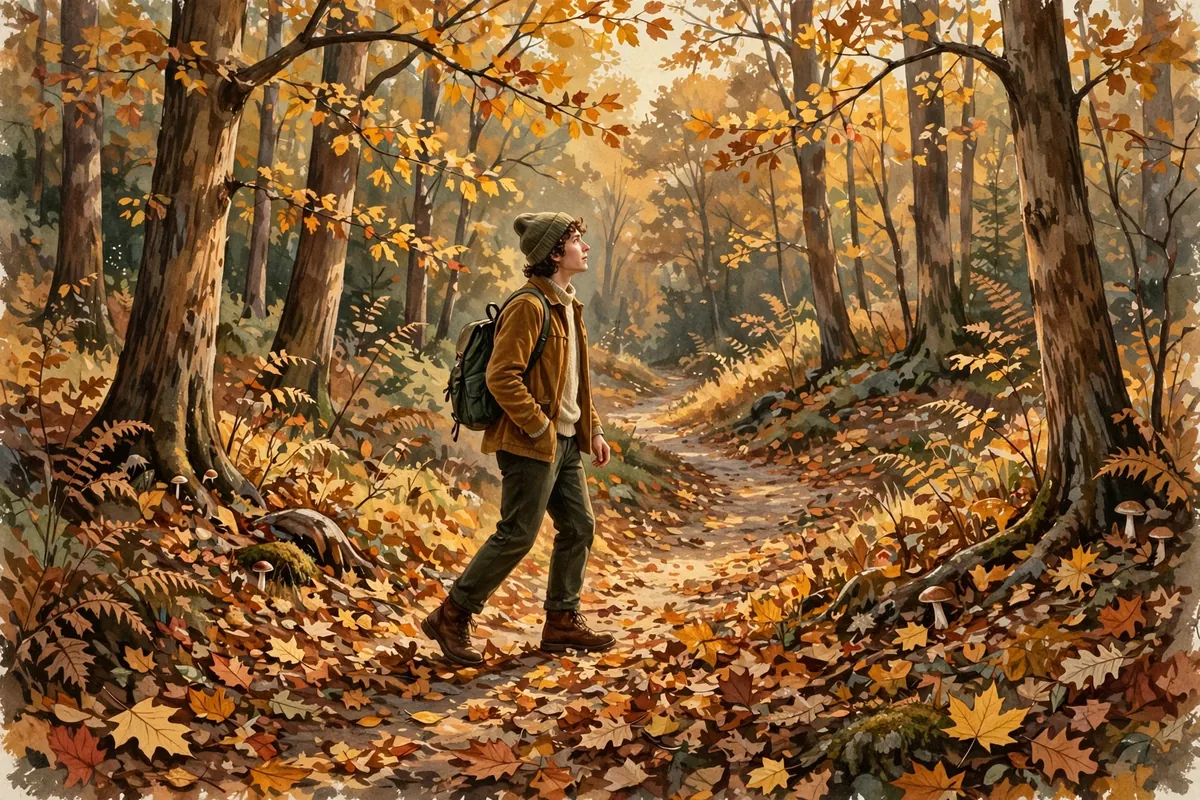
Few sounds say autumn quite like the crunch of leaves underfoot. Kids leap into leaf piles for it, and grown-ups go out of their way to step on the crispiest-looking ones. But a green leaf in July doesn't crunch at all. It just bends. So what changes?
Here's the short answer. A living leaf is full of water, which keeps its cells plump and flexible. In autumn, the tree seals off each leaf and stops sending it water. Once the leaf falls and dries out, what's left is a thin, stiff sheet of dry plant tissue. Stiff, dry things don't bend when you step on them. They snap and crack, and all those tiny breaks make the crunch.
The Tree Cuts Off the Water
As autumn arrives, many trees begin a process called abscission, which means dropping leaves. A layer of special cork cells forms at the base of each leaf stem. As that layer grows, the veins that carry water and minerals into the leaf are gradually closed off, slowly at first and then more quickly.
Eventually the leaf is cut off from the tree altogether and falls. From that moment, it has no way to get more water, and it begins to dry out. Different trees time this differently. Some keep their leaves making food right up until they're cut off, while others shut the leaf down completely before the cork layer is finished.
Why Water Makes Leaves Soft
Plant cells are surrounded by cell walls, which give them shape and strength. In most cells, these walls are flexible, so they bend instead of holding a fixed shape. Inside, water presses outward against the walls, a push scientists call turgor pressure.
When a plant loses water, that pressure drops. That's why a thirsty houseplant wilts and droops. A fallen leaf goes much further. As it dries completely, the soft, water-filled tissue is replaced by thin, dry walls that have lost their flexibility.
The Science of a Satisfying Crunch
Food scientists study a very similar effect. They describe crispiness as a hard material that makes a sound when it fractures, without bending first. Crisp sounds tend to be higher pitched, while crunchy sounds are lower.
A dry leaf works much like a potato chip. When your shoe presses down, the brittle tissue can't stretch, so it breaks in many places at once. Each tiny fracture makes a little crackle, and together they add up to that classic autumn crunch.
You can hear the difference after a rainy day. Damp leaves turn soft and limp again and make hardly any sound. It's the same reason a cracker left in a humid kitchen loses its snap.
Color Before Crunch
Before they crunch, leaves put on a show. Leaves are green because of chlorophyll. In fall, chlorophyll breaks down, revealing yellow and orange pigments called carotenoids that were hiding there all summer. Some trees also make red pigments called anthocyanins. Browns can come from chemical changes as the leaf's cells die.
Once on the ground, those leaves don't go to waste. Fallen leaves help keep soil moist, protect it from erosion, and give shelter to small creatures, before breaking down and returning nutrients to the soil. So go ahead and enjoy the crunch. It's the sound of a tree's yearly cycle coming full circle.