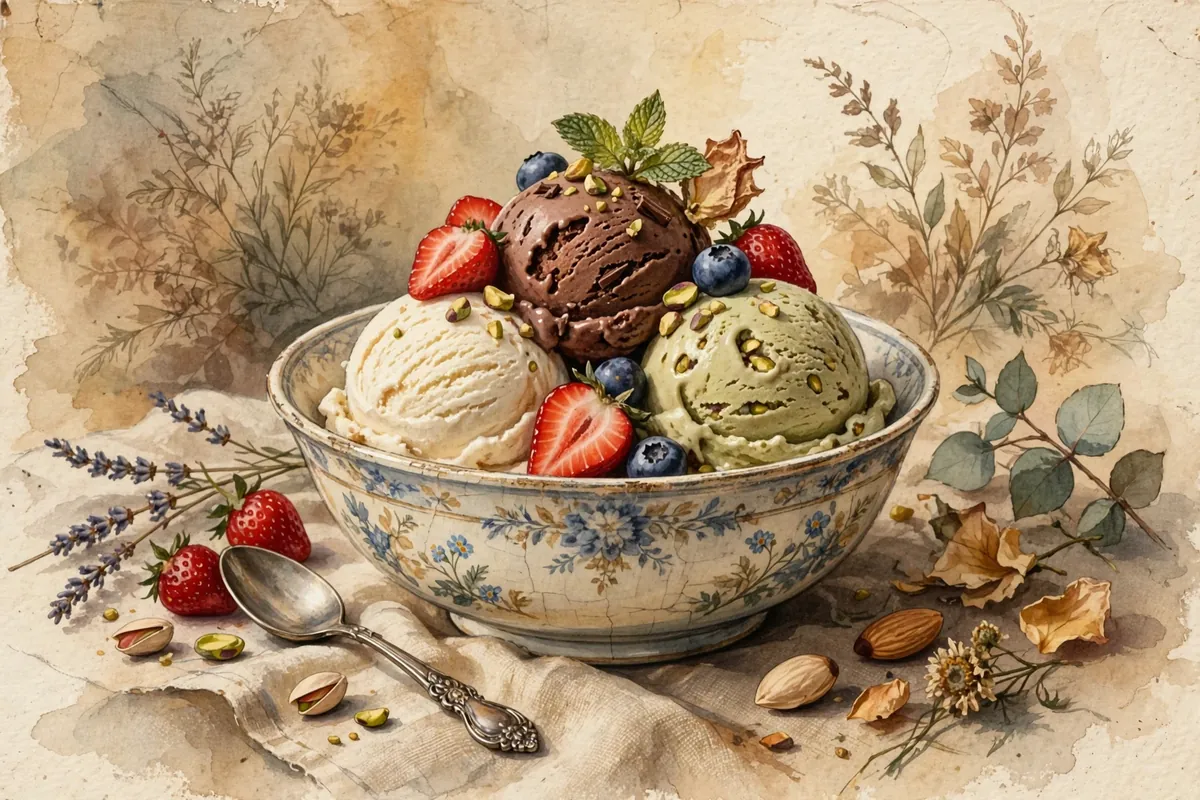
Today you can grab a pint of ice cream at any corner store for a few dollars. But in the early days of the United States, a bowl of the frozen stuff was a sign of wealth and status. America's first presidents loved it, and they paid handsomely for the privilege.
The reason is simple: ice cream was hard to make. Before refrigerators, you needed a big supply of ice, usually stored all year in an ice house, plus salt and a lot of hard work stirring the mixture. That made it an expensive luxury, enjoyed mostly by people wealthy enough to keep an ice house. Founders like George Washington and Thomas Jefferson regularly ate it and served it to guests.
Washington's Big Ice Cream Bill
Records kept by a merchant on Chatham Street in New York show George Washington spending roughly $200 on ice cream in the summer of 1790. At the time, New York was the nation's capital, and that sum was a small fortune spent on dessert.
Benjamin Franklin was a fan as well. And ice cream was already on sale in the colonies before independence, with confectioners offering it in their shops in New York and other cities.
Jefferson's 18-Step Recipe
Thomas Jefferson had his own ice cream recipe, and it ran to 18 steps. You'll sometimes hear that Jefferson introduced ice cream to America, but that's a myth. Nobody knows who brought it here first. What Jefferson did do was help introduce vanilla ice cream, a flavor that's still a classic today.
First Lady Dolley Madison also helped make ice cream fashionable. She served it at her husband James Madison's Inaugural Ball in 1813, putting the frozen treat right at the center of Washington society.
Why It Took So Much Work
For centuries, cream could be chilled but not truly frozen. The breakthrough was a bit of kitchen chemistry: adding salt to ice lowers its melting point, so the icy brine pulls heat out of the cream fast enough to freeze it. European writers described this trick in the 1500s, and by the late 1600s cooks were using it to make sorbets and ice creams.
Even then, you needed huge amounts of ice, plus someone to keep stirring the mixture so it came out light instead of rock hard. Ice was chipped from frozen lakes in winter, dragged by sled to an ice house, and stored to last into the warm months. Ordinary households simply didn't have that kind of setup.
How Ice Cream Went Mainstream
Things began to change thanks to the ice trade. In 1806, a Boston businessman named Frederic Tudor started shipping ice to the Caribbean, hoping to sell it as a luxury to the wealthy. Other merchants doubted him, but he became known as Boston's Ice King. By the 1820s and 1830s, ice was easier to get in East Coast cities, and ice cream grew more popular, though it was still a luxury.
The real game changer came in 1843, when an American named Nancy Johnson patented a hand-cranked ice cream maker that took far less time and effort. Combined with the growing supply of ice, it helped turn ice cream from a presidential indulgence into a treat for everyone.
So the next time you enjoy a scoop of vanilla on a summer afternoon, you're eating like a founding father, minus the $200 bill.