Drive through almost any American suburb on a Saturday morning and you'll hear it: the hum of mowers and the smell of fresh-cut grass. The neat front lawn feels like it has always been part of home. But for most of history, it was a luxury very few people could afford.
Here's the short answer: before the lawn mower, keeping grass short meant hours of cutting with scythes and shears, so tidy lawns belonged mostly to wealthy estates. In 1830, Englishman Edwin Beard Budding invented the mechanical lawn mower. As mowers got lighter and cheaper, middle-class families could have lawns too, and the green front yard became a signature feature of suburban life.
An Idea From a Cloth Mill
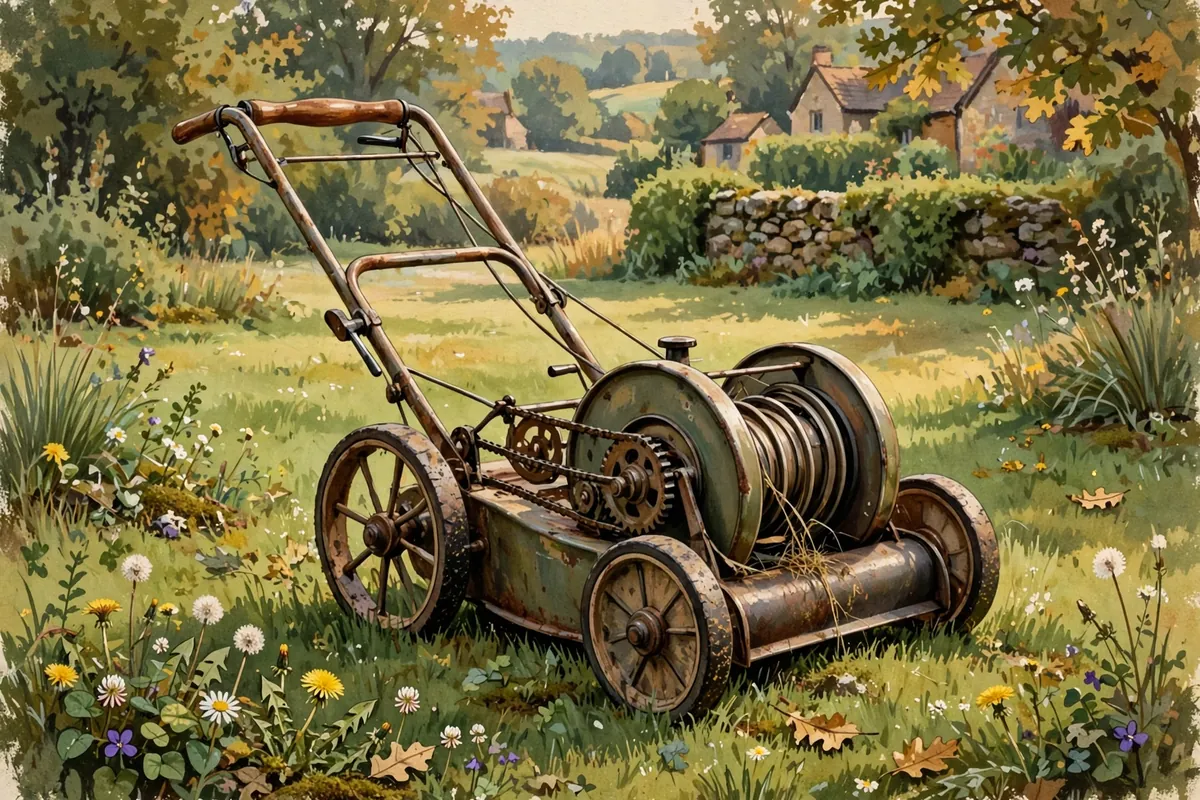
Budding, of Stroud in England, got his idea from a machine in a local cloth mill. It used a spinning bladed cylinder to trim the fuzzy surface of woolen cloth to a smooth finish. He realized the same idea could cut grass if the blades were mounted in a wheeled frame and spun close to the ground.
He received a British patent on August 31, 1830. His first machine was 19 inches wide, pushed from behind, and threw its clippings forward into a tray. It was meant for sports grounds and large gardens. Two of the earliest went to the London Zoo's gardens in Regent's Park and to the colleges of Oxford.
Lighter, Quieter, Cheaper
Early mowers had problems. They were made of heavy cast iron, hard to steer, and didn't always cut well. It took further improvements, including lighter steel and chain drives, to make them practical.
In the 1850s, a quieter chain-driven design called the Silens Messor, Latin for silent cutter, won first prize at the first lawn mower trial in London and helped kick off a boom in mower production in the 1860s. Middle-class families, imitating the landscaped grounds of the aristocracy, began growing finely trimmed lawns in their own backyards. The popularity of sports helped, too, as mowers created fields and courts for football, lawn bowls, and lawn tennis.
Lawns Come to America
Lawns began spreading across America from the 1870s onward. Amariah Hills received the first U.S. patent for a reel lawn mower in 1868, and in 1870 Elwood McGuire of Richmond, Indiana, designed a lightweight push mower that became a commercial success.
As wealthy families moved out to new suburban communities, the lawn moved with them. An 1856 architectural book about the new suburbs stressed the value of a grassy space where children could play.
Levittown and the Green Carpet
After World War II, the suburban lawn went mass-market. Between 1947 and 1951, Abraham Levitt and his sons built more than 17,000 homes in Levittown, New York, each with its own lawn. Levitt wrote that no single feature added as much charm and beauty to a home as a well-kept lawn. In Levittown's first spring, the company even fertilized and reseeded every lawn for free.
By the 1950s and 1960s, lawn-care advertising presented the yard as a husband's responsibility and a pleasant hobby for retirement. Today, some communities facing water shortages encourage alternatives to grass.
So the next time you push a mower across your yard, remember you're keeping up a tradition that once belonged only to the aristocracy. A clever idea borrowed from a cloth mill helped turn it into part of the American dream.